Dynamics of Earth's Changing Weather
Solar Radiation Dynamics
The Planet's Energy Budget
Think of Earth's climate as a massive, intricate bank account. The primary income is energy from the sun, arriving as solar radiation. The main expense is the heat Earth radiates back out into space. For the planet's temperature to remain relatively stable, the income and expenses must balance over time. This state is called radiative equilibrium().
When you look at the whole globe, this budget seems to work. But if you zoom in, you’ll find a huge regional imbalance. The tropics, lying flat under the sun, receive far more energy than they radiate away, creating a massive energy surplus. Conversely, the poles receive sunlight at a steep angle, causing them to lose more heat than they gain. This creates a persistent energy deficit.
This fundamental imbalance—a surplus at the equator and a deficit at the poles—is the primary engine driving our global climate. The Earth's systems are in a constant, churning effort to move heat from the tropics toward the poles to even things out.
This constant redistribution of heat is what creates weather, drives ocean currents, and defines climate zones. Without it, the tropics would be unimaginably hot, and the poles would be locked in an even deeper freeze.
The Ocean as a Solar Panel
So where does all that surplus tropical energy go? The vast majority of it, over 90%, is absorbed by the ocean. Water is incredibly effective at storing heat. It has a high (), meaning it takes a lot of energy to raise its temperature by even one degree.
Think about a sandy beach on a hot day. The sand gets scorching hot, quickly heating the air above it. But the ocean water stays cool and refreshing. The sand (and land in general) has a low specific heat capacity. It heats up fast and cools down fast. Water, on the other hand, acts like a giant thermal battery, absorbing huge amounts of solar energy during the day and releasing it slowly over night and through the seasons.
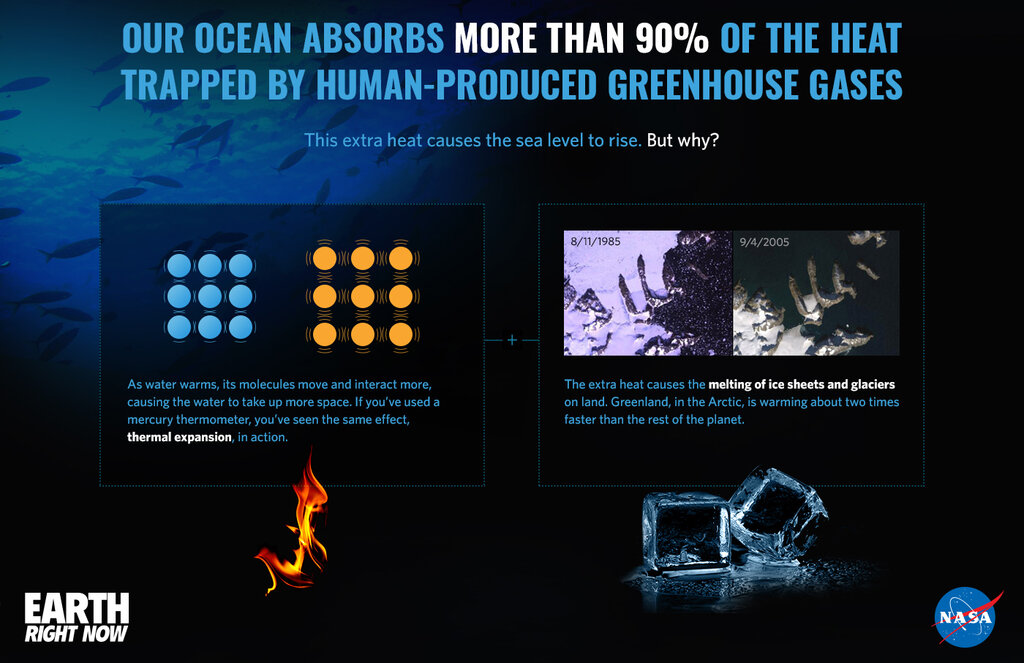
Because the ocean covers about 71% of the Earth's surface and absorbs sunlight so effectively, it functions as the planet's primary solar panel and its largest energy reservoir. This stored heat doesn't just sit there; it's the fuel that powers the entire atmospheric heat engine.
How Heat Moves
Energy moves between the sun, Earth, and space through radiation. But not all radiation is the same. Incoming energy from the sun is primarily ()—high-energy waves in the visible light, ultraviolet, and near-infrared parts of the spectrum. The atmosphere is mostly transparent to these waves, so they pass through and warm the Earth's surface.
The warmed Earth then radiates energy back out. But because the Earth is much cooler than the sun, it emits lower-energy (), which we feel as heat. Certain gases in the atmosphere absorb this outgoing longwave radiation, trapping heat and keeping the planet warm. This is the natural greenhouse effect. The balance between incoming shortwave and outgoing longwave radiation determines the planet's temperature.
Once the ocean absorbs that solar energy, it has to transfer it to the atmosphere to be moved around. This happens primarily through two processes at the air-sea interface.
| Heat Transfer Type | Mechanism | Analogy |
|---|---|---|
| Sensible Heat Flux | Direct transfer of heat from the warmer ocean to the cooler air via conduction and convection. | Like the heat you feel rising from hot asphalt. You can sense the temperature change directly. |
| Latent Heat Flux | Transfer of energy that occurs when water evaporates from the ocean surface. The energy is 'hidden' in the water vapor. | Like the cooling effect of sweat evaporating from your skin. Energy is used to change the state of water, not its temperature. |
Sensible heat is straightforward—it's the direct warming of the air by the sea surface. But latent heat is the real powerhouse. When water evaporates, it takes a tremendous amount of energy with it, without changing the water's temperature. This energy, called latent heat of vaporization, is stored in the water vapor molecules.
When that moist air rises and cools, the water vapor condenses back into liquid water to form clouds. As it condenses, it releases all that stored latent heat back into the atmosphere. This release of heat is a major driver of atmospheric circulation, powering everything from gentle sea breezes to massive hurricanes.
The atmosphere is effectively a heat engine fueled by the ocean's stored solar energy, and latent heat is its primary fuel.
Let's check your understanding of these core concepts.
What is meant by Earth's "radiative equilibrium"?
The fundamental driver of Earth's atmospheric and oceanic circulation is an energy ______ at the equator and an energy ______ at the poles.
Understanding how the sun's energy is absorbed, stored, and moved is the key to understanding the entire climate system. The uneven heating of the globe and the unique properties of water are what set everything else in motion.