Dynamics and the Nature of Force
Vector Representation
Breaking Forces Down
Forces have both magnitude and direction. This makes them vector quantities. Simply adding up the magnitudes of forces isn't enough when they pull in different directions. To analyse systems with multiple forces, we need to break each force down into components that act along a standard set of axes, usually the horizontal (x) and vertical (y) axes.
This process, called vector decomposition or resolution, turns a single diagonal force into two perpendicular forces that are easier to work with mathematically.
Using basic trigonometry, we can find the magnitudes of these components. If the magnitude of the original force is and it makes an angle with the horizontal axis:
This works because the vector and its components form a right-angled triangle. The original force vector is the hypotenuse, and the components are the adjacent and opposite sides relative to the angle .
Unit Vector Notation
To represent vectors more formally, especially in three dimensions, we use unit vectorss. These are vectors with a magnitude of exactly one, pointing along the primary axes. They are typically denoted as , , and for the x, y, and z axes, respectively.
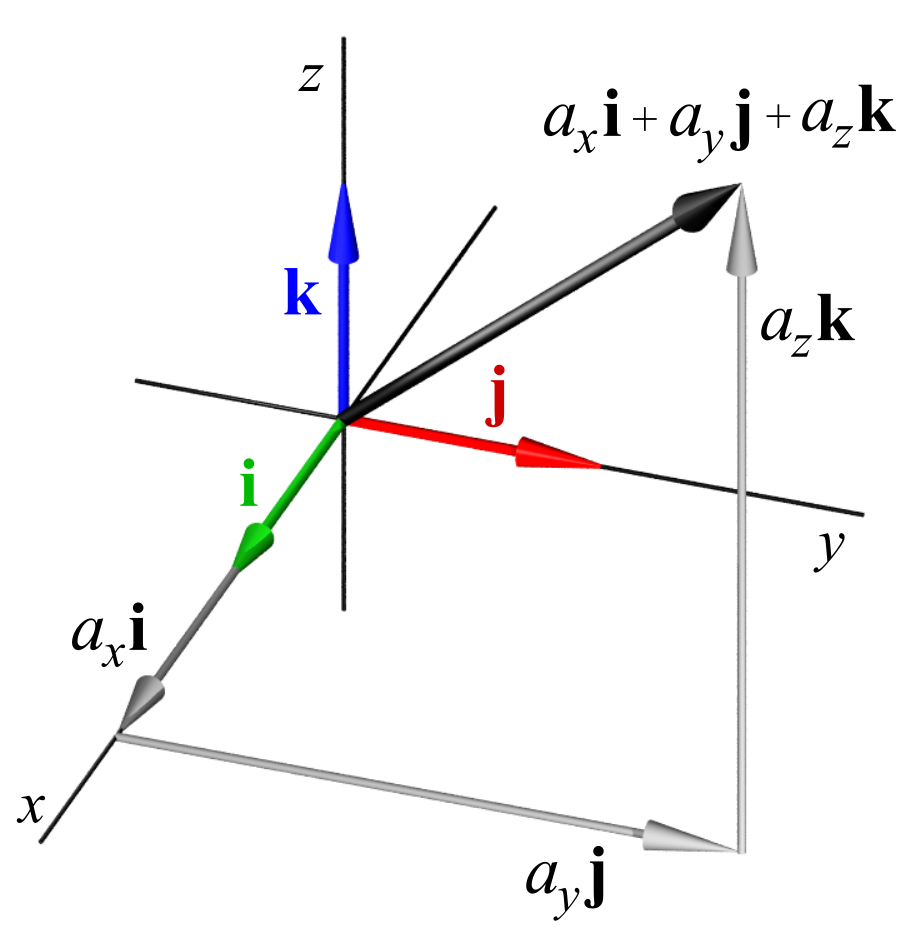
Using this notation, we can write any force vector as the sum of its components multiplied by their corresponding unit vectors.
For example, a force written as N means it has a component of 10 Newtons in the positive x-direction and 5 Newtons in the negative y-direction.
Finding the Resultant Force
The real power of vector components becomes clear when you need to add multiple forces together. The total force acting on an object, known as the , is the vector sum of all individual forces. Adding vectors graphically can be cumbersome, but adding them by components is straightforward arithmetic.
To find the resultant force, , of several forces (), you simply add their corresponding components:
- Resolve each force vector into its x, y, (and z) components.
- Sum all the x-components to get the total x-component, .
- Sum all the y-components to get the total y-component, .
- The resultant vector is then .
Once you have the components of the resultant force, you can find its overall magnitude and direction. The magnitude is found using the Pythagorean theorem, and the direction (angle) is found using the inverse tangent function.
Now, let's test your understanding of these concepts.
Why is force considered a vector quantity?
A force with a magnitude of 50 N makes an angle of 60° with the positive x-axis. What are the magnitudes of its horizontal (x) and vertical (y) components? Use the approximations and .
This mathematical framework for handling forces is fundamental to all areas of mechanics, from analysing the stresses on a bridge to calculating the trajectory of a spacecraft.