Dynamic Triggering of Earthquakes
Wave Propagation Physics
How Stress Travels
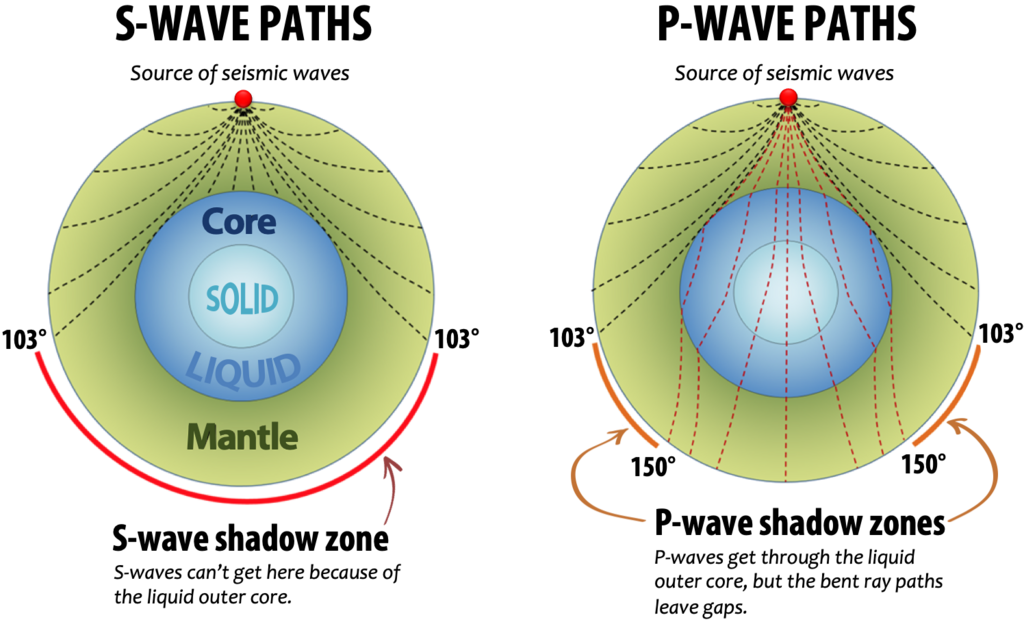
When an earthquake occurs, it releases energy that radiates outward as seismic waves. You're familiar with P-waves and S-waves, the body waves that travel through the Earth's interior. But for remote triggering, the story is more about the temporary stress these waves create as they pass through the crust. This is called dynamic stress. It’s a transient visitor; the rock is squeezed, sheared, and stretched, but only for the few seconds or minutes the wave is passing. Once the wave is gone, the static stress field returns to its previous state, but the brief disturbance can be enough to push a distant, critically stressed fault over the edge.
The energy radiates outward from the fault in all directions in the form of seismic waves like ripples on a pond.
The key to understanding this process is quantifying the dynamic stress. The magnitude of the stress change () is directly related to the ground's motion. Specifically, it's a function of the material properties of the rock, the speed of the wave, and the speed of the ground particles themselves. This relationship forms the physical basis for how a tremor in Japan could potentially influence a fault in California.
Calculating Dynamic Stress
To calculate the dynamic stress, seismologists use a straightforward approximation. The stress is the product of the rock's shear modulus () or density (), the wave's phase velocity (), and the ground's particle velocity (). For shear stress from an S-wave, the formula looks like this:
The particle velocity () is how fast the ground itself is moving up-and-down or back-and-forth. The maximum value recorded during a seismic event is called the Peak Ground Velocity (PGV), and it's a crucial metric for assessing potential triggering. A higher PGV means a greater jolt of dynamic stress. However, the energy of a wave doesn't stay constant as it travels. It diminishes with distance through two main processes: geometrical spreading and attenuation.
Geometrical spreading is simple geometry: as a wave expands from its source, its energy is distributed over a larger area. For body waves, which travel in three dimensions, the energy spreads out over the surface of an expanding sphere. For surface waves, which are trapped near the Earth's surface, the energy only spreads out over an expanding circle. This means body waves lose energy much faster with distance () than surface waves do (). Attenuation is the energy lost to heat as the wave deforms the rock it passes through. Together, these effects determine how much punch a wave still has when it arrives at a distant location.
The Main Triggering Agents
While body waves carry immense energy, they are less effective at remote triggering than surface waves. This is because body waves dive deep into the mantle, where much of their energy is lost or reflected. Surface waves, by contrast, are confined to the crust.
The two main types are Love waves (which have a side-to-side shearing motion) and Rayleigh waves (which have a rolling, elliptical motion). Because their energy attenuates more slowly and they often have longer durations and larger amplitudes at great distances, surface waves are the primary cause of dynamic stress changes far from an epicenter. Their lower frequencies and long wavelengths allow them to interact with and 'resonate' large-scale geological features, including major fault zones ready to slip.
Think of it this way: a body wave is like a bullet, delivering a sharp, quick impact. A surface wave is more like a long, slow push from a powerful ocean swell. For a fault that is already stressed to its limit, that slow, sustained push is often exactly what's needed to overcome the static friction holding it in place.
What is the primary mechanism by which a large earthquake can trigger another earthquake at a great distance?
According to the principles of dynamic stress, an increase in which of the following metrics would lead to a greater stress change on a distant fault?
Understanding how these waves propagate and transfer stress is the foundation for explaining remote triggering. By measuring the ground motion, we can calculate the transient stress and assess whether it was sufficient to activate a distant fault.