Dynamic Earthquake Triggering Mechanisms
Stress Transfer Fundamentals
How Earthquakes Talk to Each Other
An earthquake doesn't happen in a vacuum. When a fault ruptures, it's like a heavy book sliding off a shelf; everything around it shifts. The rupture instantly redistributes stress throughout the surrounding crust, changing the forces on nearby faults. This can either push a neighboring fault closer to its breaking point or, occasionally, pull it back from the brink.
This intricate conversation between faults happens in two main ways: through permanent, localized changes and through temporary, far-reaching vibrations.
Static Change vs. Dynamic Triggering
The most direct impact of an earthquake is static stress transfer. After a fault slips, the ground around it is permanently deformed. This deformation alters the stress field in the nearby crust. Think of it as permanently shifting the weight on a complex system of levers. These changes are greatest near the rupture and fade quickly with distance, typically following a relationship, where is the distance from the fault. A fault just a few kilometers away might feel a significant push, while one 50 kilometers away will feel almost nothing from this static change.
Then there's dynamic triggering. This is a more fleeting but widespread effect. As radiate from an earthquake, they travel through the crust like ripples in a pond. As these waves pass, they temporarily jiggle and squeeze the rock, causing transient spikes in stress. While P-waves and S-waves contribute, the slow-moving, high-amplitude surface waves are the primary agents of long-distance triggering. Their energy decays much more slowly with distance (often between $1/r$ and $1/r^2$), allowing them to carry enough punch to affect faults hundreds or even thousands of kilometers away.
Pushing a Fault to Failure
Most large faults are not sitting peacefully. Tectonic forces constantly load them with stress over centuries, pushing them ever closer to their breaking point. They often exist in a critically stressed state, like a block on a ramp tilted just to the angle of slipping. It doesn't take a huge shove to set it in motion; a tiny, well-directed nudge can be enough. Dynamic triggering often provides this final nudge, with stress perturbations sometimes as small as 1-5 kilopascals—less than the pressure change you feel over a few feet of elevation.
To predict whether a fault will slip, geophysicists use the This principle provides the mechanical rulebook for fault rupture. In essence, a fault fails when the shear stress pushing it to slide overcomes the combination of its inherent frictional strength and the normal stress clamping it shut.
When a seismic wave passes, it introduces transient changes to both shear stress and normal stress. If the wave temporarily reduces the clamping force (unclamps the fault) while increasing the shear stress, it can create a positive ΔCFS and trigger a slip. The specific orientation of the passing wave relative to the fault plane determines whether it pushes the fault toward failure or pulls it toward stability.
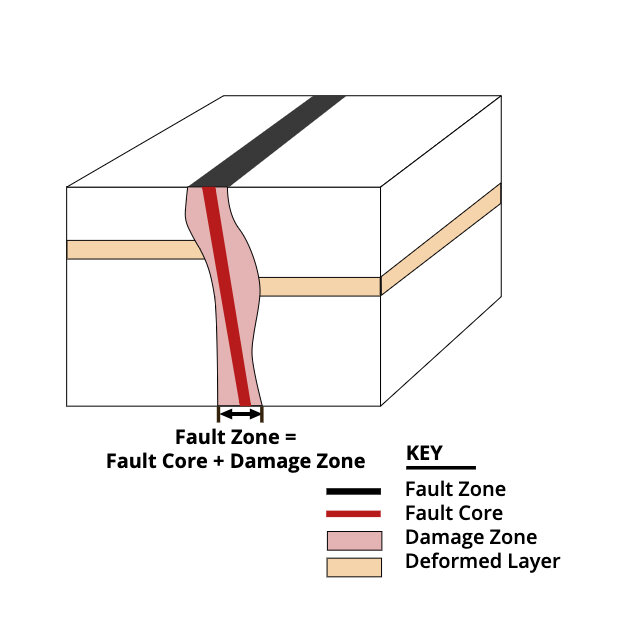
Understanding these stress interactions is crucial for seismic hazard assessment. After a major earthquake, scientists can rapidly calculate the static stress changes on all known faults in the region. This helps them identify which faults have been loaded with additional stress and may pose an increased, short-term risk, allowing them to provide more targeted warnings.
What is the primary difference between static stress transfer and dynamic triggering following an earthquake?
Which type of stress change from an earthquake decays most slowly with distance, allowing it to trigger other earthquakes hundreds of kilometers away?