DSP Processors in Voice Communication
Introduction to Digital Signal Processing
What Is Digital Signal Processing?
Most signals in the real world are analog. Think of the sound of your voice, the light hitting your eyes, or the temperature of a room. These signals are continuous waves of information. Computers, however, don't understand continuous waves. They speak the language of numbers—discrete, specific values. Digital Signal Processing, or DSP, is the technique of taking real-world analog signals, turning them into numbers, and then using a specialized processor to analyze or modify them.
In short, DSP translates the rich, messy analog world into the clean, precise digital language that computers can work with.
Why bother with this translation? Because once a signal is digital, you can do amazing things with it. You can clean up a noisy audio recording, sharpen a blurry photo, or compress a massive video file so it can be streamed over the internet. DSP is the magic behind clear cell phone calls, high-fidelity music streaming, and medical imaging like MRIs.
From Analog Wave to Digital Numbers
The journey from an analog signal to a digital one is handled by a device called an Analog-to-Digital Converter (ADC). This process involves two key steps: sampling and quantization.
Sampling
noun
The process of measuring the amplitude (or strength) of an analog signal at regular time intervals.
Imagine you're watching a spinning wheel. If you take a series of snapshots of the wheel, you can piece them together to understand its motion. Sampling does the same thing for a signal wave. It takes thousands or millions of snapshots per second. The rate at which these snapshots are taken is called the sampling rate. A higher sampling rate captures more detail, just as more frames per second create smoother video.
After sampling, each of those snapshots needs to be assigned a numeric value. This is called quantization.
Think of it like measuring your height. You might be exactly 5 feet 9.347 inches tall, but a standard tape measure would force you to round to the nearest fraction, like 5' 9 and 3/8". Quantization does the same thing, rounding the value of each sample to the nearest number in a predefined set of levels. The number of available levels is determined by the bit depth. More bits mean more levels, which results in a more accurate digital representation of the original signal.
The DSP System
A complete DSP system is essentially a data processing pipeline. It takes in a signal, processes it, and sends it back out. This pipeline is crucial for countless technologies we use every day.
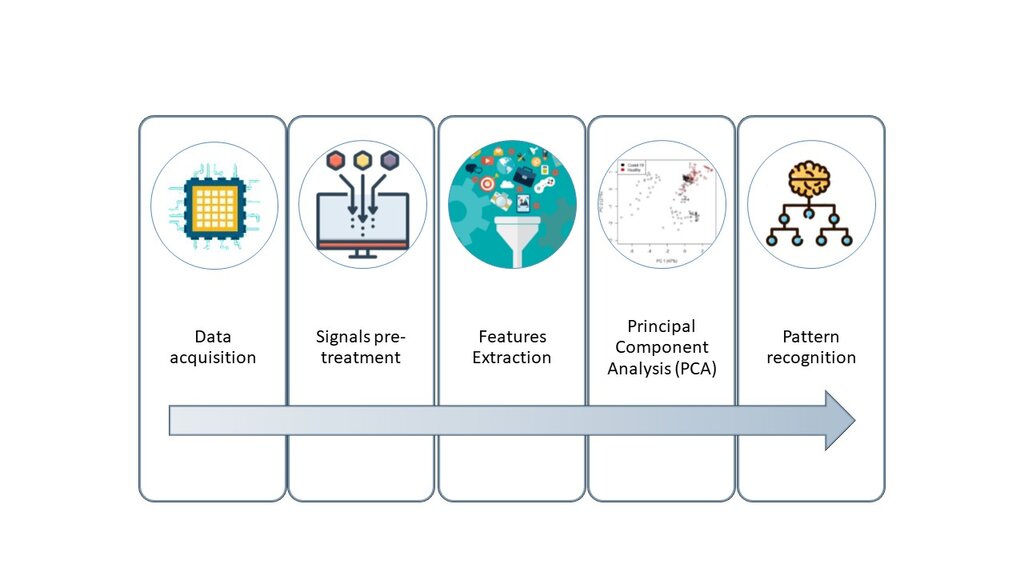
The basic components are:
-
Analog-to-Digital Converter (ADC): This is the input. It performs the sampling and quantization we just discussed, converting the analog signal into a stream of digital data.
-
DSP Processor: This is the brain of the operation. It's a specialized microprocessor designed to perform mathematical operations (like addition and multiplication) extremely quickly. It takes the digital data from the ADC and executes programmed instructions to filter, compress, or otherwise modify the signal.
-
Digital-to-Analog Converter (DAC): This is the output. After the DSP processor has finished its work, the DAC translates the processed digital data back into an analog signal. This lets you hear the cleaned-up audio through a speaker or see the enhanced image on a screen.
The DSP processor is what makes real-time applications possible. It can perform billions of calculations per second to ensure there's no noticeable delay in your phone call or video stream.
DSP in Communication
In communication systems, DSP is indispensable. It's the silent workhorse that ensures signals get from point A to point B clearly and efficiently.
For example, when you speak into your phone, your voice is converted into a digital signal. A DSP processor then compresses this signal to use less bandwidth, making it easier to transmit wirelessly. It also performs echo cancellation, removing the annoying effect of hearing your own voice a moment after you speak. On the receiving end, another DSP processor decompresses the signal and filters out background noise before the DAC converts it back into sound for the listener to hear.
This same process of filtering, compressing, and correcting errors is fundamental to Wi-Fi, 4G/5G mobile networks, satellite communications, and digital radio. Without DSP, our modern, connected world would be a lot slower and noisier.
Now, let's test your understanding of these core concepts.