Drawing Realistic Faces
Basic Facial Proportions
Start with a Solid Foundation
Drawing a realistic face isn't about magic; it's about structure. While every person looks unique, most human faces follow a surprisingly consistent set of proportions. Learning these guidelines gives you a reliable starting point for any portrait.
Think of it like building a house. You need to frame the walls and place the windows before you can start decorating. These proportions are the frame for your drawing.
The vertical and horizontal lines in the center of the face will be important marks to know where to place the eyes, nose and ears, for example, and will offer a more harmonious result.
The Basic Proportions
Let's start with a simple oval shape for the head. The first and most important step is to find the center. A vertical line divides the face into two roughly symmetrical halves, left and right. A horizontal line, cutting across the exact middle of the oval, is where the eyes will go. Many beginners draw the eyes too high, but they actually sit at the halfway point of the entire head.
Next, we'll divide the face into three equal sections. These horizontal guidelines are key to placing the rest of the features.
- Top Section: From the hairline to the eyebrows.
- Middle Section: From the eyebrows to the bottom of the nose.
- Bottom Section: From the bottom of the nose to the bottom of the chin.
This is often called the "rule of thirds" for faces.
Placing the Features
With these guidelines in place, fitting the rest of the features becomes much simpler.
-
Nose: The bottom of the nose rests on that second horizontal line, marking the end of the middle third.
-
Mouth: The line where the lips meet is about one-third of the way down into the bottom section (between the nose and chin).
-
Ears: The ears are a great way to check your proportions. They typically fit within the middle third of the face, with the tops aligning with the eyebrows and the bottoms aligning with the base of the nose.
The distance between the two eyes is equal to the width of a single eye. This spacing is a crucial detail for achieving a natural look.
The width of the nose is generally about the same as the space between the eyes. To place the mouth, you can draw vertical lines down from the center of each eye. The corners of the mouth will usually end at these lines when the face is in a neutral expression.
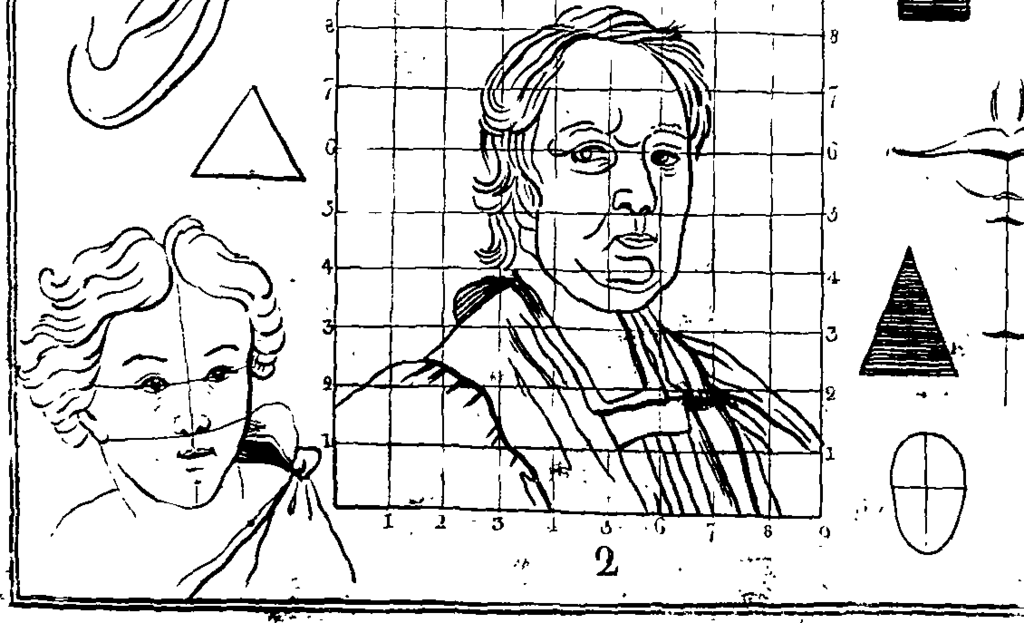
Remember, these are guidelines, not rigid rules. Every face is different, and these variations are what make people recognizable. Start with this basic structure, and as you observe real faces, you'll learn how to adjust the proportions to capture a specific person's likeness.
When drawing a face from a direct, front-on view, where should the horizontal guideline for the eyes be placed?
The 'rule of thirds' is a key guideline for placing facial features. This rule divides the face into three equal horizontal sections. The middle section spans from the eyebrows to the _______.