Drawing Fundamentals
Drawing Fundamentals
Handling Your Tools
The first step in drawing is learning how to hold your pencil. It might sound simple, but it’s different from how you hold a pencil to write. For writing, you need precise control for small letters. For drawing, you need a range of motions, from tiny details to broad, sweeping strokes.
Think of it like this: a writer's grip uses the fingers, while an artist's grip often uses the whole arm.
There are two basic grips you should know. The Tripod Grip is likely familiar to you. It's the same one you use for writing. You hold the pencil between your thumb, index, and middle fingers. This grip gives you excellent control for fine lines and details.
The Overhand Grip is different. You hold the pencil so it rests under your palm, held in place by your thumb and fingers. This grip allows for looser, more expressive strokes and is great for sketching and covering large areas. You draw using your shoulder and elbow, not just your wrist.
Try both grips. Get a piece of paper and just make marks. See how different they feel. Control comes with practice.
The Power of a Line
Every drawing starts with a line. Lines define edges, create texture, and suggest movement. The quality of your lines can make a drawing feel static or dynamic, delicate or bold.
Line quality comes from two things: pressure and speed. Pressing harder creates a dark, thick line. A lighter touch creates a faint, thin line. A quick, confident stroke looks very different from a slow, hesitant one. Experiment with varying your pressure and speed to see the huge range of marks you can make with a single pencil.
Practice drawing different kinds of lines. Fill a page with them. Don't try to draw any specific thing yet. Just focus on the act of making a mark.
- Straight lines
- Curved lines
- Wavy lines
- Zigzag lines
Try making them thick, thin, dark, and light. The goal is to build control and confidence in your hand.
Seeing in Shapes
Here’s a secret that will change how you draw: every complex object is just a collection of simple shapes.
Your coffee mug? It’s a cylinder with a curved handle. A house? It's a rectangle with a triangle on top. Learning to see the world this way is one of the most important skills an artist can develop. It simplifies complicated subjects and gives you a clear starting point.
When it comes to starting to sketch, draw out basic shapes first and start with loose lines that you can refine later.
Before you try to draw the details of an apple, just draw a circle. Before you capture the likeness of a person, start with an oval for the head and a rectangle for the torso. This process is called construction. You build your drawing from a foundation of simple geometric forms like circles, squares, rectangles, triangles, and cylinders.
Drawing What You See
The final piece of the puzzle is learning to connect your eyes to your hand. This is called observational drawing, and it's about translating the three-dimensional world onto your two-dimensional paper. The key is to draw what you actually see, not what you think you see.
Observational drawing is a fundamental practice that bridges the gap between the real world and your creative expression.
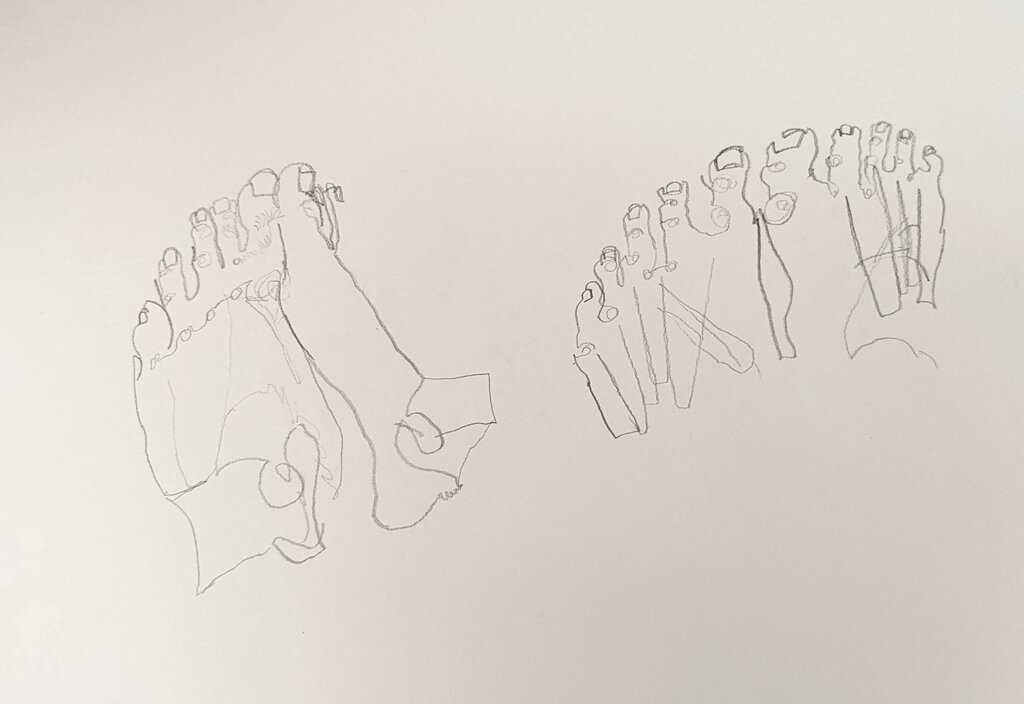
A great first exercise is called blind contour drawing. Place an object in front of you—your own hand is a perfect subject. Now, put your pencil on your paper and look only at your hand. Do not look at the paper. Trace the edges and wrinkles of your hand with your eyes, and let your pencil follow that same path on the paper. The result will look strange and distorted, and that's the point. The goal isn't a realistic drawing; it's to build a stronger connection between what your eye sees and what your hand does.
Now, let’s try a simple observational drawing. Pick an easy object, like a piece of fruit or a mug.
- Look for basic shapes. Is your apple a slightly squished circle? Is your banana a long, curved rectangle?
- Lightly sketch these shapes. Use your overhand grip to keep the lines loose.
- Refine the outlines. Now switch to a tripod grip and look closely at the object's edges, or contours. Adjust your initial shapes to match what you see.
- Don't worry about details. For now, just focus on capturing the main shape and proportions accurately. This is the foundation everything else is built on.
Which pencil grip, where the pencil rests under the palm, is best suited for making loose, expressive strokes and sketching large areas?
According to the text, what are the two main factors you can vary to change a line's quality, such as its thickness and darkness?
These are the building blocks of drawing. Mastering how to hold your pencil, control your lines, see in shapes, and observe the world around you will give you the foundation you need for everything that comes next.