Dopamine Unveiled The Brains Reward Chemical
Neurotransmitters
The Brain's Messengers
Your brain is a bustling network of billions of cells called neurons. They're constantly talking to each other, forming the basis of every thought, feeling, and action. But neurons don't physically touch. There's a tiny gap between them called a synapse.
So how does a signal jump from one neuron to the next? It uses chemical messengers. These messengers are the lifeblood of your nervous system.
Neurotransmitter
noun
A chemical substance that is released at the end of a nerve fiber by the arrival of a nerve impulse and, by diffusing across the synapse, causes the transfer of the impulse to another nerve fiber, a muscle fiber, or some other structure.
Think of it like a relay race. One runner (the electrical signal) sprints down the track (the first neuron) and has to pass the baton (the neurotransmitter) to the next runner (the next neuron) to continue the race. This handoff happens in the synapse.
How They Work
The process of sending a message is elegant and incredibly fast. It happens in a few key steps.
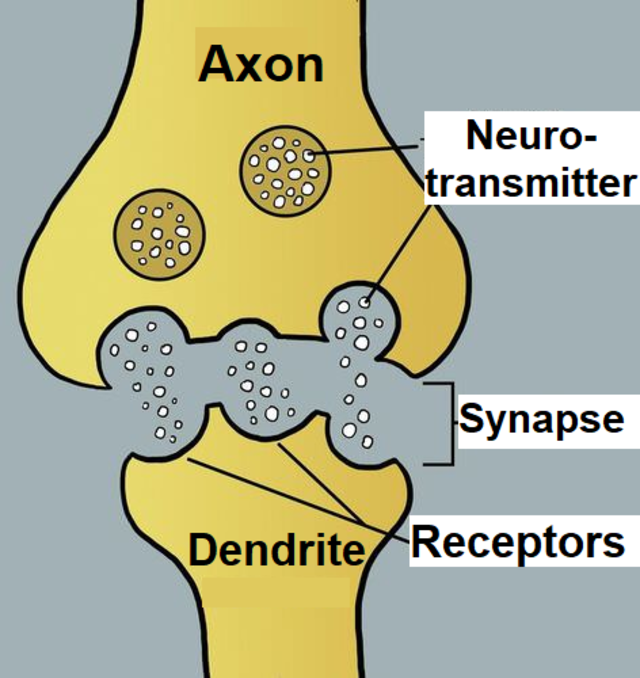
First, neurotransmitters are created and stored inside tiny sacs called vesicles at the end of the neuron sending the signal. When an electrical impulse arrives, it causes these vesicles to merge with the neuron's membrane and release their contents into the synaptic gap.
These chemical messengers then float across the tiny space. On the other side, the receiving neuron is covered with specialized proteins called receptors. Each neurotransmitter has a specific shape that fits perfectly into its corresponding receptor, like a key into a lock. When a neurotransmitter binds to its receptor, it opens a channel, allowing charged particles to flow into the receiving neuron. This influx changes the electrical state of the cell, either exciting it or calming it down, and thus passes the message along.
Once the message is delivered, the neurotransmitter is cleared from the synapse to make way for the next signal. This can happen in a few ways: it might be broken down by enzymes, drift away, or be reabsorbed by the original neuron in a process called reuptake.
Different Kinds of Messages
Not all neurotransmitters deliver the same instructions. They generally fall into one of two categories based on their effect on the receiving neuron: excitatory or inhibitory.
-
Excitatory neurotransmitters act like a gas pedal. They increase the likelihood that the receiving neuron will fire its own electrical signal. They get the system going. Glutamate is the most common excitatory neurotransmitter in the brain.
-
Inhibitory neurotransmitters are the brakes. They decrease the likelihood that the receiving neuron will fire. They help calm the brain and provide control. The main inhibitory neurotransmitter is GABA (gamma-aminobutyric acid).
Some neurotransmitters can be both excitatory and inhibitory, depending on the type of receptor they connect with. This adds another layer of complexity to the brain's communication system.
| Type | Effect on Receiving Neuron |
|---|---|
| Excitatory | More likely to fire an impulse |
| Inhibitory | Less likely to fire an impulse |
The brain's function relies on a delicate balance between these go signals and stop signals. This constant push and pull allows for precise control over everything from muscle movements to complex thought processes. An imbalance can lead to a wide range of neurological and psychological conditions.
Understanding these chemical messengers is fundamental to understanding how the brain works. They are the molecules that shape our perceptions, drive our behaviors, and form our memories. By studying them, we gain insight into the very essence of who we are.
What is the name for the tiny gap between two neurons where chemical signals are passed?
In the process of neuronal communication, what is the direct trigger that causes vesicles to release their neurotransmitters into the synapse?