Dolphin Fundamentals
Dolphin Anatomy
Built for Speed
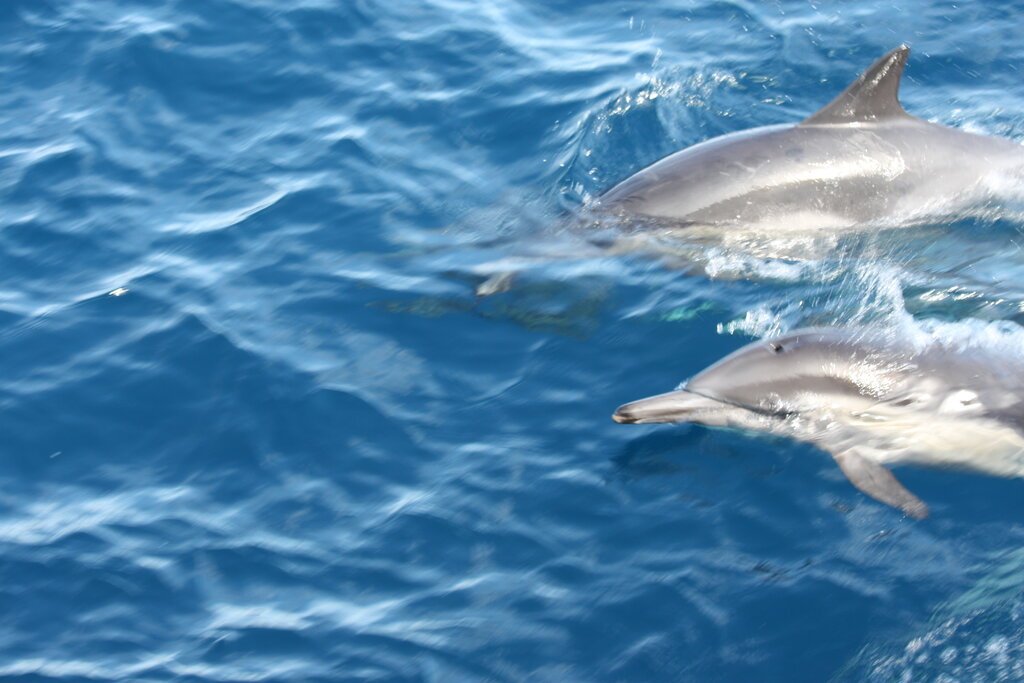
Dolphins are masters of movement in the water, and their body is a testament to millions of years of evolution. Their shape is fusiform, which is a fancy way of saying it’s torpedo-shaped. This design is incredibly streamlined, allowing them to cut through the water with minimal resistance. Think of it like an airplane's wing, but for an entire body.
Their skin is smooth and rubbery, which also helps reduce drag. Unlike fish, which typically propel themselves by swishing their tails side-to-side, dolphins generate powerful thrust by moving their tails up and down. This is possible because they are mammals, and their spine bends vertically, just like a running cheetah's.

The tail itself is made of two lobes called flukes. The flukes are composed of dense connective tissue, not bone. Steering is handled by the pectoral flippers, which are located on their sides. These flippers are homologous to human arms, meaning they share a common evolutionary origin, and contain a similar bone structure. The dorsal fin on their back acts like a keel on a boat, providing stability and preventing them from rolling over at high speeds.
fluke
noun
One of the two lobes of a dolphin's tail, used for propulsion.
A Breath of Air
Despite living in the ocean, dolphins are mammals and need to breathe air. They can't breathe underwater. Instead, they have a blowhole on the top of their head, which is essentially a modified nostril that moved its position over evolutionary time. This placement allows them to surface for air without lifting their entire head out of the water, making breathing a quick and efficient process.
A powerful muscle seals the blowhole shut when the dolphin is submerged, preventing water from entering their lungs. When they surface, they contract muscles to open it, forcefully exhaling old air and then quickly inhaling a fresh breath. This exchange is incredibly rapid, taking only a fraction of a second. Dolphins can exchange up to 90% of the air in their lungs with each breath, compared to about 15% for humans.
Interestingly, breathing is a conscious act for dolphins. Unlike humans, who breathe automatically, a dolphin must decide to take every breath. This is why they can't fully sleep; instead, they rest one half of their brain at a time.
Seeing with Sound
Dolphins have good eyesight, both in and out of the water. But in the dark or murky depths of the ocean, sight is not always reliable. To navigate and hunt in these conditions, they use an extraordinary biological sonar called echolocation.
A dolphin produces a series of high-frequency clicks using structures in its nasal passages. These clicks are then focused into a beam by a fatty organ in their forehead called the melon. The sound waves travel through the water, bounce off objects, and return as echoes.
The returning echoes are not picked up by the external ears, which are small and mostly unused for hearing. Instead, the sound waves are channeled through the dolphin's lower jawbone to the inner ear. The brain processes these echoes to create a detailed 'sound picture' of the environment. Echolocation is so precise that a dolphin can determine an object’s size, shape, distance, speed, and even its texture.
echolocation
noun
The use of sound waves and echoes to determine the location of objects.
Now let's review the key anatomical terms we've discussed.
Ready to test your knowledge on dolphin anatomy? Let's see what you've learned.
What is the primary advantage of a dolphin's torpedo-like (fusiform) body shape?
How does a dolphin's tail movement for propulsion differ from that of most fish?
These remarkable adaptations—from their torpedo-like bodies to their ability to see with sound—make dolphins perfectly suited for life in the aquatic world.