Docker Fundamentals Explained
Introduction to Docker
What is Docker?
Imagine you're shipping cargo across the ocean. In the old days, you'd have barrels of wine, crates of fruit, and stacks of lumber all loaded onto a ship individually. It was chaotic, and things often got damaged or lost. Then, the standardized shipping container was invented. Suddenly, everything could be packed into identical steel boxes, which could be easily stacked, moved, and transported by ship, train, or truck. The container didn't care what was inside; it just moved the cargo safely.
Docker does for software what the shipping container did for cargo. It’s a platform that lets you package an application and all its dependencies—like libraries, system tools, and code—into a single, standardized unit called a container. This container can then run consistently on any computer that has Docker installed, regardless of the underlying operating system.
This solves the classic developer problem: "It works on my machine!" By packaging everything together, Docker ensures that if an application works in development, it will work the same way in testing and in production.
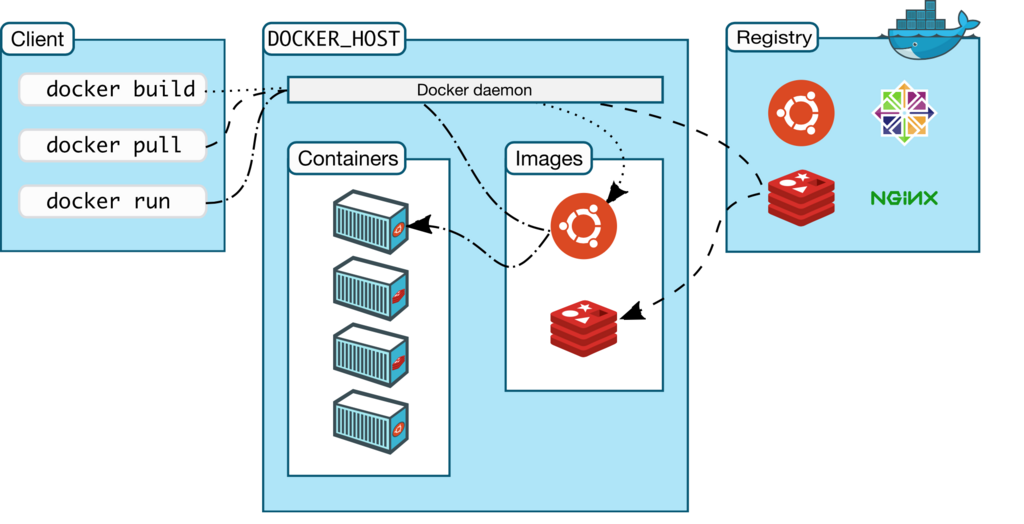
From Servers to Virtual Machines
Before Docker, deploying applications was often a headache. Developers would write code on their local machines, and system administrators would try to recreate the same environment on a production server. Mismatched library versions or different operating system configurations could cause the application to fail. It was fragile and error-prone.
The first major solution to this was virtualization. Using software like VirtualBox or VMware, you could create a virtual machine (VM). A VM is essentially a complete computer emulated in software. It has its own guest operating system, virtual hard drive, and virtual network card, all running on top of a physical host machine.
VMs were a huge step forward. They isolated applications from one another and from the host system. You could package an application inside a VM and ship the whole thing. But this came at a cost. Each VM needs a full copy of an operating system, which consumes gigabytes of storage and significant memory and CPU power. They are slow to start and resource-intensive.
Containers vs. Virtual Machines
Docker, which emerged in 2013, offered a more lightweight approach through containers. The key difference is how they use the host machine's resources.
A virtual machine virtualizes the hardware to run multiple operating systems. A container virtualizes the operating system to run multiple applications.
Instead of bundling a full guest OS, a container shares the kernel of the host machine's operating system. The kernel is the core part of the OS that manages the system's resources. All the container needs is its own application code and dependencies. This makes containers incredibly efficient.
This architectural difference leads to some clear benefits.
| Feature | Virtual Machines | Docker Containers |
|---|---|---|
| Startup Time | Minutes | Seconds |
| Size | Gigabytes | Megabytes |
| Resource Usage | High (Full OS) | Low (Shared Kernel) |
| Isolation | Full hardware isolation | Process-level isolation |
The Benefits of Docker
The impact of this technology on software development is significant. Here are the main advantages:
Portability: Docker containers run on any machine that runs Docker, from a developer's laptop to cloud servers. This
build once, run anywhere
philosophy streamlines the development and deployment process.
Consistency: Containers package the application with its specific dependencies. This eliminates inconsistencies between development, testing, and production environments, leading to fewer bugs and faster releases.
Efficiency and Speed: Because they don't need a guest OS, containers are lightweight. They start almost instantly and use fewer resources, which means you can run many more containers on a single server than you could virtual machines. This saves on hardware costs.
Isolation: While not as isolated as VMs, containers provide strong process isolation. This means applications and their dependencies are kept separate, preventing conflicts and improving security.
With these advantages, Docker has become a fundamental tool for modern software development, DevOps, and cloud computing. It simplifies the process of building, shipping, and running applications, allowing teams to focus more on writing code and less on managing infrastructure.
Let's check your understanding of these core concepts.
What real-world invention is commonly used as an analogy for Docker's role in software development?
What is the main architectural difference between a Docker container and a virtual machine (VM)?