Docker Fundamentals Explained
Introduction to Docker
What Is Docker?
Think about modern shipping. Goods are packed into standard-sized steel containers, which can then be loaded onto ships, trains, or trucks. It doesn't matter what's inside the container—electronics, bananas, or books—the shipping process is the same. Docker does something similar, but for software.
Docker is a platform that packages an application and all its dependencies into a standardized unit called a container. This makes it incredibly easy to create, deploy, and run applications anywhere, solving the classic problem of "it works on my machine, but not on yours."
Docker is a software development platform and virtualization technology that uses containers to make it simple to design, deploy, and test the application.
The Magic of Containers
The core concept behind Docker is containerization. A container bundles up everything an application needs to run: the code, runtime environment, system tools, and libraries. It's a lightweight, isolated, and executable package.
Imagine you're sharing a recipe. Instead of just giving someone a list of instructions, you give them a complete meal kit. It has the recipe, all the pre-measured ingredients, and even the specific pots and pans required. With this kit, anyone can produce the exact same dish, every single time. A Docker container is that meal kit for your software.
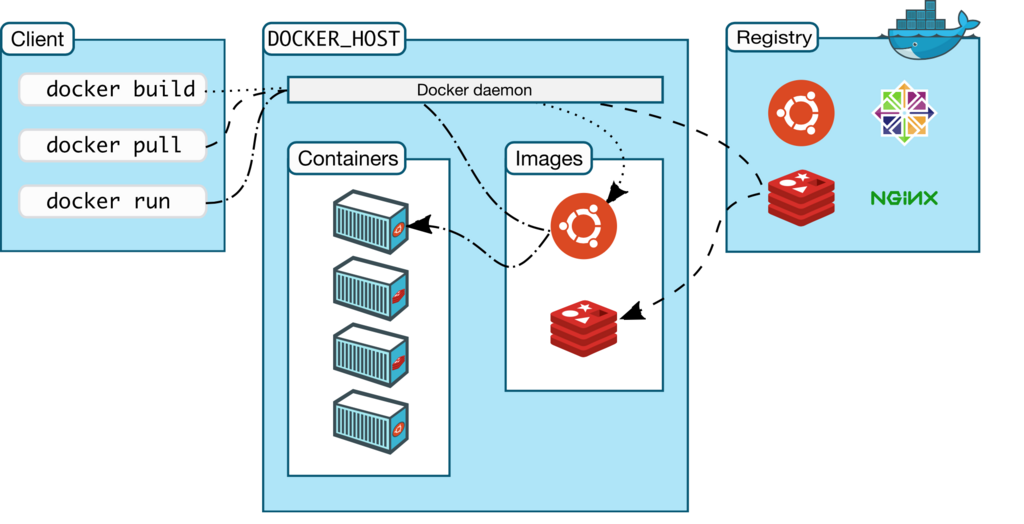
This self-contained nature ensures that the application behaves predictably, whether it's running on a developer's laptop, a testing server, or in the cloud.
Container
noun
A lightweight, standalone, executable package of software that includes everything needed to run it: code, runtime, system tools, system libraries, and settings.
Containers vs. Virtual Machines
You might be thinking this sounds a lot like a virtual machine (VM). Both provide isolated environments for running applications, but they do it in very different ways.
A VM emulates an entire computer, including a full guest operating system (like Windows or Linux) on top of the host system's hardware. This makes VMs heavy and slow to start up because you're running multiple complete operating systems.
Containers, on the other hand, share the host system's operating system kernel. They only virtualize the application layer, not the entire hardware stack. This makes them incredibly lightweight, fast, and efficient.
Because they don't need to boot a whole operating system, containers can start up in seconds. You can run many more containers on a single server than you could virtual machines, which makes better use of computing resources.
| Feature | Virtual Machine (VM) | Container |
|---|---|---|
| Isolation | Full OS and hardware | Process and application level |
| Size | Gigabytes | Megabytes |
| Start-up Time | Minutes | Seconds |
| Resource Usage | High (full OS) | Low (shared OS kernel) |
| Portability | Limited | High |
This efficiency and portability are why Docker has become a cornerstone of modern software development, especially for building complex applications and managing them at scale.
What is the primary problem Docker is designed to solve?
The analogy of a 'complete meal kit' is used to describe a Docker container. What does this analogy highlight?
Docker simplifies how we build, ship, and run software. By packaging applications into lightweight containers, it ensures they perform consistently across any environment, a huge leap forward from older, heavier virtualization methods.