Docker Fundamentals
Introduction to Docker
The “Works on My Machine” Problem
Every developer knows the feeling. You spend weeks building an application. It runs perfectly on your laptop. You hand it off to a teammate or deploy it to a server, and suddenly, it crashes. Nothing works.
This classic headache is often called the “works on my machine” problem. It happens because your computer isn't identical to the server. They might have different operating systems, different versions of programming languages, or conflicting software libraries. A tiny difference in the environment can cause a perfectly good application to fail.
Traditionally, getting software to run reliably in different places has been a major challenge in software development.
A Standard Box for Software
This is where Docker comes in. Think about global shipping. Before the 1950s, loading a ship was a chaotic, slow process. Goods were packed in odd-sized barrels, crates, and sacks. Then, the standardized shipping container was invented. Suddenly, goods could be packed into identical boxes that fit perfectly on any ship, train, or truck in the world. It revolutionized trade.
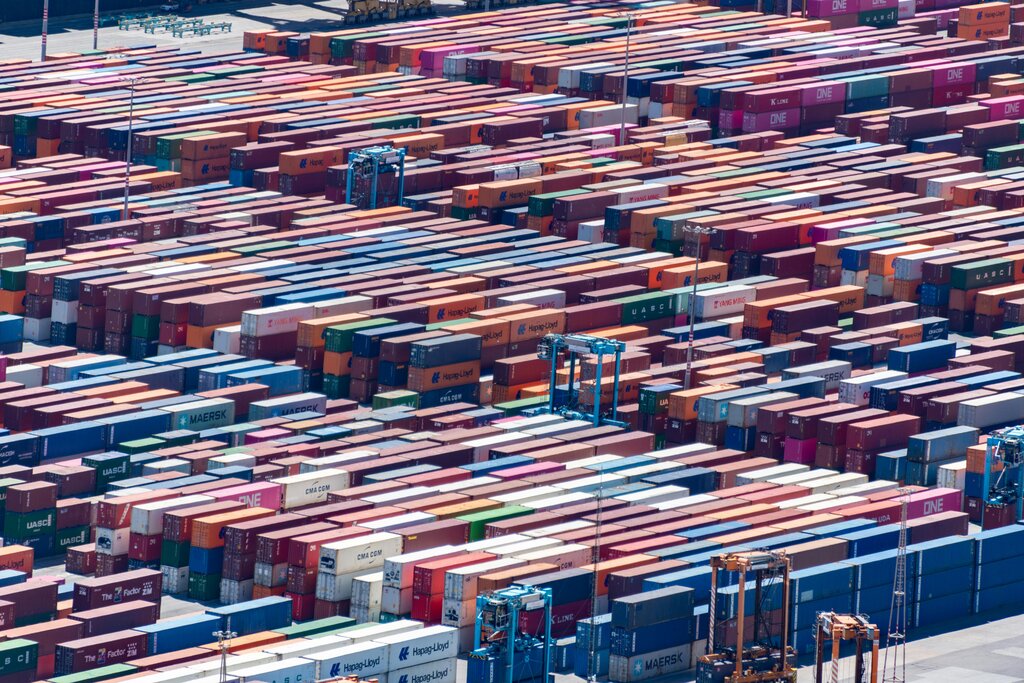
Docker does the same thing for software. It puts your application and everything it needs to run into a standard, lightweight box called a container.
Docker is an open-source platform designed to simplify application development and deployment.
A container bundles the application's code with all the files, libraries, and tools it depends on. This package is self-contained and portable. You can run that container on your laptop, a coworker’s computer, or a cloud server, and it will behave exactly the same way every time.
Containerization
noun
The process of packaging software code and all its dependencies so that it is isolated from other processes and can run uniformly in any IT environment.
Old Way vs. New Way
Before containers, developers often used virtual machines (VMs) to isolate applications. A VM is an entire computer system emulated in software, with its own guest operating system. While they provide isolation, VMs are large and slow to start because they duplicate a whole OS.
Containers are much more lightweight. Instead of bundling a full operating system, they share the host computer's OS kernel. This makes them smaller, faster, and more efficient. You can run many more containers on a server than you could virtual machines.
This efficiency is a key benefit. It also leads to faster startup times—containers can launch in seconds, while VMs can take minutes. For developers, this means a faster cycle of coding, testing, and deploying.
Docker in Modern Development
Docker has become essential in modern software development, especially in practices like DevOps, which aims to shorten the development lifecycle.
Because containers create a consistent and predictable environment, they bridge the gap between development (Dev) and operations (Ops) teams. Developers can build and test inside a container, and then hand that exact same container to the operations team to deploy. There are no surprises.
This consistency, combined with speed and efficiency, makes it easier to build, ship, and scale applications reliably. From small startups to large enterprises, teams use Docker to streamline their workflows and deliver software faster.
Docker helps teams build complex applications out of smaller, manageable pieces that all work together seamlessly.
Time to check what you've learned about Docker's role and benefits.
What is the primary cause of the “works on my machine” problem in software development?
The text compares Docker to standardized shipping containers. What key benefit does this analogy illustrate?
Docker provides a powerful way to package and run applications. By understanding the problem it solves, you can see why containerization has become a fundamental skill for modern developers.