DIY Speaker Building Basics
Introduction to Sound and Acoustics
What Is Sound?
Sound begins with a vibration. When an object vibrates, like a guitar string being plucked or your vocal cords moving, it pushes and pulls on the air molecules around it. This creates a chain reaction, a wave of pressure that travels outwards from the source.
Think of it like dropping a pebble into a still pond. Ripples spread out from where the pebble hit the water. A sound wave is similar, but instead of water, it's a disturbance traveling through a medium like air. These pressure waves are what our ears detect and our brains interpret as sound.
These waves aren't all the same. They have distinct properties that determine what we hear. The two most fundamental properties are frequency and amplitude.
Frequency and Amplitude
Frequency refers to how quickly the sound wave vibrates. We measure it in Hertz (Hz), which stands for cycles per second. A wave that completes 100 cycles in one second has a frequency of 100 Hz.
In musical terms, frequency is pitch. A low-frequency vibration produces a low-pitched sound, like a deep bass drum. A high-frequency vibration creates a high-pitched sound, like a piccolo.
Frequency
noun
The rate at which a vibration occurs, constituting a wave, measured in Hertz (Hz).
Amplitude, on the other hand, is the intensity or power of the wave. Think of it as the size of the vibration. A larger vibration pushes air molecules with more force, creating a more intense pressure wave.
We perceive amplitude as loudness. A low-amplitude wave is a quiet sound, like a whisper. A high-amplitude wave is a loud sound, like a jet engine. Loudness is often measured in decibels (dB).
Amplitude
noun
The maximum extent of a vibration or oscillation, measured from the position of equilibrium.
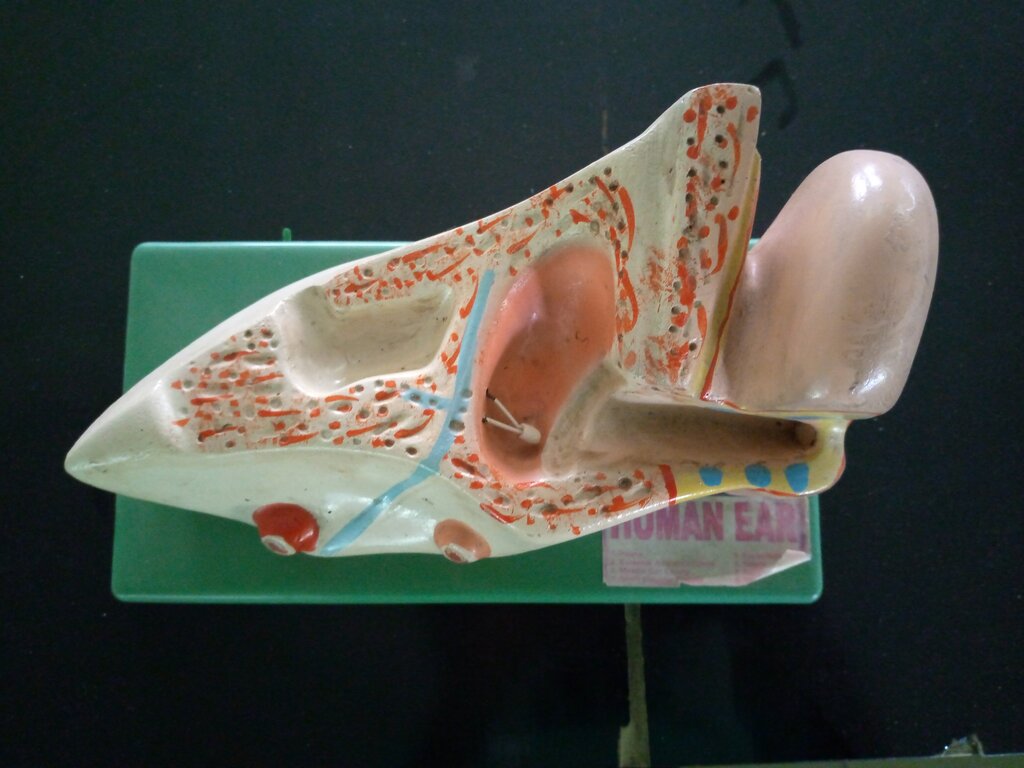
Every sound you hear has both frequency and amplitude, defining its pitch and loudness. The range of human hearing is typically from about 20 Hz to 20,000 Hz (or 20 kHz). As we age, our ability to hear higher frequencies tends to decrease.
How Sound Travels
Sound waves need something to travel through. This substance is called a medium. Air is the most common medium we experience, but sound can also travel through liquids, like water, and solids, like a wall or a wooden door.
In a vacuum, where there are no molecules to vibrate, sound cannot travel at all. That’s why in space, there is silence. The speed of sound changes depending on the medium. It travels faster through denser materials because the molecules are closer together and can pass the vibration along more efficiently.
| Medium | Speed of Sound (approx.) |
|---|---|
| Air (at 20°C) | 343 m/s |
| Water (fresh) | 1,480 m/s |
| Steel | 5,960 m/s |
But sound doesn't just travel in a straight line forever. When a sound wave encounters an object or a surface, several things can happen. This is the realm of acoustics, the science of how sound behaves in a space.
Sound in an Environment
When a sound wave hits a surface, it can be reflected, absorbed, or transmitted.
Reflection is when a wave bounces off a surface, like a ball bouncing off a wall. Hard, smooth surfaces like concrete, glass, or tile reflect sound very well. This is what causes echoes in a large, empty hall.
Absorption occurs when a material soaks up the sound energy, converting it into a tiny amount of heat. Soft, porous materials like carpets, curtains, and acoustic foam are excellent sound absorbers. This is why recording studios are lined with soft panels—to prevent unwanted reflections.
Transmission is when sound passes through a surface. If you hear someone talking in the next room, the sound is transmitting through the wall.
The way sound reflects and is absorbed in a room defines its acoustic character. Understanding these principles is the first step in controlling sound, whether you're designing a concert hall, a recording studio, or a high-fidelity speaker system.
What is the fundamental origin of any sound?
If a musical note has a very high pitch, what can you conclude about its sound wave?