Distillation Columns Explained
Introduction to Distillation
Separating Liquids by Boiling
Distillation is a powerful technique for separating mixtures of liquids. The core idea is simple: different liquids boil at different temperatures. By carefully heating a mixture, we can boil one liquid off, capture its vapor, and cool it back down into a purified liquid, leaving the other behind.
Think of boiling salt water. The water turns to steam, leaving the salt behind. If you were to collect that steam and cool it, you would have pure, fresh water. Distillation applies this same principle to separate mixtures of different liquids.
This process is fundamental in many industries, from refining crude oil into gasoline and other fuels to producing alcoholic spirits and purifying chemicals in a lab. It all hinges on a property called volatility.
Volatility is Key
Volatility describes how easily a substance evaporates. A liquid with a low boiling point is more volatile than one with a high boiling point. For example, rubbing alcohol evaporates from your skin much faster than water because it is more volatile.
volatility
noun
The tendency of a substance to vaporize.
When you heat a liquid mixture, the more volatile component will vaporize more readily. This means the vapor that forms above the liquid will have a higher concentration of the more volatile substance compared to the original liquid mixture. This crucial difference is what makes distillation possible. It's a state known as vapor-liquid equilibrium.
How a Distillation Column Works
To perform distillation on a large scale, engineers use equipment called a distillation column. While they look complex, the operation is straightforward and relies on the principles we've just discussed.
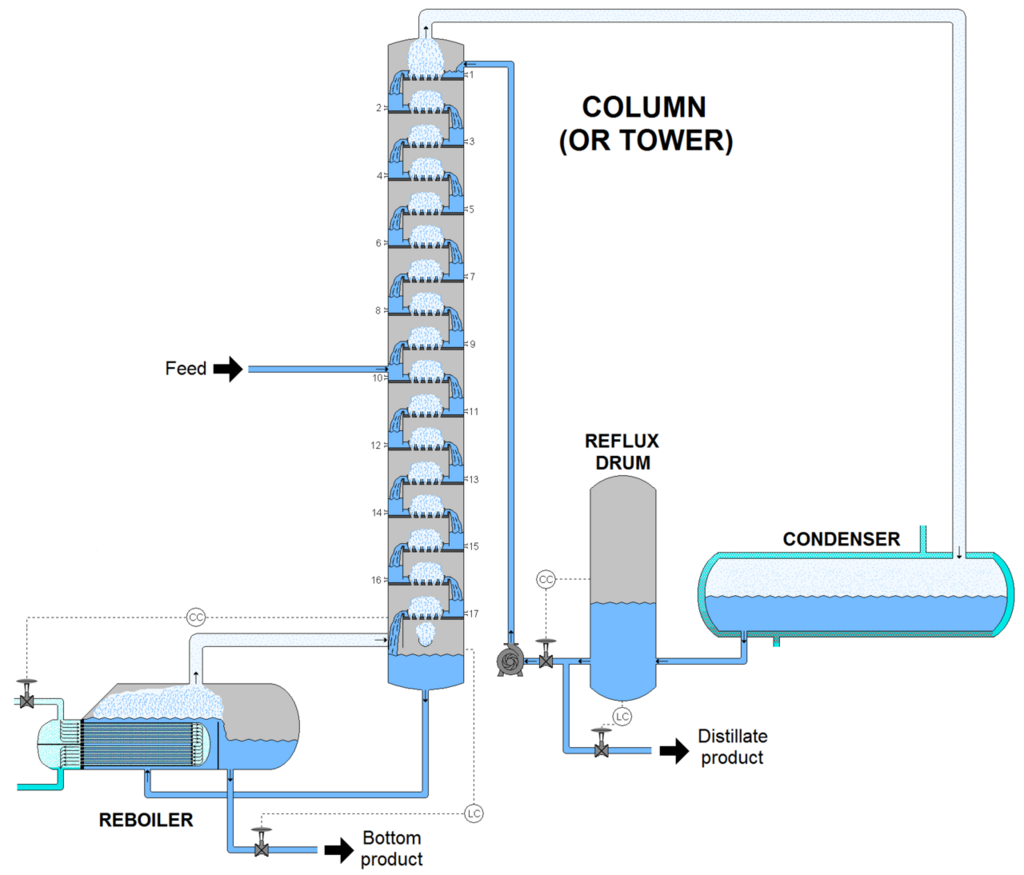
Here’s a basic rundown of the process:
-
Heating: The liquid mixture (called the feed) is pumped into the column and heated at the bottom by a reboiler. This creates vapor.
-
Rising and Falling: The hot vapor, rich in the more volatile component, rises up the column. As it rises, it cools. Inside the column are trays or packing material that allow the vapor to interact with condensed liquid moving downwards.
-
Repeated Cycles: At each tray, some of the rising vapor condenses, and some of the falling liquid re-boils. Each time this happens, the vapor becomes more and more enriched with the volatile component, while the liquid becomes more enriched with the less volatile one. This is like performing many simple distillations, one after another, all within a single tower.
-
Collection: By the time the vapor reaches the top, it is almost pure. It is then drawn off and cooled in a condenser, turning it back into a purified liquid called the distillate. The less volatile liquid, meanwhile, works its way to the bottom of the column, where it is collected as the bottoms product.
By controlling the temperature at different points in the column, engineers can precisely separate complex mixtures into their individual components.
What is the fundamental property of liquids that allows them to be separated by distillation?
A liquid that evaporates very easily can be described as having...
This process of using temperature to separate substances based on their boiling points is a cornerstone of chemical engineering and countless industrial processes.