Discovering Higher Mathematics
Introduction to Mathematical Thinking
Beyond Calculation
If you think mathematics is just about adding numbers or solving for , you've only seen the tip of the iceberg. Those are useful tools, like a hammer and nails. But mathematical thinking is about being the architect. It's a way of looking at the world, finding hidden connections, and building arguments so solid they're unshakable.
This kind of thinking isn't about memorizing formulas. It’s about understanding why those formulas work. It’s a shift from doing math to thinking mathematically. We'll explore how to make that shift by focusing on precision, logic, and the beautiful structures that underpin everything.
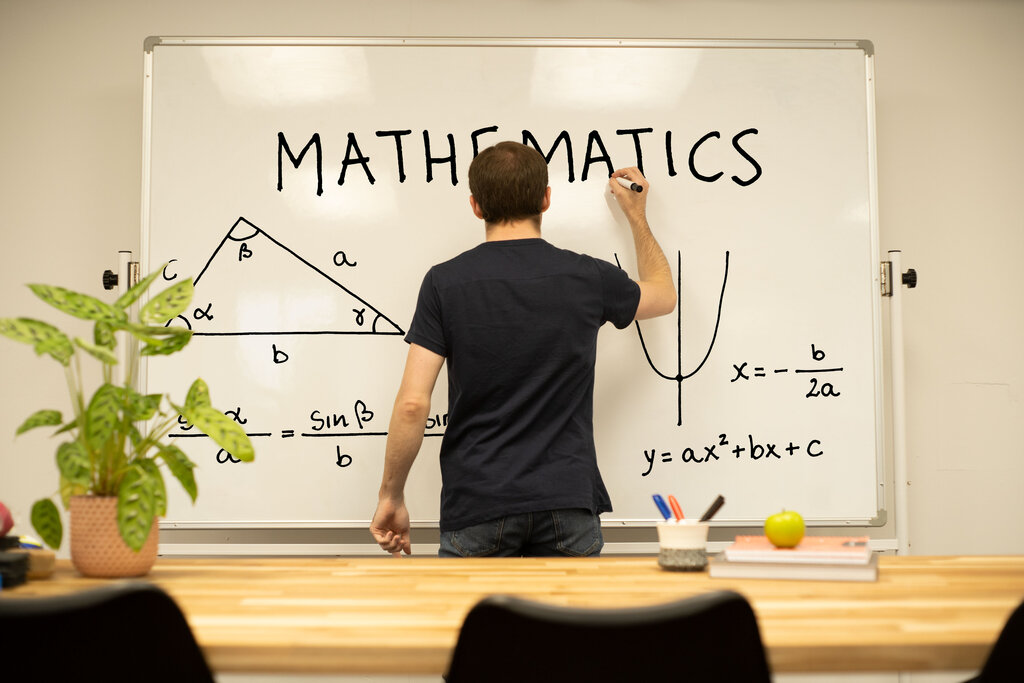
The Power of Precision
In everyday life, we use words loosely. If you say "it's a circle," you might mean something that's just roundish. In mathematics, that's not good enough. A circle isn't just a round shape; it's the set of all points in a plane that are at a given distance from a given point.
This level of precision is not just about being picky. It’s essential. Clear, unambiguous definitions are the bedrock of mathematics. Without them, we can't build logical arguments or be certain that we're even talking about the same thing. Think of it like a legal contract: every word is chosen carefully to avoid loopholes. In math, precise definitions prevent logical loopholes.
integer
noun
A whole number (not a fractional number) that can be positive, negative, or zero.
This definition is perfect. There is no ambiguity. It tells you exactly what is and isn't an integer. This clarity allows us to build more complex ideas on a solid foundation.
Patterns and Structures
At its heart, mathematics is the science of patterns. We're all natural pattern-seekers. We see the cycle of seasons, hear the rhythm in music, and recognize the structure in a story.
Mathematicians do the same thing, but with abstract ideas. They might look at a sequence of numbers and ask, "What's the rule here?" Consider the odd numbers: 1, 3, 5, 7... What happens when you add them up consecutively?
Notice a pattern? The sums are 1, 4, 9, 16. These are the square numbers: . A mathematician sees this pattern and forms a hypothesis: the sum of the first odd numbers is . This isn't just about numbers; it's about an underlying structure connecting two different types of numbers (odds and squares).
Finding a pattern is the first step. Proving it's always true is what makes it mathematics.
Logic and Proof
In science, you might test a hypothesis with experiments. If you run a thousand experiments and they all support your idea, you become very confident it's true. But you can't be 100% certain. There's always a chance the next experiment will give a different result.
Mathematics demands a higher standard of certainty: proof. A mathematical proof is a sequence of logical steps, starting from things we know are true (like definitions), that leads to an inescapable conclusion. It's like a perfect, airtight argument.
This logical structure is what gives mathematics its power. When a theorem is proven, it's true forever. It won't change with new discoveries. Euclid proved that there are infinitely many prime numbers over 2,000 years ago, and that fact is as solid today as it was then. Thinking mathematically means appreciating this quest for absolute certainty through abstract reasoning.
The key to success in mathematics isn't memorization, but understanding fundamental concepts.
Now let's check your understanding of these core ideas.
According to the text, what is the fundamental difference between establishing a truth in mathematics versus in science?
Why is a precise definition, such as 'an integer is a whole number (not a fractional number) that can be positive, negative, or zero,' crucial in mathematics?