Discovering Albert Einstein
Early Life
The Making of a Mind
Albert Einstein was born on March 14, 1879, in Ulm, Germany. His father, Hermann, was a salesman and engineer, and his mother, Pauline, was a homemaker. The family, who were non-observant Ashkenazi Jews, moved to Munich a year after Albert's birth, where his father and uncle started a company that manufactured electrical equipment. It was in Munich that young Albert's journey of discovery began.
A Curious Student
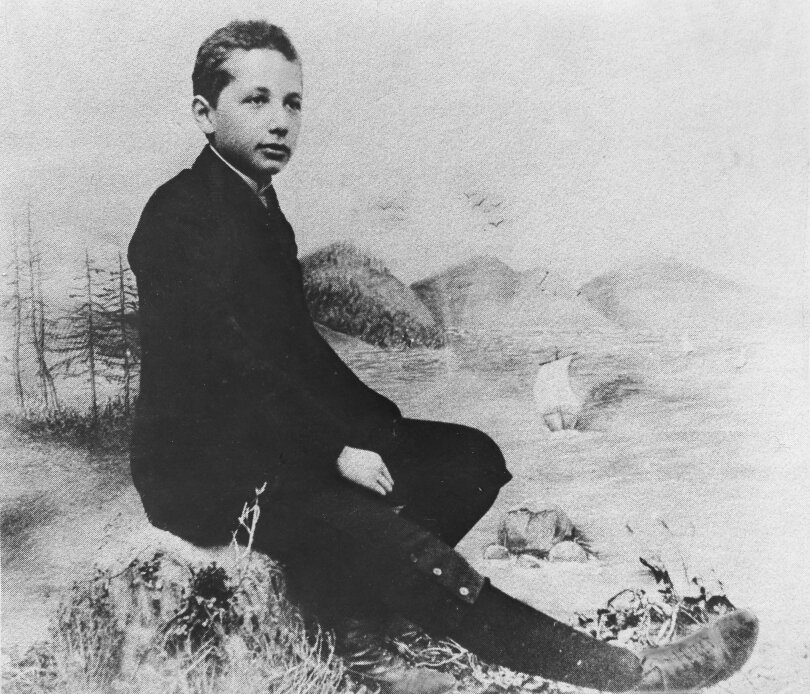
A popular myth paints Einstein as a poor student who struggled with basic subjects. The reality is quite different. While he was quiet and preferred to learn on his own, he excelled, particularly in mathematics and physics. He found the rigid, rote-learning style of his school, the Luitpold Gymnasium in Munich, stifling to his creativity.
He wasn't a bad student; he was a bored one. He often clashed with the school's authorities, who valued obedience over intellectual curiosity. His teachers failed to recognize his unique genius, with one famously telling him he would never amount to anything.
Contrary to legend, young Albert consistently earned top marks in math and science. He simply disliked the strict, unimaginative teaching methods of his school.
Two events from his childhood stand out as pivotal. The first happened when he was five years old and sick in bed. His father showed him a simple pocket compass. The boy was mesmerized by the fact that an unseen force made the needle point north, no matter which way the casing was turned. This experience sparked a lifelong fascination with invisible forces.
A few years later, a family friend named Max Talmud introduced the twelve-year-old Einstein to a book on Euclidean geometry. Einstein would later call it his "sacred little geometry book." He devoured its contents, captivated by the clear, logical proofs that built complex ideas from simple axioms. This was his first real taste of the deductive reasoning that would become central to his later work.
A New Beginning in Italy
In 1894, Hermann Einstein's business failed, forcing the family to relocate to Italy in search of new opportunities. They settled first in Milan, and later in Pavia. Albert, then fifteen, was initially left behind in Munich to finish his schooling.
Unhappy with the strict environment, he left the gymnasium after only a few months and joined his family in Italy. This period was a welcome release for him. He spent his time exploring the country, visiting museums, and, most importantly, reading and teaching himself advanced mathematics and physics. It was a formative time of intellectual freedom that solidified his desire to pursue a life dedicated to science, far from the rigid constraints of his German schooling.
What object first sparked a young Einstein's fascination with invisible forces?
True or False: The popular myth that Albert Einstein was a poor student who struggled in school is accurate.
Einstein's early years show us that curiosity and a desire for deep understanding are more important than conforming to a rigid system. His experiences set the stage for the revolutionary ideas that were to come.