Direct Current Analysis
Electrical Fundamentals
The Nature of Charge
At the heart of all things electrical is the concept of charge. It's a fundamental property of matter, just like mass. The universe is full of tiny particles, and some of them carry an electric charge. The most familiar of these are protons, which have a positive charge, and electrons, which have a negative charge.
Like charges repel each other, while opposite charges attract. A proton and an electron will pull toward one another, but two electrons will push each other away. This attraction and repulsion is the force that makes electricity work. When we talk about electricity, we're usually talking about the movement of electrons from one place to another. A buildup of these charges creates static electricity, but a steady flow of them creates an electric current.
Charge
noun
A fundamental property of matter that causes it to experience a force when placed in an electromagnetic field. It is measured in Coulombs (C).
In a simple circuit, these moving electrons carry energy that can be used to do work, like lighting a bulb.
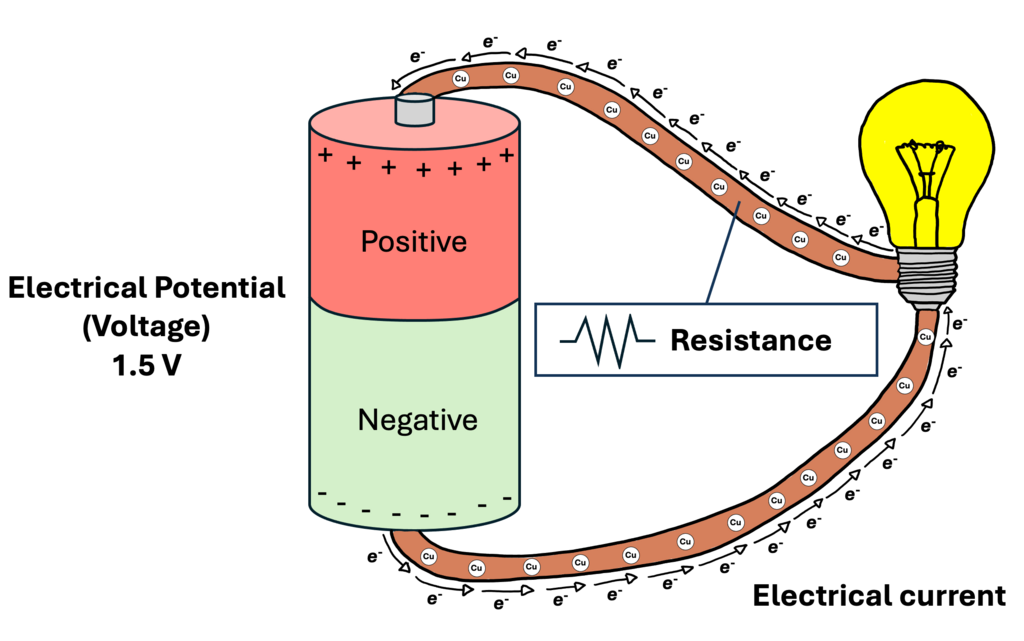
Voltage, Current, and Resistance
To understand how charge moves in a circuit, we need to know about three key concepts: voltage, current, and resistance. A common way to think about them is to imagine water flowing through a pipe.
Voltage is like the water pressure. It's the force that pushes the charged electrons through a wire. The higher the voltage, the more pressure there is to move the charges along.
Current is like the flow rate of the water. It’s the measure of how much charge is passing a single point in the circuit in a given amount of time. A higher current means more electrons are flowing.
Resistance is like the width of the pipe. A narrow pipe resists the flow of water more than a wide one. In a circuit, resistance is a measure of how much a material opposes the flow of current. A thin wire has more resistance than a thick wire of the same material.
Voltage pushes, current flows, and resistance opposes.
Voltage
noun
The difference in electric potential energy between two points in a circuit. It's the 'push' that causes charge to move. Measured in Volts (V).
Current is what we typically think of as 'electricity'.
Current
noun
The rate at which electric charge flows past a point in a circuit. Measured in Amperes (A), or Amps.
And finally, resistance is what stands in the way.
Resistance
noun
A measure of the opposition to current flow in an electrical circuit. Measured in Ohms (Ω).
Ohm's Law
Voltage, current, and resistance aren't independent. They share a simple, reliable relationship described by Ohm's Law. It states that the voltage across a conductor is directly proportional to the current flowing through it, provided all physical conditions and temperature remain constant.
Mathematically, it's expressed as:
Here, is voltage, is current, and is resistance. If you know any two of these values, you can always find the third. For example, if a circuit has a 12-volt battery and a resistor with 4 ohms of resistance, you can calculate the current.
The current flowing through the circuit would be 3 amps. This simple formula is the foundation for analyzing DC circuits.
Power and Energy
When current flows through a component with resistance, electrical energy is converted into other forms, like heat or light. Power is the rate at which this energy is converted. In other words, it’s how fast work is being done in the circuit.
Electrical power () is calculated by multiplying voltage and current.
The unit of power is the Watt (W). By combining this with Ohm's Law, we can also express power in two other useful ways:
Energy is simply power used over a period of time. If a 100-watt light bulb is left on for one hour, it consumes 100 watt-hours of energy. Understanding power and energy is key to knowing how much work a circuit can do and how much it will cost to operate.
Now, let's test your understanding of these fundamental concepts.
What happens when two particles with opposite electric charges, like a proton and an electron, are brought near each other?
Using the analogy of water flowing through a pipe, what does electrical resistance represent?
With these basics of charge, voltage, current, resistance, and power, you have the building blocks for analyzing any DC circuit.