Diminished Scales in Music
Intervals and Scales
The Space Between Notes
Music is more than just a sequence of notes. The magic happens in the relationships between them. The distance from one pitch to another is called an interval, and it's the fundamental building block of melodies and chords.
Think of musical pitches like rungs on a ladder. The smallest step you can take on this ladder is a half step, also called a semitone. On a piano, this is the distance from any key to the very next key, whether it's black or white. Moving from C to C♯ is a half step. So is moving from E to F.
Two half steps make a whole step, or a whole tone. On the piano, this usually means skipping over one key. Moving from C to D is a whole step because you skip the C♯ key in between.
Intervals have two parts to their name: a number and a quality. The number (like 2nd, 3rd, or 5th) just counts the letter names from the starting note to the ending note, including both. For example, from C to G, we count C, D, E, F, G—that's five letter names, so it's some kind of 5th.
The quality describes the precise sound and size of the interval. The main qualities are major, minor, and perfect. An interval is perfect if it has a very stable, consonant sound. Unisons, 4ths, 5ths, and octaves can be perfect.
| Interval | From C | Notes |
|---|---|---|
| Perfect Unison | C | C-C |
| Perfect 4th | F | C-F |
| Perfect 5th | G | C-G |
| Perfect Octave | C | C to the next C |
Major and minor qualities apply to 2nds, 3rds, 6ths, and 7ths. Major intervals are a half step larger than minor intervals. For instance, the distance from C to E is a major 3rd. If we shrink it by a half step by lowering the E to E♭, we get a minor 3rd (C to E♭).
Major intervals sound bright and happy, while minor intervals often sound more somber or sad.
What if we alter a perfect or major interval? If we make a perfect or major interval a half step larger, it becomes augmented. Making a perfect or minor interval a half step smaller makes it diminished. For example, C to G is a perfect 5th. C to G♯ is an augmented 5th. C to G♭ is a diminished 5th.
Building Scales
Now that we understand intervals, we can build scales. A scale is just a series of notes arranged in a specific order of intervals. Think of it as a pre-selected palette of notes for creating a melody. Every scale has a unique sound because it uses a unique pattern of whole and half steps.
Scales are the grammar of music—the recurring patterns that show up in melodies, bass lines, and chord progressions in every style.
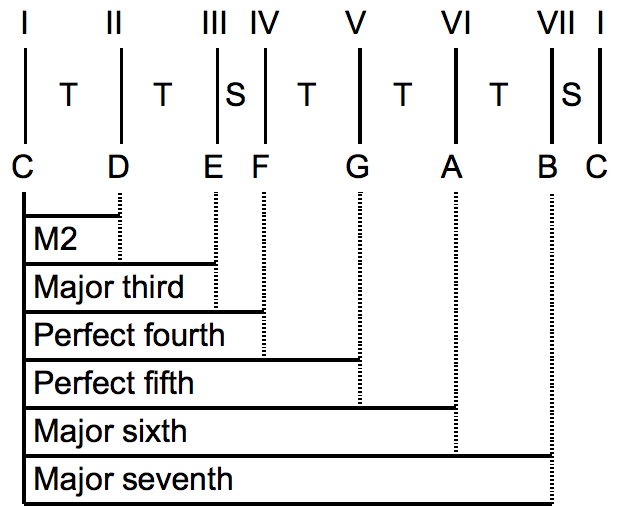
The most common scale is the major scale. Its pattern of whole (W) and half (H) steps is the same no matter which note you start on.
Let's build a C major scale. We start on C and follow the pattern:
- C to D is a whole step.
- D to E is a whole step.
- E to F is a half step.
- F to G is a whole step.
- G to A is a whole step.
- A to B is a whole step.
- B to the next C is a half step. The resulting notes are C, D, E, F, G, A, B. These are all the white keys on a piano from one C to the next.
The Minor Scale
Minor scales provide a different emotional color, often described as darker or more melancholic than major scales. There are a few types of minor scales, but the most fundamental is the natural minor scale. It uses its own distinct pattern of whole and half steps.
If we start on the note A and apply this pattern, we get the A natural minor scale: A, B, C, D, E, F, G. Notice something interesting? These are the exact same notes as the C major scale, just starting and ending on A. Because they share the same notes, A minor is known as the relative minor of C major.
Every major scale has a relative minor, which starts on the sixth note of the major scale. This shared pool of notes is why pieces of music can shift smoothly between a major and minor feel.
Let's test your understanding of these building blocks.
On a piano, the distance from an E key to the adjacent F key is called a:
What is the correct pattern of whole (W) and half (H) steps for a major scale?
Understanding how intervals combine to form scales is the first major step toward understanding how all of Western music is constructed.