Digital Social Networks Bridges and Clustering
Introduction to Social Network Analysis
Networks Are Everywhere
When you hear the term “social network,” you probably think of websites and apps. But the idea is much older and broader. A social network is simply a structure made up of individuals or organizations and the connections between them. These connections can represent friendships, family ties, business relationships, or even the spread of ideas.
To study these structures, we use a framework called social network analysis. It gives us a way to map and measure relationships and flows between people, groups, or computers. This map is a type of graph, which is the fundamental object of study in network science.
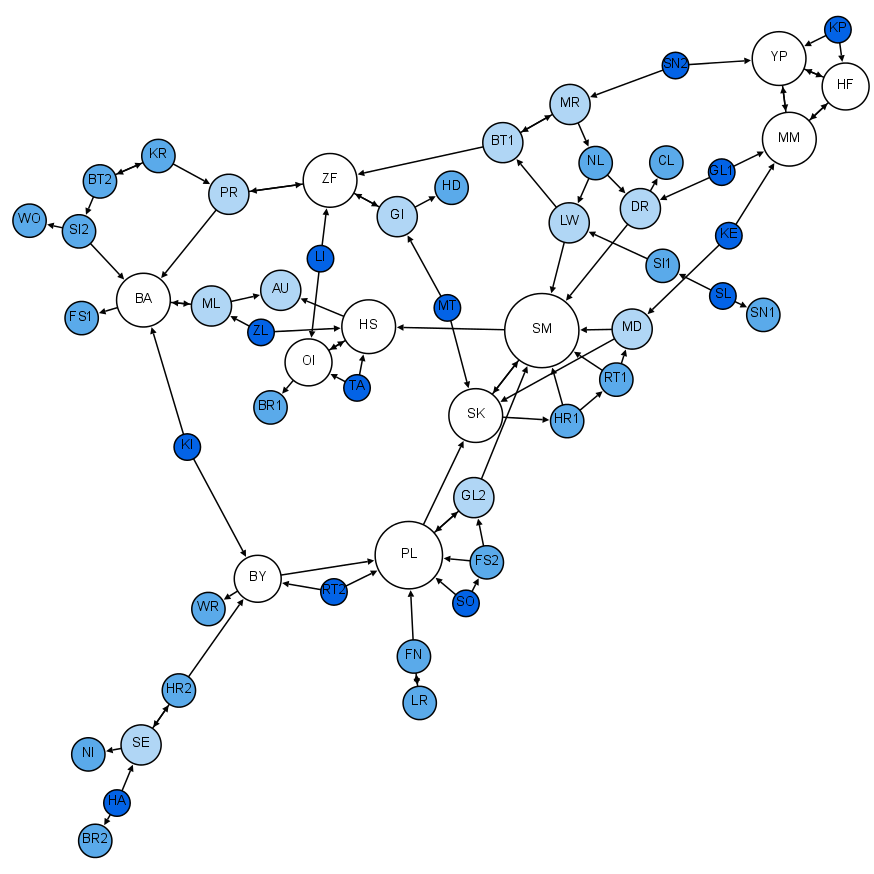
Think of a map of a city's subway system. The stations are specific locations, and the train lines are the connections between them. Social network analysis does the same thing, but for social structures.
The Building Blocks
Every network, no matter how complex, is built from two basic components: nodes and edges.
node
noun
An individual entity within a network. Also known as a vertex or actor.
Nodes are the things we are connecting. In a social network of friends, each person is a node. In a network of international trade, each country is a node.
edge
noun
The connection or relationship between two nodes. Also known as a link or tie.
Edges can have direction. If we're mapping who follows whom on a social media site, the edge goes from the follower to the person being followed. This is a directed edge. If we're mapping a simple friendship where the relationship is mutual, the edge is undirected.
Finding the Influencers
In any network, some nodes are more important or influential than others. One of the simplest ways to measure this is by counting a node's connections. This measure is called degree centrality.
Degree Centrality: The number of edges connected to a node.
A person with many friends has a high degree centrality in their friendship network. A website with many incoming links has high degree centrality in the web network. It's a straightforward count of direct influence or popularity.
In a directed network, we can be more specific. In-degree is the number of edges pointing to a node (e.g., followers), while out-degree is the number of edges pointing away from it (e.g., accounts you follow).
It's a Small World
Beyond a node's individual popularity, we can also look at the structure of its local neighborhood. Are a node's connections also connected to each other? This is measured by the clustering coefficient.
The clustering coefficient measures the degree to which nodes in a graph tend to cluster together.
Imagine you have five close friends. If all of them are also close friends with each other, your personal network has a high clustering coefficient. You are part of a tight-knit group, or a clique.
Now, imagine your five friends are from different parts of your life—one from work, one from your book club, one from your neighborhood—and none of them know each other. In this case, your personal network has a clustering coefficient of zero. You act as the sole link between otherwise disconnected people.
Both high and low clustering can be valuable. A dense cluster is good for building trust and reinforcing norms, while a low-clustering node can bridge different groups, accessing diverse information and opportunities.
Now that you understand the basic components and measures of a network, let's test your knowledge.
What are the two fundamental components of any social network graph?
On a social media platform where you can 'follow' other users, what kind of edge best represents the relationship from you to someone you follow?
These concepts are the foundation for analyzing how information spreads, how communities form, and how influence flows through a network.