Digital Product Launch Management
Product Strategy
What's the Game Plan?
Every successful product starts with a strong strategy. It’s the high-level plan that answers the big questions: What are we building? Who is it for? And how will it win?
Think of it as a recipe. Before you start cooking, you need to know what you're making, who you're feeding, and what ingredients you need. A product strategy provides that same clarity. It’s the foundation that guides every decision, from the first sketch to the final launch. Without it, you're just guessing.
Product strategy is a high-level plan that defines what you’re building, who it’s for, and how it will succeed in the market.
This plan isn't just a document that sits in a folder. It's a living guide that keeps the entire team aligned and moving in the same direction. It ensures that every feature built and every decision made serves a clear purpose.
Start with People
You can't build a product for everyone. The first step is to figure out exactly who you're building it for. This is where market research comes in. It's the process of understanding your potential customers, their needs, and their frustrations.
There are many ways to do this:
- Surveys: Great for getting quantitative data from a large group of people. You can ask about their habits, preferences, and challenges.
- Interviews: Perfect for getting qualitative insights. A one-on-one conversation allows you to dig deeper into the "why" behind a person's answers.
- Observation: Sometimes, what people do is more telling than what they say. Watching how users interact with existing products can reveal pain points they might not even be aware of.

The goal of all this research is to find a real, unmet need. You're looking for a problem that people are actively trying to solve but can't find a good solution for. That gap in the market is where your product can thrive.
Find Your Unique Edge
Once you know your audience and their problems, you need to define how your product will uniquely solve them. This is your Unique Value Proposition, or UVP. It’s a clear statement that explains what makes you different and better than the competition.
Your UVP answers a customer's most important question: "Why should I choose you?"
To find your UVP, you also need to understand the competitive landscape. Competitor analysis isn't about copying others; it's about identifying their strengths and weaknesses to find your own unique space. A simple table can help organize your findings.
| Feature | Competitor A | Competitor B | Our Opportunity |
|---|---|---|---|
| Pricing | High-end subscription | Free with ads | Offer a flexible pay-per-use model. |
| Key Feature | Advanced analytics | Simple, easy to use | Combine ease of use with one key advanced feature. |
| Customer Support | Email only, slow | No live support | Provide 24/7 chat support as a key differentiator. |
With this information, you can craft a powerful UVP. It should be specific, simple, and focused on a benefit that your target audience truly cares about.
Chart Your Course
A strategy is useless without a plan to execute it. This is where the product roadmap comes in. A roadmap is a visual, high-level summary that maps out the vision and direction of your product over time.
It's not a rigid list of features with strict deadlines. Instead, it communicates the strategic goals and the major steps you'll take to get there. Think of it as a map for a road trip: you know your destination (your objective) and the major cities you'll pass through (your milestones), but the exact route might change along the way.
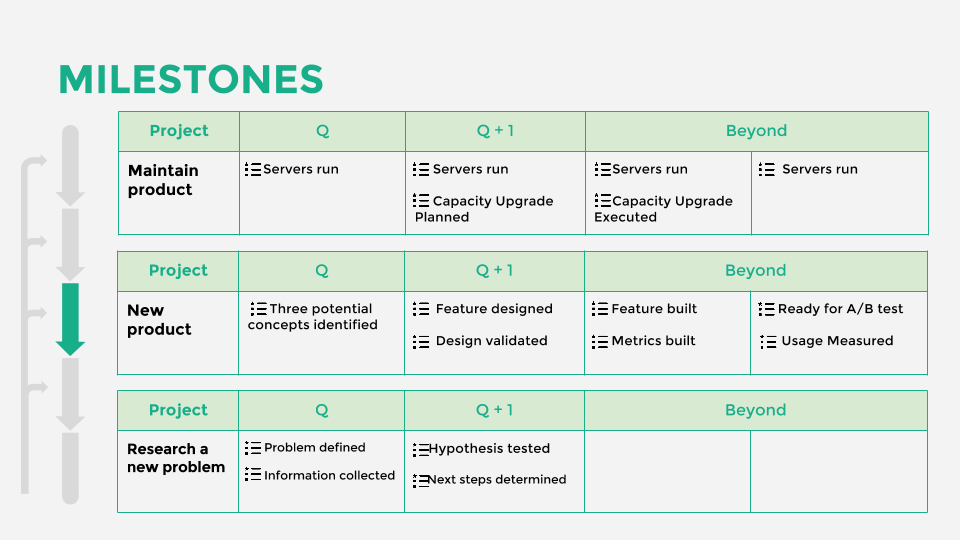
A good roadmap focuses on outcomes, not just outputs. For example, instead of listing "Build a new dashboard," a roadmap might state the objective: "Improve user engagement by making data easier to understand."
This approach gives your team the flexibility to find the best solution to the problem. The roadmap should be a living document, updated regularly as you learn more from your customers and the market. It keeps everyone aligned on the big picture and focused on what truly matters.
Before you check your understanding, let's review the key terms we've covered.
Now, let's test your knowledge on these core concepts.
What is the primary function of a product strategy?
If a product team wants to understand the deep, underlying motivations and "why" behind their users' behaviors, which market research method would be most effective?
A solid product strategy doesn't guarantee success, but building a product without one almost certainly guarantees failure. It provides the focus and direction needed to create something truly valuable.