Digital Platforms Explained
Introduction to Digital Platforms
The Digital Matchmakers
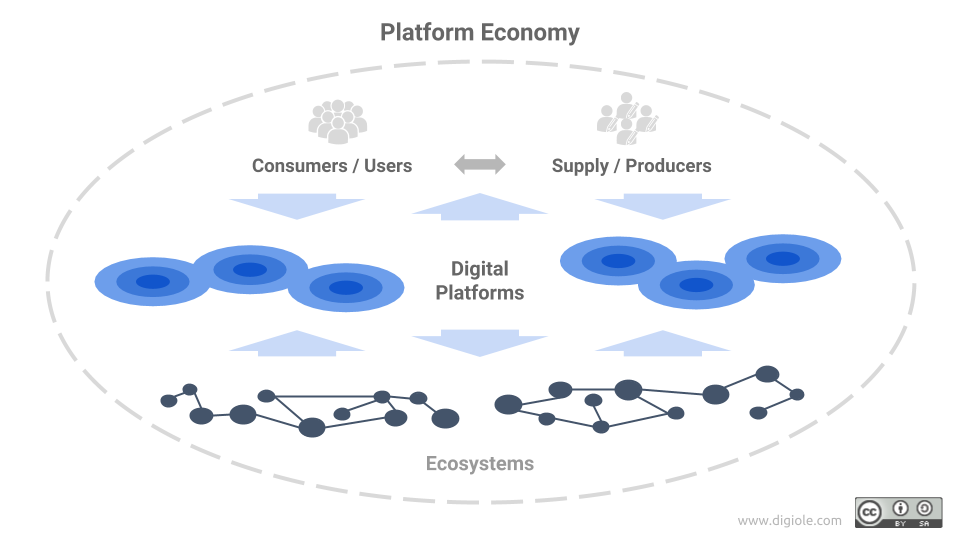
Digital platforms are the foundation of the modern internet economy. Think of them as online infrastructures, or digital spaces, that bring different groups of people together. They don't usually create the content or products themselves. Instead, they build the stage where users can interact, make transactions, and share information.
A platform could be a marketplace connecting buyers and sellers, a social network connecting friends, or an operating system connecting app developers and users. Their main job is to act as a matchmaker, reducing the friction and cost of these interactions.
The core function of a platform is to facilitate exchanges between different user groups. Amazon connects shoppers with merchants, while YouTube connects video creators with viewers.
These companies are central players in the digital economy. They create value not by producing goods in a linear supply chain, but by building and managing ecosystems. They provide the governance, tools, and services that allow producers and consumers to connect directly.
The Power of the Network
What makes platforms so powerful? The secret lies in something called the network effect. This principle states that a platform becomes more valuable as more people use it. A single telephone is just a plastic box. But as soon as someone else gets a phone, it becomes a communication device. As millions more join, it becomes an essential part of modern life.
For digital platforms, this creates a powerful feedback loop. More users attract more content creators or sellers, which in turn attracts even more users. This momentum can help a platform grow exponentially and build a strong competitive advantage. Once a network reaches a certain size, it becomes incredibly difficult for new competitors to challenge it.
Network Effect
noun
A phenomenon whereby a product or service gains additional value as more people use it.
This can be expressed mathematically. Metcalfe's law suggests that the value of a network is proportional to the square of the number of its users (). While just a model, it illustrates the explosive potential of network effects.
Changing the Rules of Business
The rise of digital platforms has profoundly changed how businesses operate. Traditional companies often use a "pipeline" model. They create a product or service at one end and push it through a supply chain to the customer at the other end. Think of a car manufacturer: they source materials, build cars in a factory, and sell them through dealerships.
Platforms operate differently. They don't own the means of production; they own the means of connection. Uber doesn't own cars, and Airbnb doesn't own real estate. They have created networks that connect people who have something with people who need something. This shift from a linear pipeline to a complex network has disrupted entire industries, from transportation and hospitality to media and retail.
| Feature | Pipeline Business | Platform Business |
|---|---|---|
| Value Creation | Internal processes | Community interactions |
| Business Focus | Optimizing a linear chain | Facilitating network connections |
| Key Asset | Physical assets, IP | The network of users |
| Example | Ford Motor Company | Facebook (Meta) |
This new model has rewritten the rules for success. While a pipeline business focuses on efficiency and controlling resources, a platform business must excel at building communities, fostering trust, and governing its network.
What is the primary function of a digital platform?
The principle that a platform becomes more valuable as more people use it is known as the __________.
By acting as digital intermediaries and leveraging network effects, platforms have become a dominant force in the global economy, shaping how we work, shop, and communicate.