Digital Marketing Mastery
Digital Marketing Basics
What Is Digital Marketing?
At its core, digital marketing is simply marketing that uses electronic devices and the internet. It’s the process of promoting brands, products, and services through online channels to connect with potential customers. Think of it as the modern-day version of putting up a flyer, but instead of a telephone pole, you’re using a website, a social media feed, or a search engine result.
Digital marketing refers to the promotion of products or services using digital channels, such as search engines, websites, social media, email, and mobile apps.
The key difference from traditional marketing is the 'digital' part. It's a two-way street. Instead of just broadcasting a message on a billboard and hoping for the best, businesses can now interact with their audience, get instant feedback, and adjust their strategies on the fly. This shift has changed everything about how companies reach people.
Digital vs. Traditional
Before the internet, marketing was a different game. Companies relied on print ads in newspapers, commercials on TV and radio, and billboards along the highway. This is traditional marketing. It's a powerful way to reach a broad audience, but it has its limits.
| Feature | Traditional Marketing | Digital Marketing |
|---|---|---|
| Reach | Broad, often untargeted | Highly specific and targeted |
| Interaction | One-way communication | Two-way conversation |
| Measurement | Difficult to track ROI | Precise, real-time analytics |
| Cost | Often high initial cost | More flexible and scalable budgets |
| Speed | Slow to launch and change | Fast to deploy and adapt |
Imagine a local bakery buys a full-page ad in a city newspaper. They'll reach thousands of people, but they won't know how many of them are actually interested in cupcakes. They also won't know for sure how many people visited the store because of that specific ad.
Now, imagine that same bakery runs a targeted ad on social media. They can choose to show their ad only to people within a five-mile radius who have shown an interest in desserts. They can track exactly how many people clicked the ad, visited their website, and even made a purchase. The difference is clear: digital marketing is data-driven, precise, and often more cost-effective.
The Main Channels
Digital marketing isn't just one thing. It's an umbrella term for many different strategies and channels, each with its own strengths. A good digital marketing plan uses a mix of these channels to create a unified strategy.
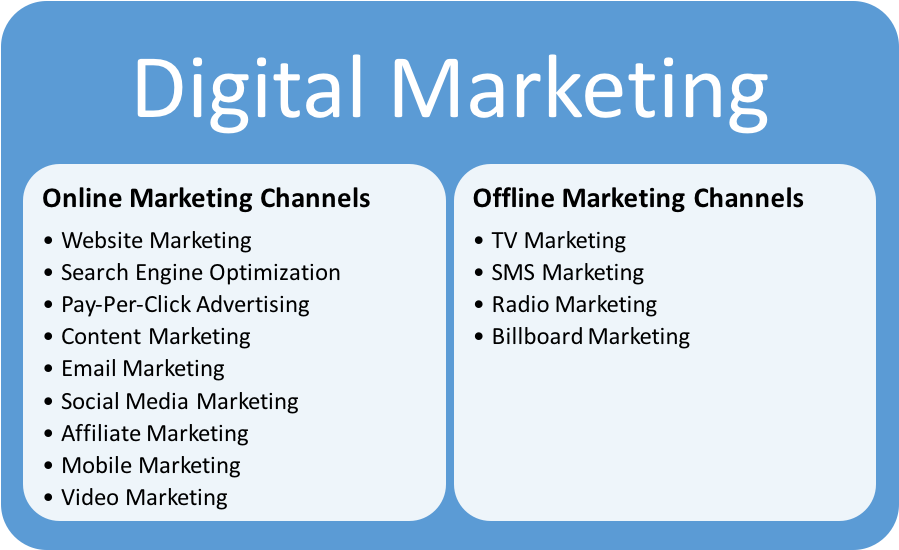
Here’s a quick look at some of the most important channels:
-
Search Engine Optimization (SEO): This is the practice of improving your website so that it appears higher in search engine results on Google, Bing, or others. When someone searches for “best coffee near me,” SEO helps your coffee shop show up at the top. The goal is to get organic, or unpaid, traffic.
-
Search Engine Marketing (SEM): While SEO focuses on organic results, SEM involves paying for ads to appear on search engine results pages. You've probably seen these—they're the listings at the very top of a Google search that are labeled "Ad."
-
Content Marketing: This channel is all about creating and sharing valuable free content—like blog posts, videos, podcasts, and infographics—to attract and retain an audience. The idea is not to explicitly promote a brand, but to stimulate interest in its products or services by providing genuinely useful information.
-
Social Media Marketing: This involves using social media platforms like Facebook, Instagram, X (formerly Twitter), and LinkedIn to promote a product or service. It's a great way to build a community, engage directly with customers, and drive traffic to your website.
-
Email Marketing: This is one of the oldest and still most effective digital marketing channels. It involves sending targeted messages directly to a list of subscribers' inboxes to nurture leads, promote deals, or share updates.
-
Data Analytics: This is the engine that powers all other digital marketing efforts. Analytics involves tracking, measuring, and analyzing data from all your channels to understand what’s working and what isn’t. It turns guesswork into informed strategy.
What is the defining characteristic of digital marketing?
A local bakery wants to appear at the top of Google search results when people search for “cupcakes near me” without paying for ads. Which digital marketing channel should they focus on?
Understanding these core concepts is the first step. Each channel is a deep topic on its own, but they all work together to help businesses grow in the digital age.