Digital Marketing in 2026
Introduction to Digital Marketing
What Is Digital Marketing?
At its core, digital marketing is any marketing effort that uses an electronic device or the internet. It's how businesses leverage digital channels like search engines, social media, email, and their websites to connect with current and prospective customers.
Think of it this way: traditional marketing tries to push a message out to you. Digital marketing aims to pull you in by being present where you already spend your time online.
Instead of a billboard on a highway, you might see an ad in your social media feed. Instead of a TV commercial, you might watch a brand's short video on YouTube. It's all about meeting people in the digital spaces they inhabit.
The Shift from Traditional to Digital
For decades, marketing was a one-way street. Companies would broadcast their messages through print, radio, or television, hoping to catch the attention of a wide audience. It was like fishing with a giant net—you'd catch some of what you wanted, but also a lot you didn't.
Digital marketing changed the game. It allows for a two-way conversation. Businesses can now target very specific groups of people, interact with them directly, and get immediate feedback on what's working and what isn't. It's more like fishing with a spear, aiming precisely for the fish you want to catch.
| Feature | Traditional Marketing | Digital Marketing |
|---|---|---|
| Communication | One-way (broadcast) | Two-way (interactive) |
| Targeting | Broad, demographic-based | Highly specific, behavior-based |
| Measurement | Difficult, often estimated | Precise, real-time data |
| Cost | Often high with uncertain ROI | More scalable and cost-effective |
This shift gives marketers incredible power. You no longer have to guess if your advertising is effective. You can track nearly every click, view, and purchase, allowing you to make smarter decisions and use your budget more wisely.
The Digital Marketing Toolkit
Digital marketing isn't just one thing; it's a collection of tools and strategies that work together. While there are many specializations, most fall into a few core categories.
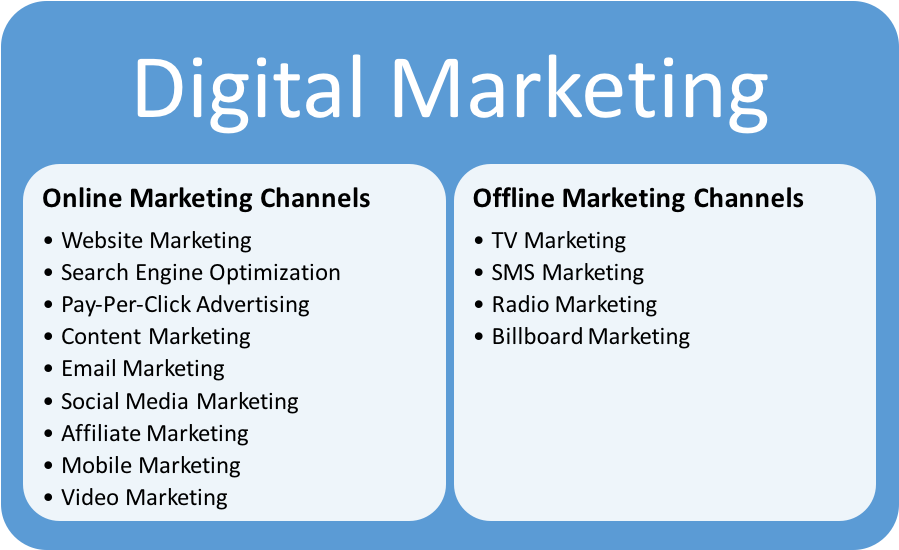
Search Engine Optimization (SEO): This is the art and science of making your website more attractive to search engines like Google. The goal is to rank higher in search results for relevant keywords, bringing in organic (unpaid) traffic. Think of it as setting up your shop on the busiest street in town, so more people naturally find you.
Content Marketing: This involves creating and sharing valuable free content—like blog posts, videos, podcasts, and guides—to attract and retain a clearly defined audience. Instead of pitching your products, you're providing value that builds trust and authority. Good content is the fuel for all your other marketing efforts.
Social Media Marketing: This is more than just posting updates. It’s about engaging with your audience where they are, building a community, and driving traffic to your website. Each platform (like Instagram, TikTok, LinkedIn, or Facebook) has its own language and best practices.
Email Marketing: This is one of the most direct and effective ways to connect with your leads, nurture them, and turn them into customers. It's a direct line to your audience's inbox, allowing for personalized messages and offers.
Pay-Per-Click (PPC) Advertising: This is where you pay for your ads to be placed on search engines or other websites. You're essentially buying visits to your site, rather than “earning” them organically. Google Ads and Facebook Ads are two of the most common PPC platforms.
The Role of Data
What truly sets digital marketing apart is the ability to measure everything. Data analytics is the backbone of any successful digital strategy. Marketers can track user behavior in incredible detail, from which ads they click on to how long they spend on a webpage.
Data-driven decision-making is crucial in digital marketing as it enables businesses to track performance, understand customer behavior, and refine strategies based on real-time insights.
This constant flow of data allows for continuous improvement. If an ad isn't performing well, you can change it. If a certain type of content is getting a lot of engagement, you can create more of it. This process of testing, measuring, and optimizing is what allows businesses to get the most out of their marketing budget and build strategies that truly work.
According to the 'fishing' analogy, what is the primary advantage of digital marketing over traditional marketing?
Which digital marketing strategy is focused on making a website more attractive to search engines like Google to gain unpaid, or 'organic,' traffic?
Digital marketing provides a powerful set of tools to connect with customers in a way that's both measurable and highly targeted. By understanding the core components, you can start building a strategy that helps your business grow.