Digital Marketing Fundamentals
Introduction to Digital Marketing
What Is Digital Marketing?
Digital marketing is any marketing that uses electronic devices and the internet. Businesses use digital channels like search engines, social media, and email to connect with current and prospective customers.
Think of it this way: traditional marketing might involve putting a billboard on a busy highway. You hope the right people see it. Digital marketing is more like having a friendly conversation with someone you know is interested in what you have to offer, right in their living room.
It’s not about finding customers for your products. It’s about creating products for your customers and meeting them where they are.
The key difference is the ability to target, interact, and measure results with incredible accuracy. Unlike a TV commercial, you know exactly who clicked your ad, what they did on your website, and whether they made a purchase. This shift from one-way broadcasting to two-way conversation has changed how businesses operate.
| Feature | Traditional Marketing | Digital Marketing |
|---|---|---|
| Reach | Broad, often untargeted | Highly specific, global |
| Interaction | One-way (broadcast) | Two-way (conversation) |
| Cost | Often high with uncertain ROI | Scalable, often more affordable |
| Measurement | Difficult, based on estimates | Precise, real-time data |
| Speed | Slow to launch and change | Fast to launch and adapt |
The Main Channels
Digital marketing isn't a single strategy but a collection of different channels, each with its own strengths. Most successful campaigns use a mix of these to reach people at different stages of their decision-making process.
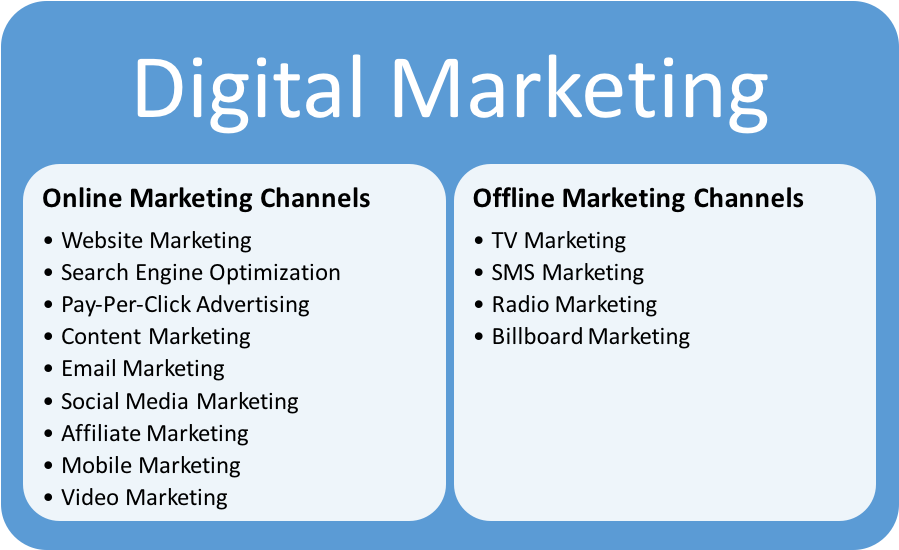
Here are the core channels you'll encounter:
-
Search Engine Optimization (SEO): This is the process of improving your website to increase its visibility when people search for products or services related to your business in Google, Bing, and other search engines. The better your SEO, the more likely you are to attract relevant traffic.
-
Content Marketing: This involves creating and sharing valuable free content—like blog posts, videos, and ebooks—to attract and retain a clearly defined audience. Instead of pitching your products, you're providing useful information that builds trust.
-
Social Media Marketing: This is the use of social media platforms like Facebook, Instagram, and LinkedIn to promote a product or service. It's about building a community, engaging with followers, and driving traffic to your website.
-
Email Marketing: One of the oldest but most effective channels. Email marketing allows businesses to stay in touch with their customers, promoting content, discounts, and events. It's a direct line to your most engaged audience.
-
Paid Advertising (PPC): Pay-Per-Click (PPC) is a model where marketers pay a fee each time one of their ads is clicked. The most common type is search engine advertising, where you can pay for top slots on Google's search results page.
The Digital Marketing Funnel
To understand how these channels work together, marketers often use a model called the marketing funnel. It visualizes the journey a person takes from first learning about a brand to becoming a loyal customer. While different models exist, a typical funnel has four main stages.
-
Awareness: This is the top of the funnel. Potential customers are experiencing a problem and become aware that you offer a solution. The goal here is to attract a wide audience through channels like content marketing, SEO, and social media.
-
Consideration: Once people are aware of you, they move into the consideration stage. They are now actively researching solutions. Here, you want to provide more detailed information through email marketing, case studies, or webinars to help them evaluate your offerings.
-
Conversion: This is where a prospect decides to become a customer. The goal is to make it as easy as possible for them to take action, whether that's making a purchase, signing up for a service, or filling out a form. Highly targeted ads and clear calls-to-action are crucial here.
-
Loyalty: The journey doesn't end at the sale. The final stage is about turning a one-time customer into a repeat buyer and advocate for your brand. This is nurtured through great customer service, email newsletters, and community building.
The funnel helps businesses stay organized. By understanding which stage a customer is in, a company can create targeted messages and use the right channels to gently guide them to the next step.
What is a primary advantage of digital marketing compared to traditional marketing methods like billboards or TV commercials?
A business that creates and shares free, valuable content like blog posts and videos to attract a specific audience is practicing which strategy?
By leveraging these channels and understanding the customer journey, businesses can build strong relationships with their audience, drive growth, and achieve their goals in an increasingly digital world.