Digital Marketing Fundamentals Mastery
Introduction to Digital Marketing
What Is Digital Marketing?
At its core, digital marketing is simply promoting products or services using electronic devices and the internet. Think of it as the modern version of putting up a poster in the town square. Instead of a physical square, you're using digital spaces where people spend their time: social media, search engines, and their email inboxes.
Digital marketing refers to the promotion of products or services using digital channels, such as search engines, websites, social media, email, and mobile apps.
The main goal is to connect with customers where they are most active. Unlike a billboard that everyone sees, digital marketing lets you talk directly to people who are likely interested in what you have to offer. This could be through a funny video, a helpful blog post, or an ad that appears when they search for something specific.
Digital vs. Traditional Marketing
Traditional marketing includes methods like print ads, billboards, and TV commercials. It broadcasts a message to a wide audience, hoping to catch the right people. Digital marketing is more targeted and measurable. You can aim your message at a specific group—like 25-year-old coffee lovers in Chicago—and see exactly how many people clicked your ad or bought your product.
| Feature | Traditional Marketing | Digital Marketing |
|---|---|---|
| Reach | Broad, often untargeted | Highly targeted and specific |
| Cost | Generally more expensive | More cost-effective and scalable |
| Measurement | Difficult to track results | Highly measurable with analytics |
| Interaction | One-way communication | Two-way, interactive conversation |
| Speed | Slow to launch and change | Campaigns can be launched and adjusted quickly |
The biggest shift is from a one-way conversation (a TV ad talking at you) to a two-way dialogue. Brands can now interact with customers in real-time, answer questions, and build relationships directly. This makes marketing more personal and effective.
Key Digital Marketing Channels
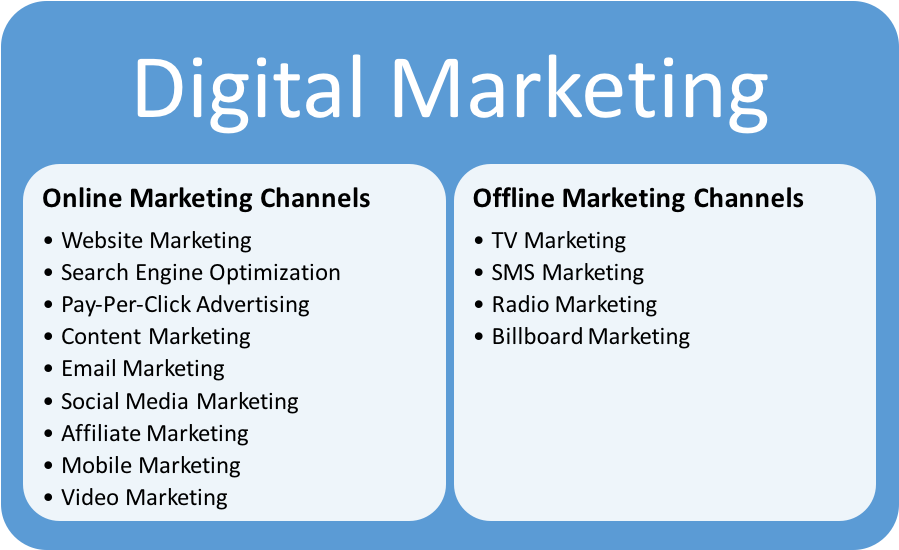
Digital marketing isn't just one thing; it's a collection of different channels and strategies. Each one serves a unique purpose in reaching and engaging customers online. Here are some of the most important channels you'll encounter.
Search Engine Optimization (SEO) This is the practice of increasing the quantity and quality of traffic to your website through organic search engine results. It’s about making your site more visible to people who are using search engines like Google to find what you offer.
Search Engine Marketing (SEM) Often used alongside SEO, SEM involves paying for advertisements that appear on search engine results pages. You've probably seen these as the first few results on Google, marked with an "Ad" label.
Social Media Marketing This involves using social media platforms like Facebook, Instagram, X (formerly Twitter), and LinkedIn to promote a product or service. It's great for building a community and engaging directly with your audience.
Content Marketing Content marketing focuses on creating and distributing valuable, relevant, and consistent content—like blog posts, videos, and infographics—to attract and retain a clearly defined audience. Instead of directly pitching your products, you're providing something useful.
Email Marketing This is one of the oldest and most effective digital marketing channels. It involves sending commercial messages to a group of people using email, often to nurture leads, promote products, or share updates.
Paid Advertising (PPC/PPA) This is a broad category that includes any form of online advertising where you pay for your ads to be shown. Pay-Per-Click (PPC) is a common model, where you pay a fee each time one of your ads is clicked. This includes ads on social media and search engines.
Understanding these basic channels is the first step toward building a successful digital marketing strategy.
What is the primary goal of digital marketing?
A coffee shop wants to appear at the top of Google's search results when people in their city search for "best local espresso." Which digital marketing channel focuses on achieving this through organic (non-paid) methods?