Digital Marketing Fundamentals
Digital Marketing Basics
What Is Digital Marketing?
At its core, digital marketing is any marketing effort that uses an electronic device or the internet. It's how businesses leverage digital channels like search engines, social media, email, and their websites to connect with current and prospective customers.
Digital marketing refers to the promotion of products or services using digital channels, such as search engines, websites, social media, email, and mobile apps.
Think about your own day. You might check social media when you wake up, use a search engine to find a coffee shop, and read emails from your favorite stores. Each of these moments is an opportunity for a business to reach you. The importance of digital marketing is simple: you have to meet your customers where they are, and increasingly, they're online.
Traditional vs Digital
Marketing has been around for centuries, but its methods have changed dramatically. Before the internet, marketing was dominated by print ads in newspapers, commercials on TV and radio, and billboards along the highway. This is known as traditional marketing.
Digital marketing offers a fundamentally different approach. While a TV commercial broadcasts the same message to everyone watching, a digital campaign can show a specific ad to a 25-year-old in Chicago who loves hiking, and a different ad to a 45-year-old in Miami who's interested in boating. This ability to target specific audiences is one of digital's biggest strengths. It's also much easier to measure results and adjust your strategy in real-time.
| Feature | Traditional Marketing | Digital Marketing |
|---|---|---|
| Reach | Broad, often untargeted (e.g., national TV ad) | Highly specific, targeted (e.g., social media ad for an age group) |
| Measurement | Difficult to track direct results (e.g., how many people saw a billboard and then bought a product) | Precise and immediate (e.g., track clicks, views, and sales from an ad) |
| Cost | Often requires a large upfront budget (e.g., printing flyers, buying a TV spot) | Can be more cost-effective, scalable from small to large budgets |
| Interaction | One-way communication (company to consumer) | Two-way communication (consumers can comment, share, and interact) |
The Digital Marketing Toolkit
Digital marketing isn't just one thing; it's a collection of different strategies and channels that work together. Understanding the main components is the first step to building a solid plan.
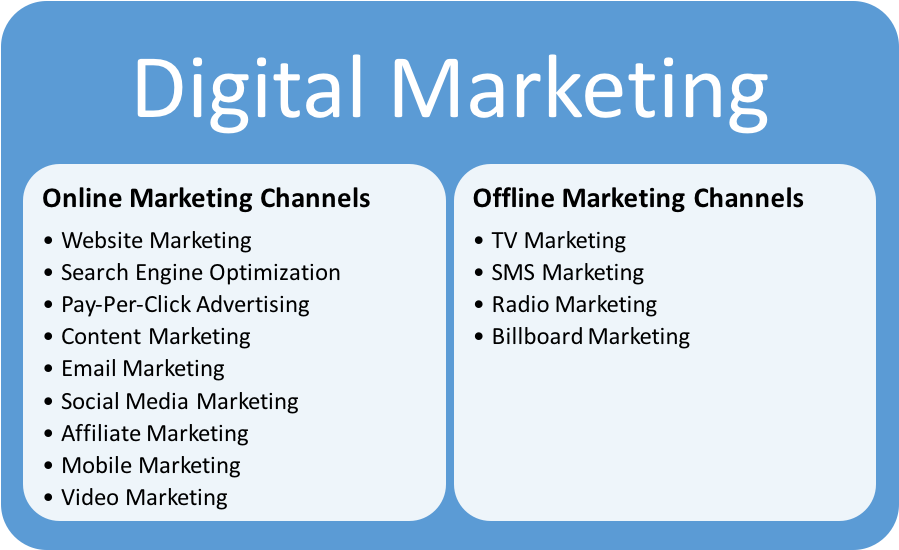
Here are the key strategies you'll encounter:
Search Engine Optimization (SEO) This is the practice of improving your website to increase its visibility when people search for products or services related to your business in Google, Bing, and other search engines. The goal is to appear higher in the search results, which can bring more organic, or non-paid, traffic to your site.
Content Marketing Content marketing focuses on creating and distributing valuable, relevant, and consistent content to attract and retain a clearly defined audience. This can include blog posts, videos, infographics, podcasts, and ebooks. Instead of directly pitching your products, you provide useful information that builds trust and authority.
Social Media Marketing This involves promoting your brand and your content on social media channels like Facebook, Instagram, Twitter, and LinkedIn to increase brand awareness, drive traffic, and generate leads. It's about engaging with your audience and building a community around your brand.
Email Marketing Email marketing is a way to communicate with your leads, prospects, and customers directly in their inbox. It's used to promote content, share discounts, and direct people toward your website. A well-crafted email can nurture leads and turn one-time buyers into loyal fans.
Paid Advertising Also known as pay-per-click (PPC) advertising, this strategy involves paying for your ads to be shown to a target audience. The most common type is search engine advertising, where you pay for your website to appear at the top of the search results for specific keywords. You can also run paid ads on social media platforms.
These strategies aren't meant to be used in isolation. The most effective digital marketing plans combine several of these components to create a unified approach that reaches customers at different stages of their journey.
Now that you understand the basic concepts, let's test your knowledge.
What is the primary characteristic that defines digital marketing?
A key advantage of digital marketing compared to traditional marketing, like a TV commercial, is its ability to:
These foundational concepts are the building blocks of any successful digital strategy. By understanding what digital marketing is and the tools it provides, you're ready to explore how each component works in more detail.