Digital Marketing Fundamentals Explained
Introduction to Digital Marketing
What Is Digital Marketing?
Digital marketing is any marketing effort that uses an electronic device or the internet. Businesses leverage digital channels such as search engines, social media, email, and their websites to connect with current and prospective customers.
Think of it this way: traditional marketing is like shouting a message from a rooftop, hoping the right people hear it. Digital marketing is more like having a one-on-one conversation with people you know are interested in what you have to say. It's direct, personal, and measurable.
The core goal is simple: meet people where they spend their time and attention—which, today, is overwhelmingly online.
Digital vs. Traditional
The biggest difference between digital and traditional marketing is the medium. Traditional marketing uses offline channels like print ads, television commercials, and billboards. It's generally a one-way street; the brand sends a message out, but it's hard to know exactly who saw it or what they did afterward.
Digital marketing, on the other hand, is a two-way conversation. It’s interactive. You can see precisely who you're reaching, what they're interested in, and how they react to your message. This ability to track results in real-time is a game-changer.
| Feature | Traditional Marketing | Digital Marketing |
|---|---|---|
| Interaction | One-way broadcast | Two-way conversation |
| Targeting | Broad, general audience | Highly specific, targeted audience |
| Measurement | Difficult, often estimated | Precise, real-time data |
| Cost | Often high with uncertain ROI | Scalable, often lower cost with clear ROI |
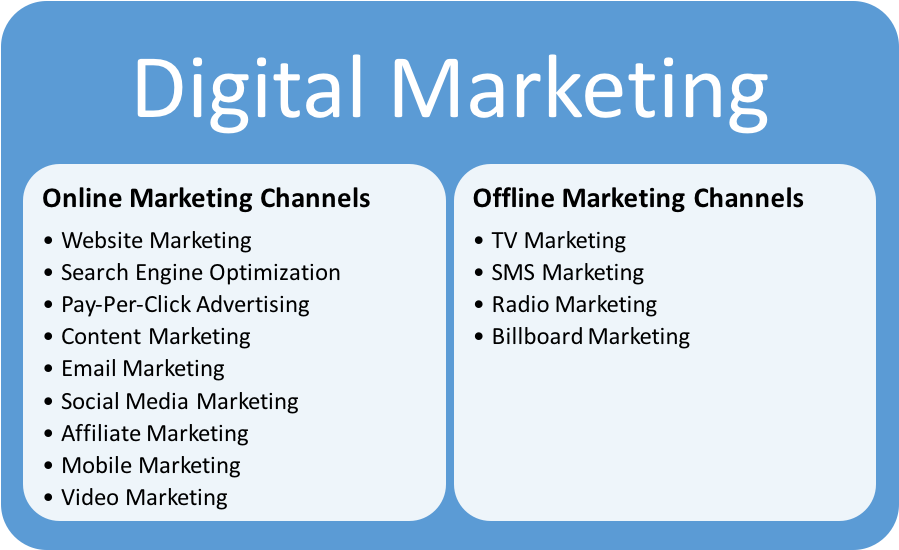
The Digital Marketing Toolkit
Digital marketing isn't just one thing. It's a collection of different strategies and channels, each with its own purpose. While you don't need to master them all at once, it's important to know the key players.
Search Engine Optimization
noun
The practice of increasing the quantity and quality of traffic to your website through organic (non-paid) search engine results. The goal is to make your website appear higher up on pages like Google when someone searches for a relevant term.
Commonly known as SEO, this is all about playing by the search engine's rules to get your content seen without paying for ads.
Search Engine Marketing
noun
A digital marketing strategy used to increase the visibility of a website in search engine results pages through paid advertising. These are the ads you often see at the very top of a Google search.
Content Marketing
noun
A strategic approach focused on creating and distributing valuable, relevant, and consistent content to attract and retain a clearly defined audience. Examples include blog posts, videos, podcasts, and infographics.
Instead of pitching your products or services, you are providing content that helps your audience solve their problems.
Social Media Marketing
noun
The use of social media platforms and websites to promote a product or service. It involves creating content, engaging with followers, and often running paid ad campaigns on platforms like Instagram, Facebook, TikTok, and LinkedIn.
This channel is all about building a community and connecting with people in a more informal, authentic way.
Email Marketing
noun
The act of sending a commercial message, typically to a group of people, using email. It's used to build relationships, promote content, and guide potential customers toward a purchase.
Despite the rise of social media, email remains one of the most effective ways to nurture leads and turn them into customers. These different channels all work together to create a unified marketing presence.
What is the primary characteristic that distinguishes digital marketing from traditional marketing?
The practice of improving a website's visibility in search engine results without paying for ads is known as ______.
This overview covers the basics of what digital marketing is and the main tools it uses. Each of these channels has its own deep strategies, which we'll explore later.