Digital Marketing Fundamentals and Strategy
Digital Marketing Overview
Marketing in a Digital World
At its core, digital marketing uses online channels to connect with customers. While traditional marketing relies on print, broadcast, and billboards, digital marketing meets people where they spend a significant amount of their time: on their phones, laptops, and smart devices.
Digital marketing is the practice of promoting brands, products, and services through digital channels and technologies, such as web, email, and social media, in order to engage target audiences.
The most significant difference isn't just the medium, but the method. Traditional marketing is often a one-way broadcast. A TV commercial or magazine ad sends a message out, but it can't listen for a reply. Digital marketing, on the other hand, is a two-way conversation. It's interactive, data-driven, and highly adaptable.
| Feature | Traditional Marketing | Digital Marketing |
|---|---|---|
| Communication | One-way broadcast | Two-way conversation |
| Targeting | Broad (demographics) | Specific (behavior, interests) |
| Measurement | Difficult, often indirect | Precise, real-time data |
| Pace | Slower, long campaigns | Fast and iterative |
This shift allows for precise targeting and measurement. Instead of buying a billboard and hoping the right people drive by, you can show an ad directly to someone who has shown interest in your product. Every click, view, and purchase can be tracked, providing immediate feedback on what's working and what isn't.
The Core Channels
A strong digital strategy rarely relies on a single channel. Instead, it blends several complementary approaches to create a cohesive plan. Think of these as the primary tools in the digital marketer's toolkit.
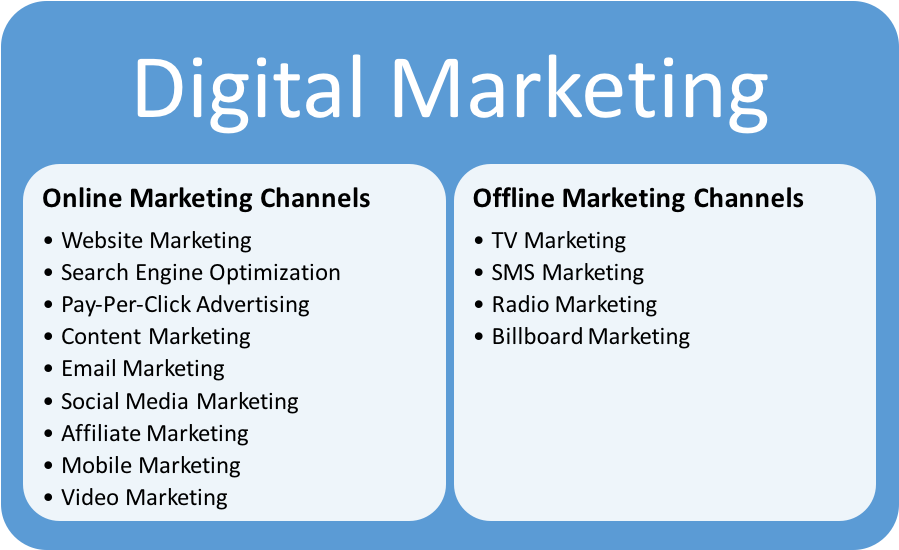
First is . This is the process of improving your website to increase its visibility when people search for products or services related to your business in Google, Bing, and other search engines. The better your SEO, the more likely you are to attract organic, or non-paid, traffic.
Content Marketing is the engine that often drives SEO and social media. It involves creating and sharing valuable free content—like blog posts, videos, and ebooks—to attract and retain a clearly defined audience. Instead of pitching your products, you're providing useful information that builds trust and authority.
Social Media Marketing involves using platforms like Facebook, Instagram, LinkedIn, and X to build your brand, drive website traffic, and generate sales. It's about more than just posting updates; it's about engaging with your audience and creating a community around your business.
Email Marketing is one of the most direct and effective ways of connecting with your leads, nurturing them, and turning them into customers. It's a powerful tool for building relationships over time, often through newsletters, promotional campaigns, and personalized messages.
Finally, there's . This includes various methods where you pay to drive traffic to your website. The most common form is pay-per-click (PPC), where you pay a fee each time one of your ads is clicked. This can appear on search engines, social media platforms, or other websites.
Connecting Channels to Goals
The ultimate goal of digital marketing is to help a business achieve its objectives, whether that's increasing sales, generating leads, or building brand awareness. The key is to map the right channels to the right goals.
For example, if your goal is to generate new leads for a B2B software company, you might focus on content marketing (creating an insightful ebook) and paid advertising on LinkedIn to promote it to a specific professional audience.
If you're an e-commerce brand wanting to drive direct sales, your focus might be on SEO to capture people searching for your products, combined with social media ads that retarget website visitors who didn't make a purchase.
The measurability of digital channels is what makes this strategic alignment possible. Through a practice called , marketers can run experiments to see which headlines, images, or calls to action perform best. This data-driven approach allows for continuous optimization, ensuring that the marketing budget is spent as effectively as possible.
This ability to reach the right person with the right message at the right time—and to know for certain if it worked—is the fundamental advantage of digital marketing.
Ready to test your knowledge? Let's see what you've learned.
What is the primary advantage of digital marketing compared to traditional marketing?
The practice of creating and sharing valuable free content, like blog posts or ebooks, to attract an audience is known as:
By understanding these core concepts, you're ready to explore how each digital channel works in more detail.