Digital Marketing Essentials
Digital Marketing Basics
What is Digital Marketing?
At its core, digital marketing is simply marketing that uses electronic devices and the internet. It's the art of promoting brands, products, and services through digital channels to connect with current and potential customers.
Digital Marketing is the process of promoting products, services, and personal brands using the internet and digital technologies.
Think of it this way: if marketing is a conversation, digital marketing is having that conversation where people are spending most of their time today—online. This includes everything from your social media feed and the websites you browse to the emails that land in your inbox.
Digital vs. Traditional Marketing
For centuries, marketing relied on print ads in newspapers, commercials on television and radio, and billboards along the highway. This is what we now call traditional marketing. It casts a wide net, hoping to catch the attention of a broad audience.
Digital marketing, on the other hand, is much more targeted and measurable. Instead of putting a billboard on a busy road, you can show an ad to a specific group of people, like 30-year-old coffee lovers in Chicago. This precision is one of its biggest advantages.
| Feature | Traditional Marketing | Digital Marketing |
|---|---|---|
| Reach | Broad, often local or national | Global and highly specific |
| Cost | Can be very expensive (e.g., TV ads) | More cost-effective and scalable |
| Targeting | Limited (e.g., magazine readership) | Precise (age, interests, behavior) |
| Measurement | Difficult to track direct results | Highly measurable with analytics |
| Interaction | One-way communication | Two-way, interactive communication |
The ability to track performance in real-time is a game-changer. With digital marketing, you know exactly how many people saw your ad, clicked on it, and made a purchase. This data allows businesses to understand what's working, what isn't, and adjust their strategies on the fly.
Key Digital Marketing Channels
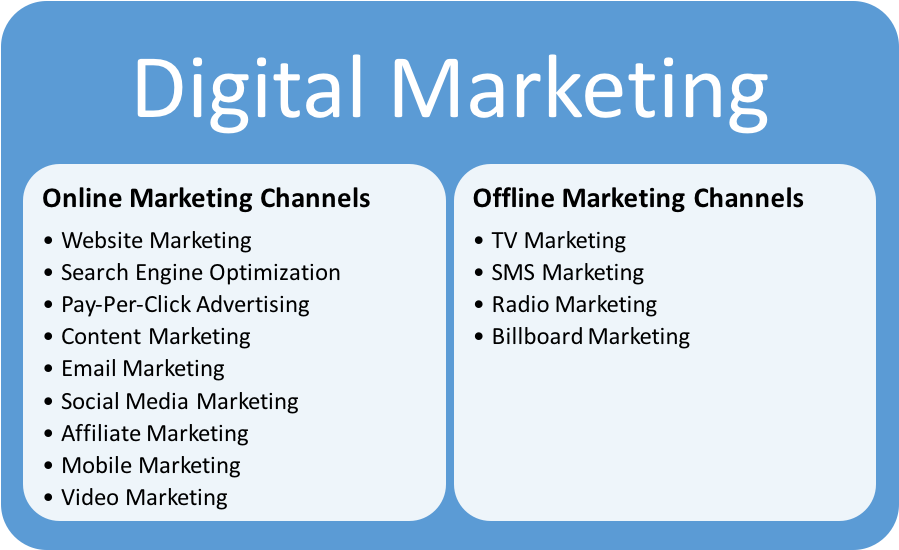
Digital marketing isn't just one thing; it's an umbrella term for many different strategies and channels. Each channel has its own strengths and is used to reach customers in different ways. Here are a few of the most important ones.
SEO
noun
Search Engine Optimization. The process of improving your website to increase its visibility when people search for products or services related to your business in Google, Bing, and other search engines.
While SEO focuses on unpaid traffic, its counterpart focuses on paid ads.
SEM
noun
Search Engine Marketing. A digital marketing strategy used to increase the visibility of a website in search engine results pages through paid advertising.
Beyond search engines, creating valuable content is another crucial channel.
Content Marketing
noun
A marketing strategy focused on creating and distributing valuable, relevant, and consistent content to attract and retain a clearly defined audience — and, ultimately, to drive profitable customer action.
Other major channels include Social Media Marketing (using platforms like Facebook, Instagram, and LinkedIn to connect with your audience), Email Marketing (communicating with customers through email), and Affiliate Marketing (partnering with others to promote your products for a commission).
The most effective strategies often combine several of these channels. For example, a great blog post (content marketing) can be promoted on social media and discovered through SEO.
Understanding these basics is the first step. By knowing what digital marketing is and the tools it uses, you can start to see how businesses connect with people in the modern world.
What is the primary characteristic that defines digital marketing?
A key advantage of digital marketing over traditional marketing is its ability to be highly targeted and measurable.