Digital Marketing Essentials
Introduction to Digital Marketing
What Is Digital Marketing?
Simply put, digital marketing is any marketing effort that uses an electronic device or the internet. It's how businesses connect with current and potential customers through digital channels.
Think of it like this: traditional marketing is like shouting from a rooftop, hoping the right people hear you. Digital marketing is more like having a quiet conversation with someone you know is already interested in what you have to say. It uses online platforms to promote products, services, and brands.
Digital vs. Traditional Marketing
For a long time, marketing was dominated by print ads in magazines, commercials on TV, and billboards on the side of the road. This is traditional marketing. It casts a wide net, but it's hard to know exactly who you're reaching or how effective your message is.
Digital marketing changed the game. Instead of a one-way broadcast, it's a two-way street. Companies can interact with their audience, get immediate feedback, and tailor their message to very specific groups of people. The biggest difference is the ability to track and measure results with incredible precision.
| Feature | Traditional Marketing | Digital Marketing |
|---|---|---|
| Audience | Broad, general | Specific, targeted |
| Interaction | One-way communication | Two-way conversation |
| Cost | Often high with uncertain ROI | More cost-effective, clear ROI |
| Measurement | Difficult to track results | Easy to measure and analyze |
Key Channels
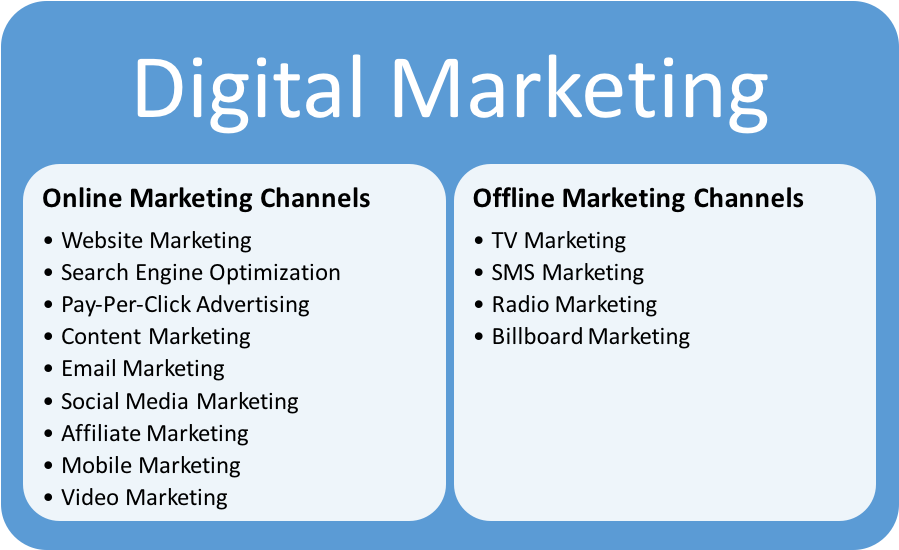
Digital marketing isn't just one thing; it's a collection of different strategies and channels working together. Here are a few of the most important ones.
Search Engine Optimization
noun
The practice of increasing the quantity and quality of traffic to your website through organic (non-paid) search engine results.
Search Engine Marketing (SEM) Also known as pay-per-click (PPC) advertising, SEM involves paying for ads to appear on search engine results pages. Unlike SEO, which earns you a spot through quality content, SEM buys you a spot at the top.
Social Media Marketing This involves using social media platforms like Instagram, Facebook, and LinkedIn to build a brand, drive website traffic, and generate sales. It's about meeting your customers where they spend their time online.
Email Marketing This is one of the oldest forms of digital marketing, and it's still one of the most effective. It involves sending promotional messages or newsletters to a list of subscribers to nurture relationships and encourage repeat business.
Content Marketing This strategy focuses on creating and distributing valuable, relevant, and consistent content—like blog posts, videos, or podcasts—to attract and retain a clearly defined audience. The goal is to provide value first, which builds trust and authority.
These channels rarely work in isolation. A great blog post (content marketing) can be promoted with ads (SEM), shared on Twitter (social media marketing), and sent to your subscribers (email marketing).
Why Bother with Digital?
The shift to digital isn't just a trend; it's a fundamental change in how businesses operate. The benefits are significant.
First, digital marketing allows businesses to reach a massive audience. Your market is no longer limited to your city or country. More importantly, you can target specific demographics, interests, and behaviors, ensuring your message reaches the people most likely to be interested.
Second, every aspect of a digital marketing campaign can be measured. You can see how many people saw your ad, clicked on it, and then made a purchase. This data allows you to understand what's working and what isn't, so you can adjust your strategy in real-time. This level of insight is nearly impossible to achieve with a newspaper ad.
Finally, digital marketing is often more affordable than traditional methods, making it accessible for businesses of all sizes. This levels the playing field, allowing small companies to compete with large corporations for customer attention.
Ready to check your understanding?
What is the primary characteristic that defines digital marketing?
Which of the following is described as a key advantage of digital marketing over traditional marketing?
By leveraging these channels and understanding its core benefits, businesses can create powerful, measurable strategies to grow and connect with their audience in the digital age.