Digital Marketing Essentials
Introduction to Digital Marketing
What Is Digital Marketing?
At its core, digital marketing is simply marketing that uses electronic devices and the internet. It's how businesses use digital channels like search engines, social media, email, and their websites to connect with current and prospective customers.
If marketing is about connecting with your audience in the right place and at the right time, then today, you need to meet them where they are already spending time: online.
Think about the last time you wanted to buy something. Did you see a commercial on TV, or did you search for it on Google? Did you read a magazine ad, or did you see a post about it from an influencer on Instagram? Chances are, your journey started online. Digital marketing encompasses all of these online efforts, from your company's website itself to your online branding assets like digital advertising, email marketing, and social media.
How It All Began
Digital marketing wasn't born overnight. Its roots trace back to the early 1990s when the internet started becoming more accessible to the public. The very first clickable banner ad went live in 1994, and it was a game-changer. For the first time, advertisers could get a rough idea of how many people saw and interacted with their ads.
Then came the search engines. In the late '90s, companies like Yahoo! and Google emerged, creating a new way for people to find information. This gave rise to search engine optimization (SEO) and search engine marketing (SEM), as businesses realized they needed to be visible on these platforms to get found. The 2000s brought the social media explosion with platforms like Facebook, Twitter, and LinkedIn, opening up direct lines of communication between brands and consumers. The landscape has been evolving ever since.
Digital vs. Traditional Marketing
Traditional marketing includes things like print ads in magazines, billboards, TV commercials, and radio spots. For decades, this was the only way to reach a broad audience. While it can still be effective, digital marketing offers several distinct advantages. The key differences lie in targeting, measurement, and interaction.
| Feature | Traditional Marketing | Digital Marketing |
|---|---|---|
| Audience | Broad, often untargeted (e.g., all viewers of a TV show) | Highly specific (e.g., targeting by age, location, interests) |
| Measurement | Difficult to track direct results (e.g., how many people bought after seeing a billboard) | Precise and measurable (e.g., track clicks, views, conversions) |
| Interaction | One-way communication (brand to consumer) | Two-way conversation (brands and consumers can interact) |
| Cost | Often requires a large upfront budget | Can be very cost-effective and scalable for any budget |
Imagine a local bakery. They could take out a newspaper ad (traditional) and hope that some readers are interested in cakes. Or, they could run a targeted Facebook ad (digital) shown only to people within a 5-mile radius whose birthday is in the next week. Digital marketing allows for a level of precision that traditional methods can't match.
The Digital Marketing Toolbox
Digital marketing isn't just one thing; it's a collection of different channels and tactics. A good strategy often uses a mix of these tools, each serving a unique purpose. Think of it like a toolbox, where you pick the right tool for the job.
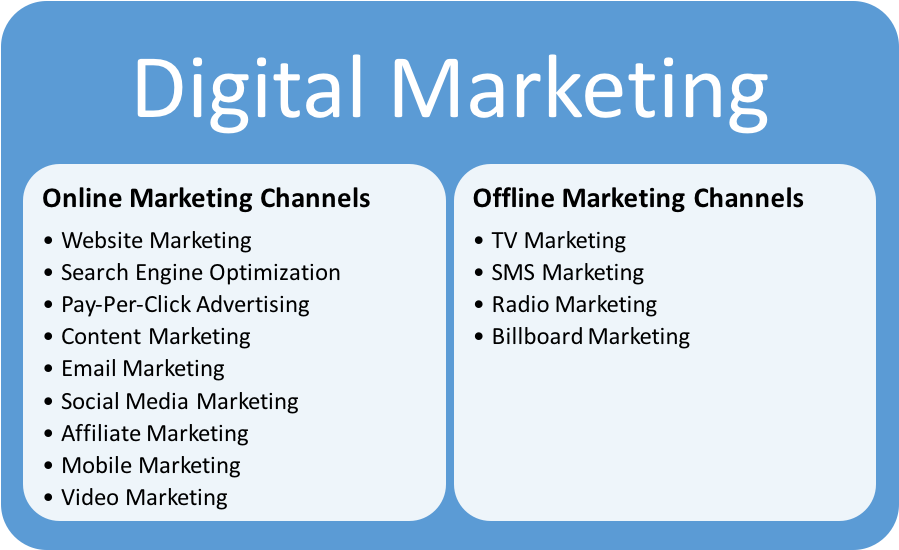
Here are some of the most common channels:
- Search Engine Optimization (SEO): This is the process of optimizing your website to rank higher in search engine results pages, thereby increasing the amount of organic (free) traffic your website receives.
- Search Engine Marketing (SEM): This is a broader term that includes SEO but also encompasses paid advertising on search engines, like Google Ads. You pay to have your website appear at the top of the search results for specific keywords.
- Social Media Marketing: This involves promoting your brand and content on social media channels like Facebook, Instagram, Twitter, and LinkedIn to increase brand awareness, drive traffic, and generate leads.
- Email Marketing: This is a way of communicating with your audience directly through email. It's often used to promote content, discounts, and events, as well as to direct people toward the business's website.
- Content Marketing: This is a strategic approach focused on creating and distributing valuable, relevant, and consistent content to attract and retain a clearly defined audience. Examples include blog posts, videos, and infographics.
To excel in digital marketing, the first step is to truly understand your audience.
Ultimately, the goal of using these channels is to build a strong online presence, connect with the right customers, and drive business growth. By understanding these foundational concepts, you can begin to see how the pieces fit together to create a powerful marketing strategy.