Diffusion Models for Niche Chemistry Data Needs
Introduction to Diffusion Models
What Are Diffusion Models?
Imagine a sculptor who starts with a formless block of marble and chips away until a statue emerges. Diffusion models work a bit like that, but in reverse. They start with pure randomness—digital noise—and methodically refine it step-by-step to create something new and coherent, like an image, a sentence, or a molecular structure.
Think of diffusion models like a sculptor working in reverse.
At their core, diffusion models are a type of generative model. Their job is to learn the underlying patterns and structure of a dataset they are trained on, such as a collection of chemical compounds. Once trained, they can generate entirely new examples that are statistically similar to the original data but are not simple copies.
Generative Model
noun
An artificial intelligence model that learns the patterns from a set of input data in order to create new, synthetic data that has similar characteristics.
This ability to produce high-quality, diverse outputs has made them a leading technology in artificial intelligence, powering everything from text-to-image generators to advanced scientific discovery tools.
How They Work A Two-Step Dance
The magic of diffusion models comes from a two-part process. First, a simple, fixed process systematically destroys data by adding noise. Then, a powerful, learned process carefully reverses the damage to create new data from scratch.
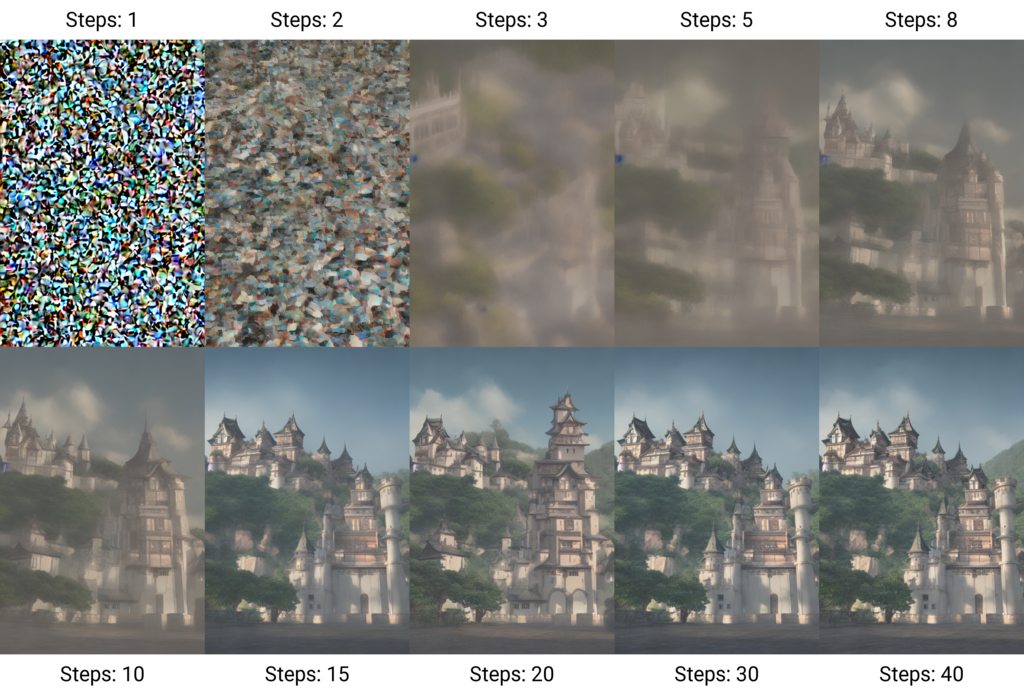
Let's break down these two key stages.
The Forward Process (Diffusion)
This is the noising step. We take a clean piece of data, like a clear picture of a molecule, and add a tiny amount of random (Gaussian) noise to it. We repeat this process over and over, hundreds or even thousands of times. With each step, the image becomes slightly more corrupted, until it is completely indistinguishable from pure static. This process is predictable and doesn't involve any learning; we just need to know how much noise we're adding at each step.
This formula shows how a slightly noisy sample is created from the previous sample . The term controls the amount of noise, , added at each step . The model keeps a record of this schedule.
The Reverse Process (Denoising)
This is where the learning happens. The goal is to train a neural network to undo the forward process. The model is given a noisy sample from one of the intermediate steps and is asked to predict the noise that was added to it. By subtracting this predicted noise, the model can take a small step backward toward the original, clean data.
The model learns to predict the noise, not the final image directly. By removing the predicted noise, it refines the data one step at a time.
To generate something new, we simply give the trained model a completely random field of noise and ask it to start denoising. Since the model has learned the patterns of the original dataset, it will guide the noise, step by step, until it settles into a coherent new structure that looks like it belongs in the training data.
Applications in Chemistry
While generating artistic images is a popular application, the true power of diffusion models extends into complex scientific domains like chemistry. Here, they are not just creating pictures, but designing functional new things at the molecular level.
One of the most exciting frontiers is de novo drug design. This means designing a brand-new molecule from scratch that has specific properties to treat a disease.
A diffusion model can be trained on a vast database of known molecules. It learns the fundamental rules of chemical bonding and structure—what makes a molecule stable and
Possessing properties making it suitable for a medication
Once trained, chemists can guide the generation process by providing a set of desired properties, such as the ability to bind to a specific protein target. The model then generates novel molecular structures that fit these criteria, vastly accelerating the search for new medicines.
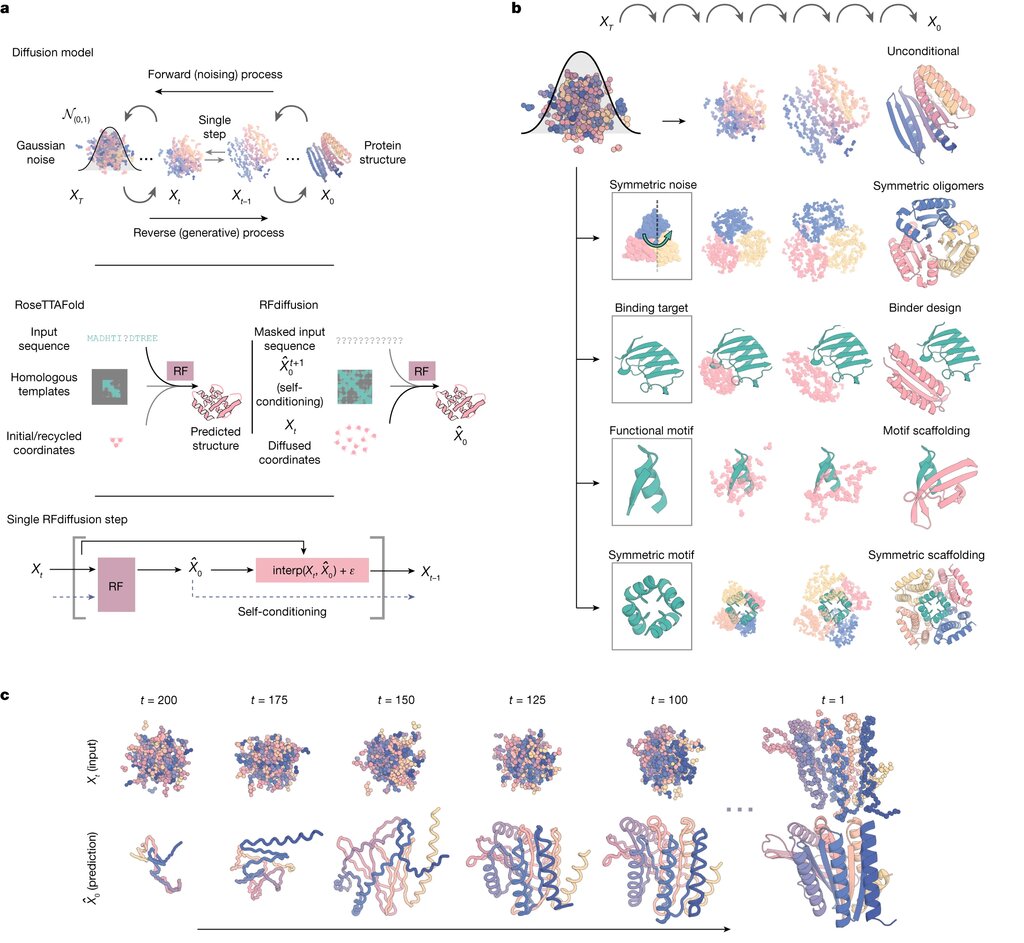
Beyond small molecules, diffusion models are also being used to design large, complex proteins. Proteins are the workhorses of biology, and designing new ones with specific functions—like enzymes that can break down plastics—has enormous potential. By learning from the structures of millions of existing proteins, diffusion models can generate blueprints for entirely new ones that have never been seen in nature.
The core process of a diffusion model is best described as:
True or False: The 'forward process' in a diffusion model involves a neural network learning how to best add noise to an image.
By starting with randomness and carefully applying learned rules, diffusion models offer a powerful new way to explore the vast landscape of chemical possibilities, accelerating discovery in medicine, materials science, and beyond.