Diffusion Models Explained
Introduction to Diffusion Models
Creating with Chaos
Imagine dropping a bit of food coloring into a glass of water. At first, it's a concentrated dot, but it slowly spreads out, or diffuses, until the water is a uniform, faint color. Now, what if you could perfectly reverse that process? You could start with faintly colored water and watch as all the dye particles gathered back into a single, sharp drop. This is the core idea behind diffusion models in AI.
Diffusion models are a type of generative AI that creates new data, like images, by reversing a process of controlled destruction. It works in two main phases:
-
Forward Process (Adding Noise): The model takes a clean image from a training dataset and gradually adds a tiny amount of random noise to it, step by step. It repeats this process until the original image is completely unrecognizable, just a canvas of static.
-
Reverse Process (Removing Noise): This is where the magic happens. The model learns how to undo the noise-adding process. It starts with a completely random, noisy image and, step by step, carefully removes the noise. Because it has learned the patterns from the training data, the noise it removes isn't random. It carves away the chaos to reveal a brand-new, coherent image that looks like it could have been part of the original dataset.
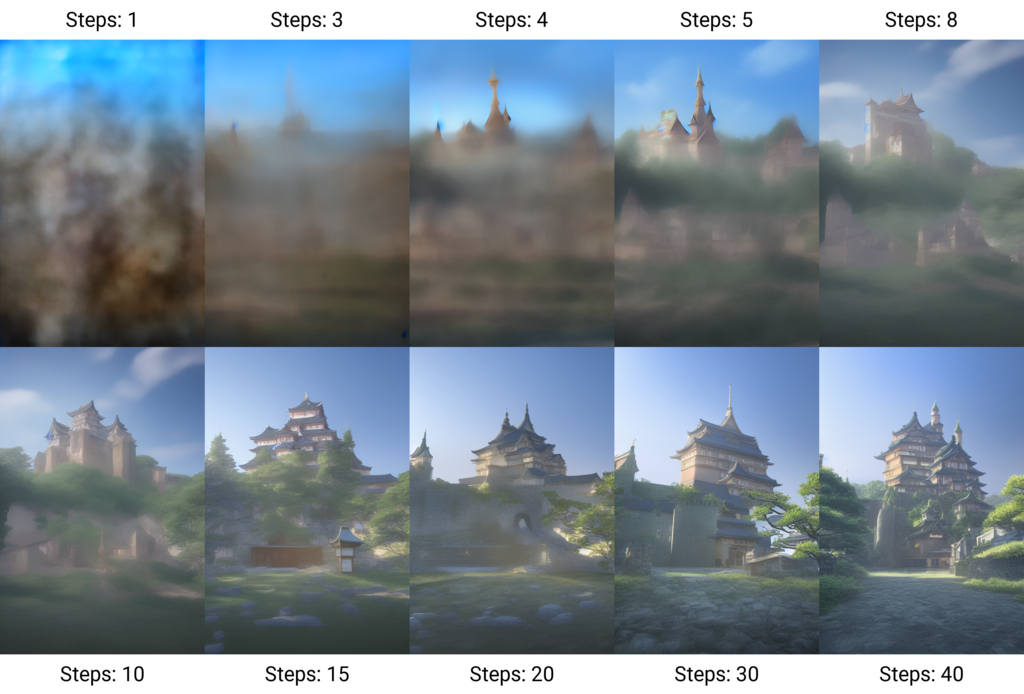
This method is inspired by non-equilibrium thermodynamics in physics, which studies how systems move from order to disorder. By learning to reverse this path, AI can generate incredibly detailed and realistic images, which is why it powers popular tools like Stable Diffusion and Midjourney.
A New Kind of Digital Artist
The most well-known application of diffusion models is generating images from text prompts. But their ability to manipulate noise makes them versatile for other tasks. They can be used for upscaling low-resolution images into high-definition ones, or for inpainting, which is filling in missing parts of an image. They can even do the opposite, called outpainting, to extend the borders of an existing picture.
This level of control gives artists and creators powerful tools. Instead of starting from scratch, they can guide the AI to modify, enhance, or build upon existing visuals. But how do these models stack up against other generative AI techniques?
Diffusion models are not the only way to generate images. Two other major types are Generative Adversarial Networks (GANs) and Variational Autoencoders (VAEs).
GANs feature a competition between two neural networks: a Generator that creates images and a Discriminator that tries to spot the fakes. VAEs learn a compressed, simplified representation of the training data and then use it to generate new samples. Each has its own strengths and weaknesses.
| Model Type | How It Works | Strengths | Weaknesses |
|---|---|---|---|
| Diffusion Models | Learns to reverse a noise-adding process. | High-quality, diverse images. | Slower generation process. |
| GANs | Two networks (Generator, Discriminator) compete. | Fast generation; sharp images. | Can be unstable to train; less diversity. |
| VAEs | Encodes data to a compressed form, then decodes. | Stable training; good for latent space control. | Often produces blurrier, less realistic images. |
Diffusion models have become popular because they often produce higher-quality and more varied results than their predecessors, even if they take a bit longer to generate an image. This trade-off has proven worthwhile for many applications, from creating digital art to generating synthetic data for training other AIs.
Let's check your understanding of these creative AI models.
What is the fundamental principle behind how diffusion models generate new images?
The process where a diffusion model adds noise to an image is called the ______ process, while the process of removing noise to create an image is called the ______ process.
The step-by-step denoising process allows for a level of detail and realism that has pushed the boundaries of what people thought AI could create.