Diffusion Language Models Explained
Introduction to Diffusion Models
Starting from Noise
Generative AI models are designed to create new, original content. One powerful type is the diffusion model. At its core, a diffusion model works by learning to reverse a process of destruction. It takes a clear piece of data, like an image, and systematically adds noise to it until nothing but static remains. Then, it learns how to undo that process, step by step. By mastering the art of denoising, the model can start with pure random noise and gradually sculpt it into a completely new, coherent image.
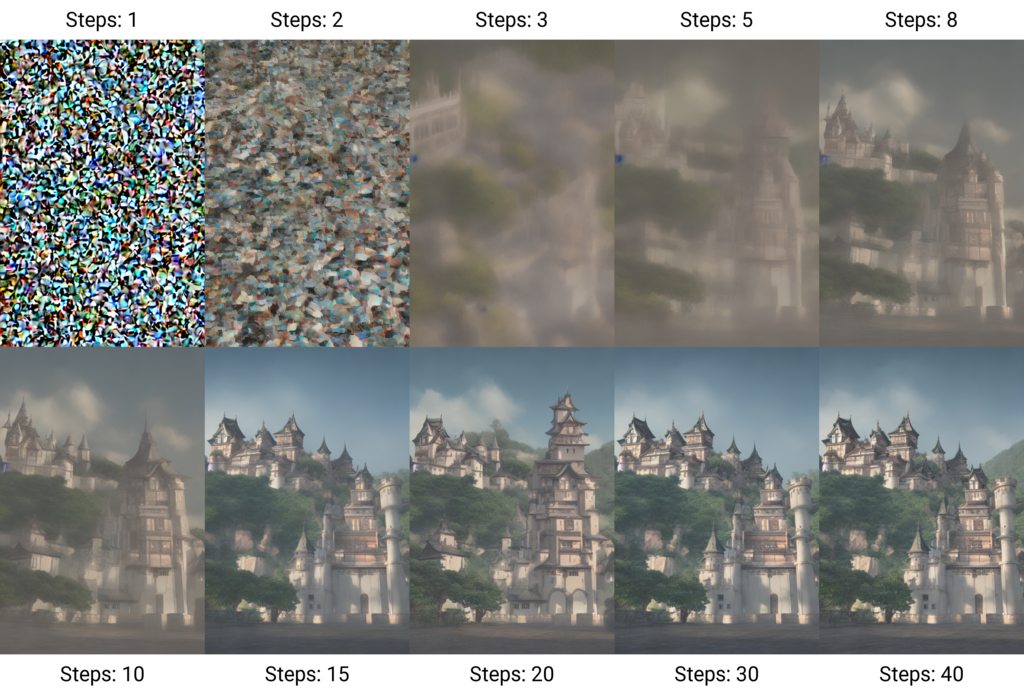
Think of it like watching a video of a glass shattering, but in reverse. The model learns how the shards of glass fly back together to form the original object. Once it understands this process perfectly, it can start with a random arrangement of shards and form a brand new glass. This method has proven to be incredibly effective at producing high-quality, detailed results.
The Two-Step Process
The magic of diffusion models comes from two distinct phases: the forward process and the reverse process. The model first observes the forward process to learn, and then uses the reverse process to generate.
Forward Process: Adding noise to corrupt data. Reverse Process: Removing noise to generate data.
In the forward process, we take a clear, structured piece of data (). We then add a small amount of random (Gaussian) noise to it. We repeat this over many timesteps (). With each step, the data becomes slightly more corrupted, until eventually, after a large number of steps, it is indistinguishable from pure noise. This process is fixed; we don't learn anything here. We're just creating the examples the model will learn from.
Math in a Nutshell
We don't need to dive deep into the math, but a simple formula helps clarify the forward process. At each step , we create a new noisy image from the previous one using a predefined schedule. A simplified way to write this is:
Here, is random noise, and is a small number that controls how much noise is added at each step. During training, the model's job is to learn to predict the noise from the noisy data . If it can do that accurately, it can reverse the equation and recover a slightly less noisy version of the data. Repeating this is how generation works.
How They Compare
Diffusion models are not the only type of generative model. Two other popular types are Generative Adversarial Networks (GANs) and Variational Autoencoders (VAEs). Each has its own approach.
| Model Type | How It Works | Strengths & Weaknesses |
|---|---|---|
| Diffusion Models | Learns to reverse a process of adding noise. | Strengths: High-quality output, stable training. Weaknesses: Slow generation process. |
| GANs | Two models, a generator and a discriminator, compete against each other. | Strengths: Fast generation, sharp results. Weaknesses: Unstable training, mode collapse. |
| VAEs | Encodes data into a compressed latent space and then decodes it back. | Strengths: Stable training, meaningful latent space. Weaknesses: Often produces blurrier results. |
While GANs were once the state-of-the-art for image generation, their training process can be notoriously difficult to manage. Diffusion models, while computationally intensive, are much more stable to train and have recently surpassed GANs in their ability to generate diverse and high-fidelity images.
Now that we understand the core mechanics, we can explore how these principles are applied to language.