Diffusion Language Models Explained
Introduction to Diffusion Models
What Are Diffusion Models?
Diffusion models are a type of generative AI. Their goal is to create new data, like images or sounds, that looks like the data they were trained on. Think of it like a sculptor who starts with a block of marble and slowly chips away stone to reveal a statue. Diffusion models work in a similar way, but in reverse. They start with pure random noise and gradually refine it into a coherent piece of data.
This process is powerful because it breaks down a very hard problem, creating something from nothing, into a series of much smaller, manageable steps. Instead of making a masterpiece in one giant leap, the model learns to make tiny improvements, step-by-step, turning chaos into order.
The Forward Process: Adding Noise
The first part of training a diffusion model is the forward process. It might seem counterintuitive, but to learn how to create, the model first learns how to destroy. We start with a piece of clean data, like a clear photograph, and systematically add a small amount of random noise over many steps. We keep adding noise until the original image is completely lost, leaving behind only static.
This forward process is mathematically simple. At each step, we're just adding a bit of what's called Gaussian noise. Think of it as the static on an old TV screen. We have a fixed recipe, or schedule, for how much noise to add at each step, so the process is predictable. We can calculate exactly what the noisy image should look like at any step based on the original image .
This formula describes how to get from one step to the next. Here, is the data at the previous step, and is the data at the current step. The means we're adding Gaussian noise. The amount of noise is controlled by a small number, (beta), which we set in advance. The key takeaway is that this is a well-defined, straightforward process.
The Reverse Process: Learning to Denoise
This is where the real learning happens. The model's job is to learn how to reverse the forward process. It needs to take a noisy image and figure out how to remove just a little bit of the noise to make it slightly cleaner. By repeating this process over and over, it can start with pure static and end up with a brand new, clean image.
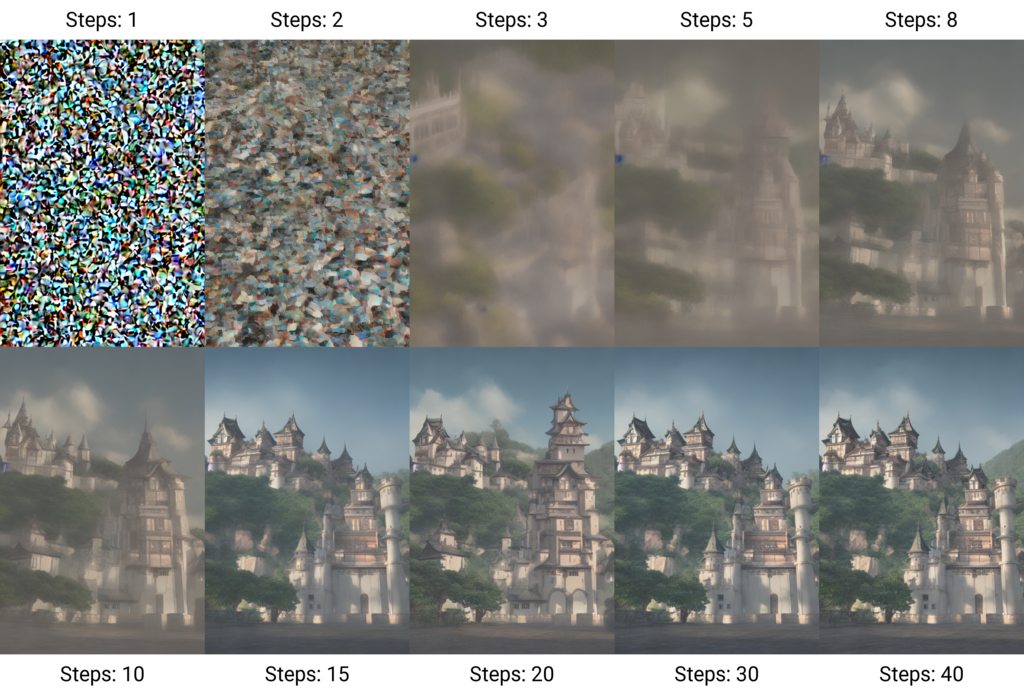
To do this, we train a neural network. We give the network a noisy image from the forward process (say, ) and tell it what step () the image is from. The network's task is not to guess the final clean image, but simply to predict the noise that was added to create . If the model can predict the noise accurately, we can subtract it from the image to get a slightly less noisy version, .
The model doesn't learn to create an image directly. It learns to predict and remove noise.
The mathematical goal is to approximate the reverse step, which we can write as . The (theta) represents the parameters of our neural network that we are training. The network learns these parameters by looking at thousands of examples from the forward process and trying to minimize the difference between the noise it predicts and the actual noise that was added.
Once trained, the model can generate new data. We give it a random noise image and ask it to perform the denoising process from step all the way back down to step 0. Each step refines the image based on what the model learned about the structure of the training data, ultimately producing a novel creation.
Time for a quick check on these core concepts.
What is the primary goal of the forward process in training a diffusion model?
During the reverse process, the neural network's main task is to predict the ________ that was added to the noisy image.
Understanding the forward and reverse processes is the key to diffusion models. This dual process of controlled destruction and learned reconstruction is what allows them to generate such detailed and high-quality results.