Dialogic and Collaborative Learning
Introduction to Dialogic and Collaborative Learning
Learning Is a Team Sport
Think about how we learn outside of a classroom. We talk to friends, debate ideas, and work on projects with others. Learning is naturally social. Two powerful approaches, dialogic and collaborative learning, bring this social dynamic into education. They shift the focus from a teacher simply telling students information to students building knowledge together.
The Power of Conversation
Dialogic learning is more than just a classroom discussion. It's a structured, meaningful conversation where everyone works together to build understanding. Imagine building a complex model with friends. One person adds a piece, another suggests a better way to connect it, and a third points out something everyone missed. Through this back-and-forth, you create something far better than any one person could have alone. That's the essence of dialogic learning.
Dialogue
noun
A type of conversation where participants explore ideas openly, listen to understand, and build on each other's contributions to reach a deeper, shared meaning.
This idea has deep roots. Thinkers like Mikhail Bakhtin emphasized that we find meaning through our interactions with others. Educator Paulo Freire used dialogue to empower learners to think critically about their world. The goal isn't to win a debate or find a single right answer. Instead, it's to explore different perspectives, challenge assumptions, and construct knowledge as a group. This process teaches students how to think, not just what to think.
In dialogic learning, questions are often more valuable than answers because they open up new paths for exploration.
Stronger as a Team
Collaborative learning happens when students work together in small groups to achieve a shared goal. This could be solving a math problem, analyzing a poem, or designing a science experiment. It's a move away from the traditional model of students working silently and competing with one another.
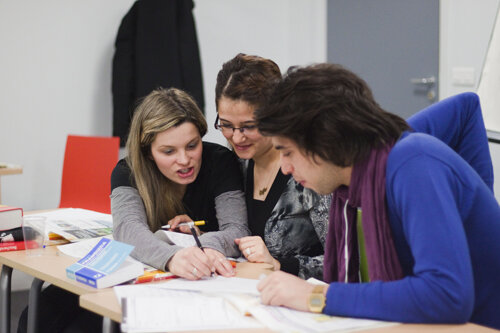
The psychologist Lev Vygotsky argued that learning is fundamentally social. He introduced the idea of the "zone of proximal development," which is the sweet spot between what a learner can do alone and what they can achieve with guidance from a peer or teacher. Collaborative learning creates the perfect environment for this to happen. Students teach each other, fill in gaps in one another's understanding, and tackle problems that would be too difficult to face alone.
SE educators can use Collaborative Learning (CL) to help students develop collaboration skills.
When students learn dialogically and collaboratively, the benefits are clear. They develop stronger communication and critical thinking skills. They learn to value different viewpoints and navigate disagreements respectfully. This approach doesn't just prepare them for a test; it prepares them for a world where teamwork and communication are essential for success.
Time to check your understanding of these foundational concepts.
What is the primary aim of dialogic learning?
The concept of the "zone of proximal development," which is central to collaborative learning, was introduced by which psychologist?
These two approaches provide a foundation for creating more engaging and student-centered learning environments. By understanding their core principles, educators can begin to transform their classrooms into active, social spaces for learning.