Dialectical Behavior Therapy Skills
Introduction to DBT
What Is Dialectical Behavior Therapy?
Dialectical Behavior Therapy, or DBT, is a type of talk therapy developed in the late 1980s by psychologist Dr. Marsha Linehan. She originally designed it to help people who experience emotions with overwhelming intensity, particularly those diagnosed with borderline personality disorder. Dr. Linehan found that traditional cognitive-behavioral approaches weren't enough. Her clients needed something more—a way to accept their intense feelings while also learning skills to change their responses to them.
This led to a new kind of therapy that blends established techniques for change with powerful concepts of acceptance, drawn largely from mindfulness practices.
The Core Idea: A Balancing Act
The key to understanding DBT is in its name. The word "dialectical" means bringing together two things that seem like opposites. In DBT, the central dialectic is the balance between acceptance and change. It's the idea that you can fully accept yourself in this moment, while also working to change your behaviors and build a better life.
The core message is: You are doing the best you can, and you can do better.
This balance is crucial. Pushing for change without acceptance can feel invalidating and lead to shame. On the other hand, acceptance without change can lead to feeling stuck. DBT creates a middle path by weaving together cognitive-behavioral techniques (focused on change) with mindfulness practices (focused on acceptance).
The Four Skill Sets
DBT is a skills-based therapy. It teaches practical ways to navigate difficult emotions and situations. These skills are organized into four main modules, each addressing a different aspect of emotional and social functioning.
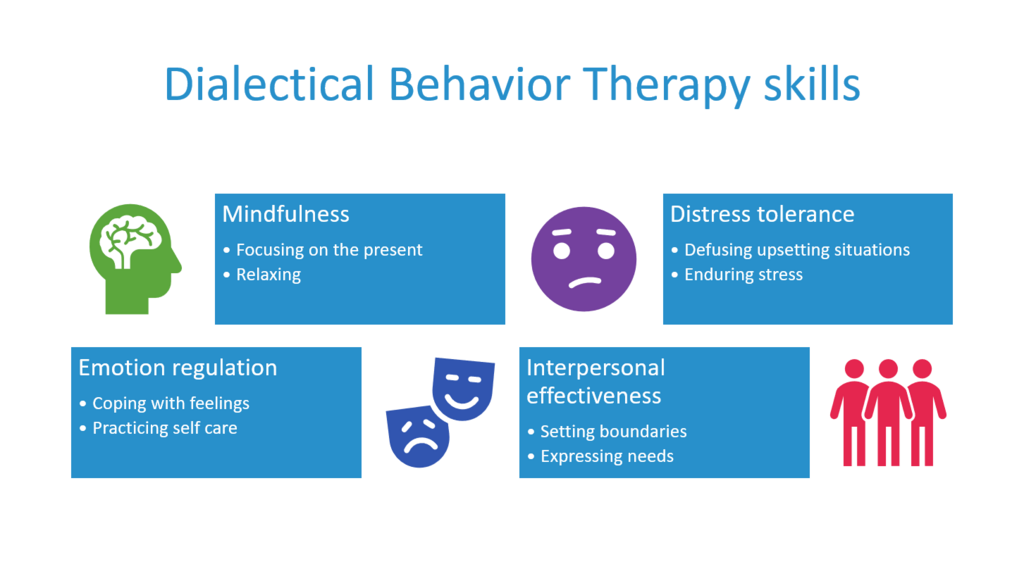
Here's a quick look at what each module covers.
| Module | Primary Goal |
|---|---|
| Mindfulness | To increase awareness of the present moment without judgment. This is the foundation for all other DBT skills. |
| Distress Tolerance | To get through crisis situations without making them worse. These are skills for surviving immediate pain. |
| Emotion Regulation | To understand, manage, and change intense emotions in a way that is helpful, not harmful. |
| Interpersonal Effectiveness | To build and maintain healthy relationships, communicate your needs, and say no effectively. |
These modules provide a toolkit for building a life that feels more manageable and meaningful, even when faced with significant emotional challenges.
With DBT, you’ll learn to use four core skills, sometimes called modules, to cope with emotional distress in positive, productive ways.
By learning to balance acceptance with change, individuals can develop new ways of relating to their emotions, their relationships, and themselves.