DevOps Fundamentals
Introduction to DevOps
What is DevOps?
At its heart, DevOps is a way of working that brings together two traditionally separate teams: software development (Dev) and IT operations (Ops). The goal is to shorten the time it takes to get an idea from a developer's mind to a customer's hands, without sacrificing quality or stability.
Imagine one team designs a high-performance race car, and a completely different team is responsible for driving and maintaining it. The design team might create a car that's incredibly fast but difficult to repair. The driving team might complain, but the message gets lost because they don't speak the same language or share the same goals. This separation creates friction and slows everything down.
In software, developers were the designers, focused on building new features. Operations were the drivers, focused on keeping the system running smoothly. DevOps gets them working together on the same team, with a shared goal: delivering a great product to users, fast and reliably.
DevOps
noun
A set of practices that combines software development (Dev) and IT operations (Ops) to shorten the systems development life cycle and provide continuous delivery with high software quality.
A Quick History
To understand why DevOps was needed, we have to look at how software used to be built. For a long time, the dominant method was the "Waterfall model." It was a slow, linear process where each step had to be completed before the next could begin. You'd gather all the requirements, then do all the design, then all the building, and finally, all the testing. This could take months or even years.
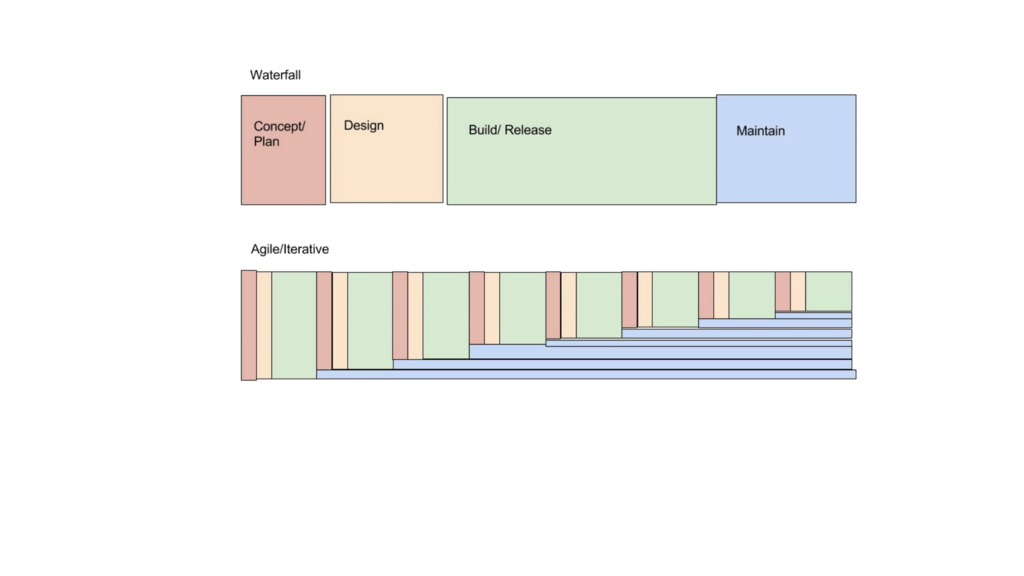
Then came the Agile methodology, which broke big projects into small, manageable pieces. Teams worked in short cycles, or "sprints," to build and release software incrementally. This was a huge improvement, allowing developers to move much faster and respond to change.
But a new problem emerged. Developers were churning out new code and features at a rapid pace, but the operations team, responsible for deploying and managing the software, couldn't keep up. They were still working in the old, slower way, focused on stability above all else. This created a major bottleneck, a classic "wall of confusion" between Dev and Ops. DevOps was born from the need to break down that wall and extend Agile principles to the entire delivery process.
Core Principles and Benefits
DevOps isn't a specific tool or piece of software; it's a philosophy built on a few key ideas:
- Break Down Silos: Development and operations teams work together, sharing responsibility for the software's entire lifecycle. This shared ownership improves communication and leads to better outcomes.
- Automate Everything: Repetitive, manual tasks are prone to human error. DevOps encourages automating processes like building, testing, and deploying software to make them faster, more consistent, and more reliable.
- Continuous Improvement: Teams are always looking for ways to improve their processes. They gather feedback, measure performance, and experiment with new approaches to get better over time.
- Focus on the Customer: The ultimate goal is to deliver value to the end user. By working more efficiently, teams can get features and fixes into the hands of customers faster.
Adopting these principles brings significant benefits. Businesses can release software more frequently, which means a faster time to market for new ideas. The improved collaboration leads to higher quality products with fewer bugs. And when problems do occur, teams can respond and recover much more quickly.
DevOps is a practice of delivering the software to the customer faster, reliably, scalable and also with almost no downtime.
It's a Culture Shift
More than anything, DevOps is a change in culture. It's about moving from a culture of blame and finger-pointing to one of shared responsibility and trust. Instead of developers throwing code "over the wall" to operations, everyone is on the same team, working towards the same objective.

This cultural shift requires a new mindset. It emphasizes learning from failure instead of punishing it. When something goes wrong, the question isn't "Whose fault is it?" but rather "What can we learn from this, and how can we prevent it from happening again?" This creates a safer environment for innovation and experimentation, empowering teams to build and deliver better software.
Ready to check your understanding of these core concepts?
What is the primary goal of the DevOps philosophy?
The "wall of confusion" that DevOps aims to break down refers to the conflict and lack of communication between which two teams?
By breaking down barriers and focusing on shared goals, DevOps helps teams build, test, and release software faster and more reliably. It's a fundamental change in how people work together to create value.