DevOps Fundamentals
Introduction to DevOps
The Wall of Confusion
In the not-so-distant past, software development often felt like a relay race with a very clumsy handoff. The development team would write code, bundle it up, and essentially throw it over a wall to the operations team. The developers’ job was done, and it was now up to operations to make the code run on live servers.
This created what many called the “wall of confusion.” When things broke, and they often did, the finger-pointing would begin. Developers would say, “It worked on my machine!” Operations would reply, “Well, your machine isn’t the production server!” Each team had different goals. Developers were pushed to create new features quickly, while operations focused on keeping the systems stable and reliable. These competing goals created friction, slowed down releases, and made fixing problems a painful, drawn-out process.
A New Way of Working
DevOps emerged as a way to tear down that wall. It isn't a specific tool or a job title, but a cultural philosophy and a set of practices that bring development (Dev) and operations (Ops) teams together. The goal is to shorten the software development lifecycle and deliver high-quality software more frequently and reliably.
DevOps (a portmanteau of “development” and “operations”) is an approach to IT delivery that combines people, practices and tools to break down silos between development and operations teams.
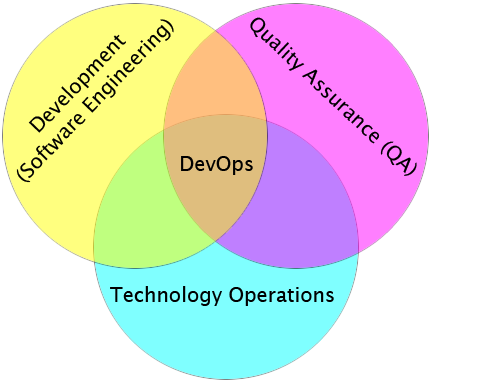
By combining these teams, along with Quality Assurance (QA), everyone shares responsibility for the software, from the first line of code to its performance in the hands of users. This shared ownership encourages communication and collaboration across the entire process.
Core Principles
DevOps is guided by a few key principles that help teams build and deliver better software, faster.
Collaboration and Shared Ownership: The foundation of DevOps is culture. Instead of separate teams with conflicting goals, DevOps creates a single, unified team. Developers, operations engineers, and QA analysts work together throughout the entire product lifecycle. They plan together, build together, and solve problems together.
Automation: Repetitive, manual tasks are prone to human error and slow things down. DevOps emphasizes automating as much of the development pipeline as possible. This includes building the code, testing it for bugs, and deploying it to servers. Automation frees up people to focus on more creative and complex tasks.
Continuous Improvement: DevOps is not a one-time fix. It’s a process of constantly looking for ways to improve. Teams regularly measure their performance, gather feedback, and experiment with new ideas to make their workflow faster, more efficient, and more reliable. This creates a cycle of learning and refinement.
Focus on Customer Value: Ultimately, the goal is to deliver value to the end user. By working together and releasing smaller updates more frequently, DevOps teams can get feedback from customers faster. This allows them to quickly adapt to changing needs and ensure they are building a product that people actually want to use.
The core idea is simple: break down barriers between teams to create a smoother, faster, and more reliable path from an idea to a working product.
Time to check what you've learned.
What primary problem in traditional software development did the DevOps philosophy emerge to solve?
Which of the following is NOT considered a core principle of DevOps?
By embracing this philosophy, organizations can respond more quickly to market changes and deliver better software to their users.