DevOps Artifact Creation
Introduction to DevOps
Breaking Down the Wall
In the past, software development and IT operations were often like two different teams playing for opposite sides. The development team (Dev) wanted to push out new features as quickly as possible. The operations team (Ops) wanted to keep everything stable and running smoothly, which meant resisting frequent changes. This often created a wall of confusion and conflict between the two.
DevOps is a set of practices and a cultural philosophy that tears down this wall. It combines software development (Dev) and IT operations (Ops) to shorten the development lifecycle and deliver high-quality software more frequently and reliably.
DevOps is a set of practices that combines software development (Dev) and IT operations (Ops) to shorten the software development lifecycle, deliver features, fixes, and updates frequently in close alignment with business objectives.
Instead of working in separate silos, Dev and Ops teams collaborate across the entire software lifecycle, from development and testing through deployment and operations. The goal is to create a seamless, automated workflow that improves both speed and quality.
The Engine of DevOps
At the heart of DevOps are two key practices: Continuous Integration (CI) and Continuous Delivery (CD). They form an automated pipeline that moves code from a developer's machine to the hands of users.
Continuous Integration
noun
The practice of developers frequently merging their code changes into a central repository. After each merge, an automated build and test are run.
Think of CI as having an expert check your work every time you add a new piece to a puzzle. Instead of waiting until the end to see if everything fits, you get immediate feedback. This allows teams to detect and fix problems early, when they're small and easy to manage.
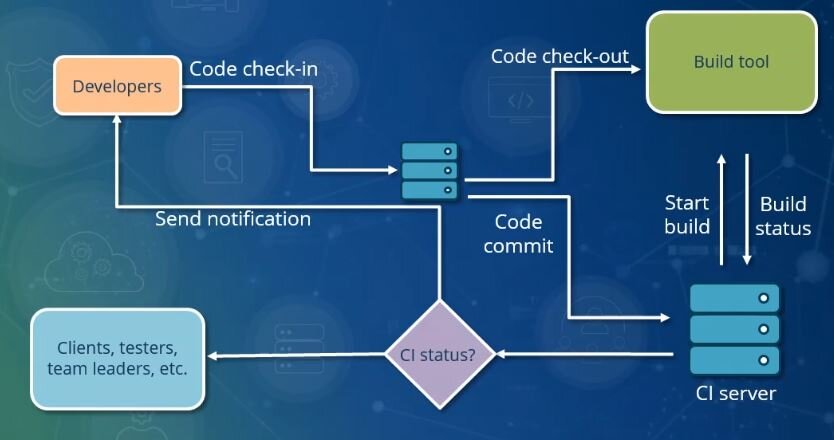
Continuous Delivery (CD) picks up where CI leaves off. Once the code has been successfully built and tested, CD automatically prepares it for release. The code is packaged and ready to be deployed to a production environment with the click of a button. It ensures that you always have a version of your software that is ready to be released.
A more advanced version of this is Continuous Deployment, where every change that passes all the automated tests is automatically deployed to production. There's no manual approval step.
More Than Just Tools
While automation is critical, DevOps is fundamentally about a change in culture and mindset. It's about breaking down silos and fostering a culture of collaboration and shared responsibility. Everyone on the team, from developers to operations engineers, is responsible for the product's success.
This culture is supported by several key technical practices:
- Version Control: Everything, from application code to configuration files, is stored and tracked in a version control system like Git. This creates a single source of truth.
- Infrastructure as Code (IaC): Servers, databases, and networks are provisioned and managed using code and automation, making the process repeatable and less error-prone.
- Monitoring and Feedback: Teams constantly monitor the performance of their application in production. This feedback helps them quickly identify and resolve issues, and it informs future development.
Now, let's check your understanding of these core concepts.
What is the primary cultural shift that DevOps promotes?
In the DevOps pipeline, what is the main purpose of Continuous Integration (CI)?
By embracing these principles, teams can move faster, experiment more, and deliver more value to their users. This collaborative, automated approach is the foundation upon which modern software is built.