Designing Interfaces for AI Agents
Introduction to Human-Computer Interaction
What is Human-Computer Interaction?
Human-Computer Interaction, or HCI, is the study of how people design, implement, and use interactive computer systems. It's a field that sits at the crossroads of computer science, psychology, and design. The main goal is simple: to make technology useful, usable, and enjoyable for people.
A basic goal of HCI is to improve the interactions between users and computers by making computers more usable and receptive to the user’s needs.
Think about the apps you use every day. Some feel intuitive and effortless, while others are confusing and frustrating. The difference often comes down to the quality of their HCI. Good design is often invisible; you only notice it when it's absent.
Interaction
noun
In HCI, this refers to any communication between a user and a computer system. It can be direct, like clicking a button, or indirect, like a smart thermostat adjusting the temperature based on your habits.
The scope of HCI is broad. It covers everything from the physical design of a mouse to the layout of a website, the sound a notification makes, and even the way a virtual assistant responds to your voice.
A Quick History of Interfaces
How we talk to computers has changed dramatically over the years. In the early days, interacting with a computer required specialized knowledge. You had to use punch cards or type cryptic commands into a command-line interface (CLI). These systems were powerful but unforgiving. A single typo could derail everything.
The big breakthrough came with the graphical user interface (GUI). Instead of typing commands, people could now point and click on icons, menus, and windows. The GUI used metaphors from the real world, like a desktop, folders, and a trash can, to make computing feel familiar and intuitive. This innovation opened up personal computing to a much wider audience.
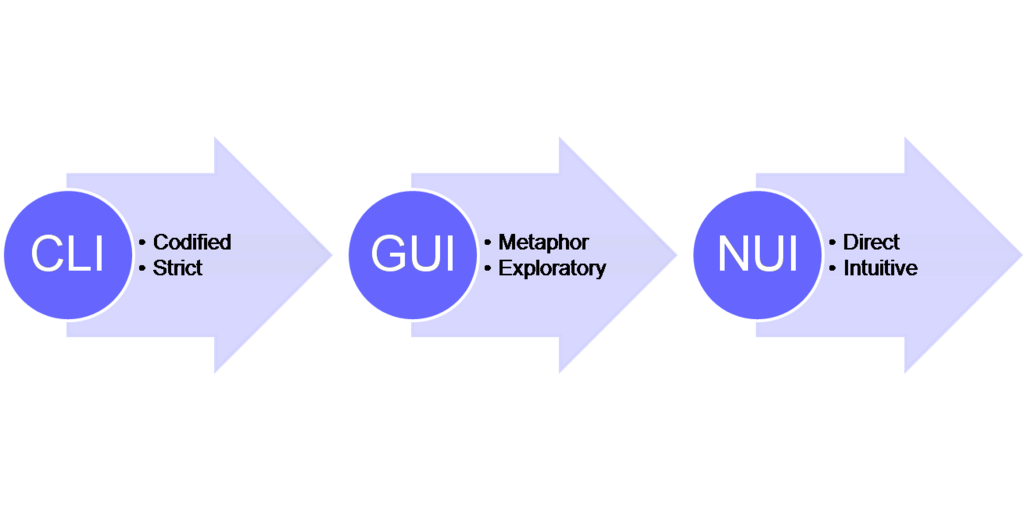
Today, we're moving toward natural user interfaces (NUIs), where the interaction is even more direct. Think of tapping and swiping on a smartphone, speaking to a voice assistant, or using hand gestures with a virtual reality system. The goal is to make the computer itself seem to disappear, so you can focus on your task, not the tool.
Designing for People
The most important principle in HCI is user-centered design. This is a philosophy that places the user, not the system, at the center of the design process. It means that to build a successful product, you must first deeply understand the people who will use it.
What are their goals? What is their background? In what environment will they be using the product? Answering these questions before writing a single line of code is crucial. It’s the difference between creating a tool that solves a real problem and one that just creates new ones.
User-centered design is a cycle: build a little, test it with real users, learn from their feedback, and then repeat. This iterative process is key to refining a product until it feels just right.
Part of designing for people means making technology accessible to everyone, including those with disabilities. Accessibility isn't an afterthought; it's a core component of good design. This involves practices like providing alternative text for images, ensuring high color contrast for readability, and making sure interfaces can be navigated using only a keyboard.
How the Mind Works
To design effective interfaces, we need to understand a bit about how the human brain processes information. Cognitive psychology provides valuable insights into our mental capabilities and limitations.
For example, we know that human short-term memory is limited. We can only hold about 5-9 items in our mind at once. This is why phone numbers are chunked into smaller groups. Good interface design respects this limit. It avoids making users remember information from one screen to another and keeps interfaces clean and uncluttered.
Human-Computer Interaction isn't just about making things look pretty—it's about understanding the cognitive, perceptual, and behavioral principles that determine whether users succeed or fail with a system.
Another key concept is cognitive load, which is the total amount of mental effort being used in working memory. A well-designed interface minimizes unnecessary cognitive load. It makes common tasks simple and presents information clearly, so users can focus on achieving their goals instead of figuring out how the interface works.
Fitt's Law is another principle from psychology that finds its way into HCI. It states that the time required to move to a target area is a function of the distance to the target and the size of the target. In simple terms, bigger buttons that are closer to the cursor are easier and faster to click. This is why important buttons are often large and placed in easily accessible corners of the screen.
Now, let's test your understanding of these foundational HCI concepts.
What is the core principle of user-centered design?
Which of the following lists computer interface types in the correct chronological order of development?
Understanding these core principles of HCI is the first step toward creating technology that truly serves people. It’s about building tools that are not only powerful but also intuitive, accessible, and a pleasure to use.