Designing Instructional Symbols
ISO 7010 Standards
The Grammar of Safety
In an emergency, clarity saves lives. There’s no time to decipher confusing instructions. This is why the International Organization for Standardization developed , a universal visual language for safety signs. It goes beyond just picking colors and pictures; it’s a strict system of geometric shapes and proportions that communicate specific types of messages instantly, regardless of language.
The system is built on a simple premise: shape dictates the category of the message. These shapes act as a container for a specific pictogram, and their form tells you how to react before you even process the symbol inside.
| Shape | Category | Meaning |
|---|---|---|
| Circle | Prohibition | STOP. An action is forbidden. |
| Circle | Mandatory | DO. An action is required. |
| Triangle | Warning | BEWARE. A potential hazard is near. |
| Square/Rectangle | Safe Condition / Information | GO/KNOW. Shows directions to safety or provides information. |
This framework ensures that a circular sign always conveys a command, either to do something or not to do something, while a triangle always signals a warning.
The Geometry of 'No'
Prohibition signs are perhaps the most critical. To ensure they are universally understood, ISO 7010 specifies their geometry with precision. A prohibition sign consists of a black pictogram on a white background, framed by a red circular band and a diagonal slash.
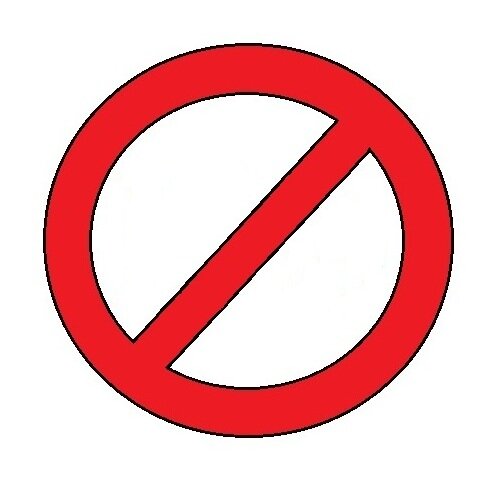
The geometry of this 'no' symbol is not arbitrary. The slash must be drawn from the upper-left to the lower-right at a perfect 45-degree angle relative to the horizontal. Its thickness is also defined: it must be 8% of the outer diameter of the red circle. The red circular band itself must have a thickness of 10% of that same outer diameter. These precise ratios ensure the sign is legible and its prohibitive nature is clear from a distance.
In contrast, mandatory action signs use a solid blue circle with a white pictogram. There is no slash. The message is a positive command: 'You must do this.' Think of 'Wear Hard Hat' signs on a construction site. The simple, bold blue circle signals a requirement.
🔵 Regulatory Signs ✔️ Green Circle = Permission ⛔ Red Circle/Slash = Prohibition 🔷 Blue Circle = Mandatory Action
Categorization and Legibility
To organize the vast library of safety symbols, ISO 7010 assigns a letter and number to each one. This reference code helps professionals select the correct sign for a specific need. The letter indicates the sign's category.
| Prefix | Category | Description |
|---|---|---|
| P | Prohibition | Signs that forbid an action (e.g., P002: No smoking). |
| M | Mandatory | Signs that require an action (e.g., M003: Wear hearing protection). |
| W | Warning | Signs that warn of a hazard (e.g., W001: General warning). |
| E | Emergency | Signs indicating emergency exits or first aid (e.g., E001: First aid). |
| F | Fire Safety | Signs related to firefighting equipment (e.g., F001: Fire extinguisher). |
This system, for example, classifies the 'no smoking' sign as P002 and the 'fire extinguisher' sign as F001. A project manager planning a new facility can simply reference these codes to ensure compliance. The combination of shape, color, and pictogram is governed by another standard, , which works in tandem with ISO 7010.
By following these strict geometric and categorical rules, safety professionals can create an environment where life-saving information is communicated instantly and without ambiguity.
Ready to check your understanding?
What is the primary purpose of the ISO 7010 standard?
According to the ISO 7010 system, what type of message does a circular shape convey?
Understanding these standards isn't just an academic exercise. It's about building a common language of safety that protects people everywhere.