Design Thinking for Future Cybersecurity
Design Thinking Basics
Solving Problems for People
How do you solve a problem you don't fully understand? You start by talking to the people who have it. This is the core idea behind design thinking. It's a method for creative problem-solving that focuses on the user's needs and experiences above all else.
Design thinking is a human-centered problem-solving methodology used to creatively tackle complex challenges.
Instead of jumping straight to solutions, design thinking forces you to slow down, ask questions, and truly understand the human perspective. It’s an iterative process, meaning you’ll cycle through the steps, refining your ideas as you learn more. It's less of a strict recipe and more of a flexible framework for innovation.
The Five Stages
The design thinking process is often broken down into five distinct stages. While they're presented in order, think of them as different modes of thinking you can move between as your project evolves. A key insight during the testing phase might send you right back to brainstorming, and that's a good thing.
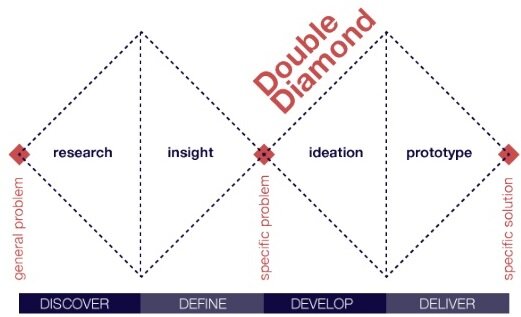
Let's walk through each stage.
1. Empathize This is the foundation. Your goal is to gain a deep, personal understanding of the people you’re designing for. This means observing them, engaging with them, and immersing yourself in their world. You’re looking to uncover not just what they need, but why they need it. Empathy is about setting aside your own assumptions to see the world through others' eyes.
Empathy is the essence of Design Thinking.
2. Define After gathering information in the empathize stage, you need to make sense of it. The define stage is where you analyze your observations and synthesize them to create a clear, actionable problem statement. This is often called a "point-of-view" statement. A well-defined problem statement gives you a clear target to aim for and provides a strong foundation for generating solutions.
3. Ideate Now it's time for creativity. The ideation stage is all about brainstorming. The goal is to generate a wide range of ideas, from the practical to the outlandish. This is not the time for judgment or analysis; it’s about quantity over quality. Techniques like brainstorming, mind mapping, and sketching can help you and your team explore the solution space broadly and come up with innovative approaches to your defined problem.
4. Prototype An idea is just an idea until you make it tangible. Prototyping is about building inexpensive, scaled-down versions of your solution. A prototype can be anything from a series of sketches or a role-playing activity to a simple physical model. The purpose isn't to create a finished product, but to create something users can interact with. This allows you to test your ideas quickly and cheaply, learning what works and what doesn't before investing significant time and resources.
5. Test With a prototype in hand, you go back to your users and get their feedback. This is a crucial learning opportunity. Observe how they use your prototype, listen to their thoughts, and ask clarifying questions. The goal is to refine your solution based on real user input. Often, the results of the testing phase will lead you to revisit earlier stages, like redefining the problem or generating new ideas.
A Flexible Mindset
It's important to remember that design thinking is not a rigid, linear path. It's a cyclical and iterative mindset. You might test a prototype and realize you need to redefine the problem entirely. You might be in the middle of ideation and discover you need more user empathy. This back-and-forth is natural and is what leads to truly innovative and human-centered solutions.
Design thinking is an iterative process.
By embracing this approach, you move from making assumptions about what people want to building solutions based on what they actually need.
Ready to check your understanding? Let's review the core concepts of design thinking.
What is the primary goal of the 'Empathize' stage in design thinking?
True or False: The design thinking process is a rigid, linear path that must be followed in a strict order from Empathize to Test.
Understanding these five stages gives you a powerful framework for tackling complex problems. By putting people at the center of the process, you can create solutions that are not only effective but also meaningful.