Design Thinking for Coastal Community Development
Introduction to Design Thinking
A Human-Centered Approach
Design thinking is a method for solving complex problems by focusing on people first. Instead of starting with a solution, it starts with understanding the needs, experiences, and emotions of the person you're trying to help. It's a creative and hands-on process that encourages us to challenge assumptions, explore new ideas, and learn through doing.
Design thinking provides a framework for decision-making and creating based on what is actually desired rather than on what has been done in the past or presumptions about what is wanted.
This approach is not just for designers. It's used in business, education, science, and community development to create innovative products, services, and systems. The core idea is simple: by deeply understanding the people we're designing for, we can arrive at solutions that are not only effective but also desirable and meaningful.
The Five Stages
The design thinking process is often broken down into five stages. Think of these not as a rigid checklist, but as a flexible, repeating cycle. You might jump between stages, revisit earlier ones, and loop through the process multiple times as you refine your ideas.
1. Empathize This is the foundation. It involves observing, engaging with, and immersing yourself in the user's world to understand their experiences and motivations. The goal is to set aside your own assumptions and gain real insight into theirs.
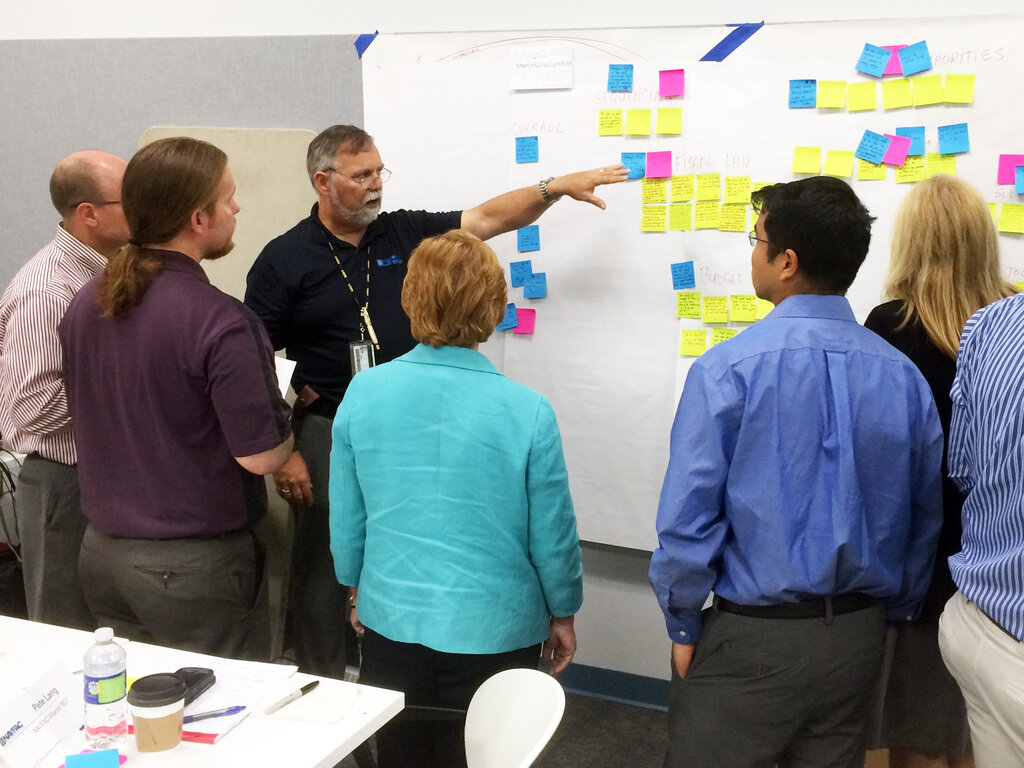
2. Define Next, you'll synthesize your findings from the empathy stage to form a clear problem statement. This isn't just about identifying a problem; it's about framing it in a human-centered way. A good problem statement guides your team and keeps the focus on the user.
For example, instead of saying "We need to increase sales," a human-centered problem statement might be, "Busy parents need a way to shop for healthy food that is quick and stress-free."
3. Ideate With a clear problem defined, it's time to generate ideas. The goal here is quantity over quality. Brainstorming, mind mapping, and other techniques are used to explore a wide range of potential solutions. This is a judgment-free zone where wild ideas are encouraged to spark creativity.
The ideation step is closely modeled on design thinking, which views ideation as a strictly judgment-free zone.
4. Prototype In this stage, you create scaled-down, inexpensive versions of your potential solutions. A prototype could be anything from a series of paper sketches to a role-playing activity. The point is to create something tangible that users can interact with, allowing you to learn quickly and cheaply.
5. Test Finally, you share your prototypes with users to get their feedback. This is not about defending your idea, but about watching how people use it and listening to what they think. The insights gained from testing will help you refine your solution, redefine your problem statement, or even go back to the empathy stage to learn more.
Putting It All Together
Let's see how this works with a simple example: improving the experience at a local library.
-
Empathize: A team spends time at the library, observing how people use the space and talking to them. They discover that many parents with young children feel stressed because they struggle to keep their kids quiet and entertained while they look for books.
-
Define: The team defines the problem: "Parents of young children need a way to feel welcome and supported at the library, so both they and their kids can have a positive experience."
-
Ideate: They brainstorm dozens of ideas. Create a separate, soundproofed children's area? Offer 'story time' sessions every hour? Create library scavenger hunts for kids? Provide easy-to-maneuver strollers?
-
Prototype: They decide to test the 'children's area' idea first. Instead of building walls, they simply rearrange some furniture in a corner, put down colorful rugs, and create a few signs that say "Kids' Corner: Play and Read!" It's a quick, low-cost prototype.
-
Test: They observe how families use the new space. They find that parents love the idea, but the corner is too small and doesn't have enough engaging toys. Based on this feedback, the library can now invest in a larger, better-equipped space with confidence, knowing it meets a real user need.
Through this iterative process of understanding, creating, and learning, design thinking helps turn challenges into well-defined problems and then into innovative, human-centered solutions.
Ready to check your understanding?
What is the primary focus of the Design Thinking process?
During which stage of design thinking is the main goal to generate a large quantity of diverse ideas without judgment?
By embracing this flexible, user-focused mindset, we can better address complex challenges in any field.