Design Thinking Essentials
Introduction to Design Thinking
What is Design Thinking?
Design Thinking is a way of solving problems by focusing on people. It's a method for creating new things—be it a product, a service, or a process—that starts with understanding human needs and ends with a solution tailored to them. It’s less of a rigid formula and more of a mindset that encourages us to be curious, creative, and comfortable with trying things out.
The idea isn't brand new. Its roots trace back to the 1960s, drawing from how architects and industrial designers approached their work. Instead of just focusing on aesthetics or engineering, they considered how people would actually use a space or an object. The concept was later popularized by design firms like IDEO, which showed how this human-centered approach could be applied to solve all sorts of business and social challenges, far beyond traditional design fields.
Putting People First
The core of Design Thinking is human-centered design. This means that instead of starting with a business goal or a piece of technology, you start with the people you're trying to help. It's a shift in perspective. You're not just designing for users; you're designing with them.
Imagine trying to build a better coffee mug. A technology-first approach might focus on inventing a new self-heating material. A business-first approach might look for the cheapest way to manufacture it. A human-centered approach starts by asking: Why do people drink coffee? What frustrates them about their current mugs? Maybe they need a mug that fits in their car's cup holder, is impossible to spill, or keeps their drink hot for hours. The solution comes from a real person's needs, not from a spreadsheet.
Human-centered design (HCD) is an approach that aligns innovation development with the needs of the people and the settings where those innovations will be used.
This focus on people ensures that you're solving the right problem. It's easy to build an elegant solution to a problem nobody has. Design Thinking helps avoid that trap by grounding the entire process in real-world understanding.
The Three Pillars
While there are many facets to Design Thinking, it stands on three foundational principles: empathy, collaboration, and experimentation.
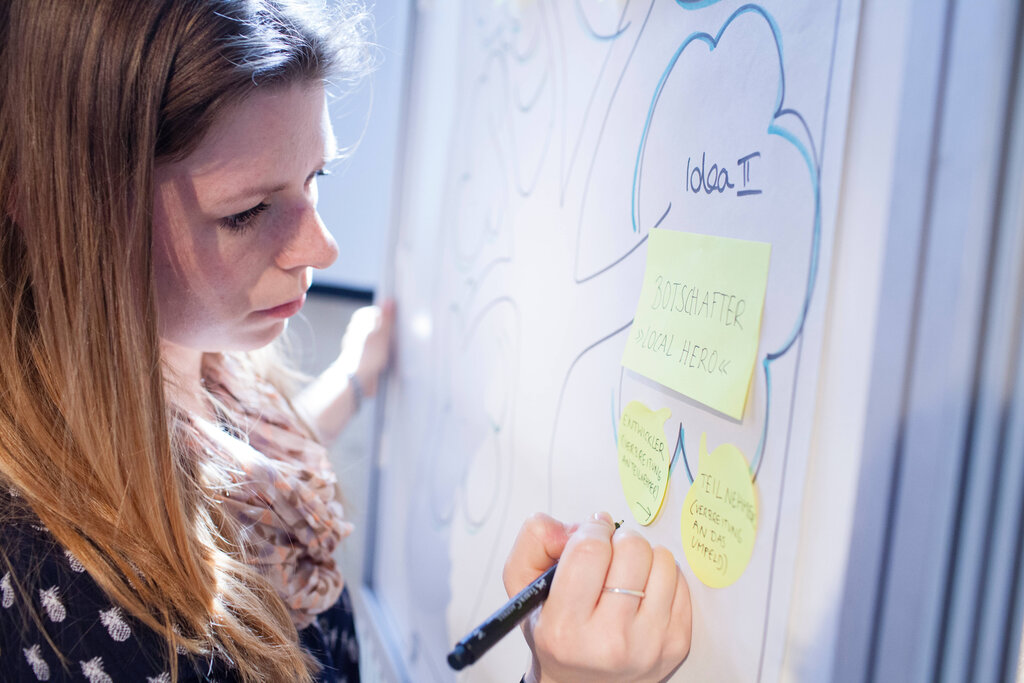
Empathy is the ability to see the world from another person's perspective. In design, this means going beyond surveys and data to truly understand someone's experiences, motivations, and pain points. It involves observing, listening, and immersing yourself in their world to uncover insights you wouldn't find otherwise.
empathy
noun
The action of understanding, being aware of, being sensitive to, and vicariously experiencing the feelings, thoughts, and experience of another.
Collaboration is about bringing diverse minds together. Design Thinking recognizes that complex problems are rarely solved by one person. By creating teams with different backgrounds, skills, and viewpoints, you foster a richer creative process. Great ideas can come from anyone, whether they're an engineer, a marketer, or a customer service representative.
Experimentation embraces a bias toward action. Instead of spending months in endless discussion, Design Thinking encourages you to build, test, and learn. This means creating simple prototypes, getting them in front of real people for feedback, and being willing to fail and adapt. The goal is to learn quickly and cheaply, iterating your way to a better solution.
Beyond the Drawing Board
Design Thinking isn't just for designers. Its principles have been applied across countless industries to tackle a wide range of challenges.
- In healthcare, it's used to redesign hospital experiences to be less stressful for patients.
- In finance, banks use it to create mobile apps that are easier and more intuitive for people to manage their money.
- In education, teachers apply it to develop new lesson plans that better engage students.
- In the social sector, nonprofits use it to devise more effective programs for communities in need.
Anywhere there's a complex, human-centered problem, Design Thinking offers a framework for finding creative and effective solutions.
What is the central focus of the Design Thinking process?
Which of the following is NOT one of the three foundational principles of Design Thinking mentioned in the text?