Deriving the Cylinder Formulas
Circular Extrusion Logic
From Flat Shape to Solid Form
You're already familiar with the properties of a two-dimensional circle. But how do we take that flat shape and give it substance in the three-dimensional world? The process is called extrusion — a term that simply means extending a 2D shape along a new axis. Think of it like a stack of coins. A single coin is a flat, circular disc. When you stack one on top of another, you create a column with height. This new dimension, height, is what transforms the circle into a cylinder.
This transformation from 2D to 3D is fundamental in fields from engineering to computer graphics. The original 2D circle serves as the blueprint, or cross-section, for the final 3D object. Its properties, specifically its area, directly determine a key property of the cylinder: its volume.
Stacking the Discs
The area of the circle at the base of a cylinder is given by the familiar formula . Now, imagine that the cylinder is made up of an infinite number of incredibly thin circular discs, each with that same area, stacked one on top of the other. The volume of the entire cylinder is simply the sum of the volumes of all those discs.
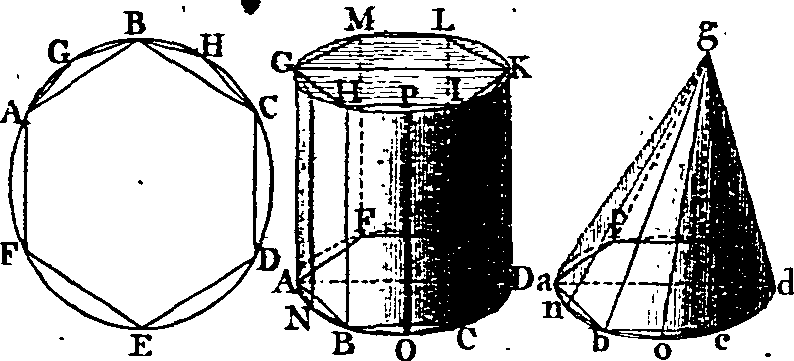
How high is the stack? That's where the height, represented by , comes in. The height acts as a multiplier. It tells us how far the base area is extended. If the area of the base is the amount of space on one layer, the height tells us how many layers there are. This gives us the formula for the volume of a cylinder.
So, the logic is a direct bridge from two dimensions to three. You aren't learning a new, unrelated formula; you're simply adding a dimension to a concept you already know. The area of a circle is its 2D measurement. Multiply that by its height, and you have its 3D measurement: volume.
Now, let's test your understanding of this transition from area to volume.
What is the process of extending a 2D shape along a new axis to create a 3D object called?
True or false: The volume of a cylinder is found by multiplying the area of its circular base by its height.
Understanding how a 2D shape like a circle extends into a 3D form like a cylinder is a key step in mastering solid geometry.