Deriving the Cylinder Formulas
Cylindrical Decomposition
Deconstructing the Cylinder
A cylinder is one of the most common three-dimensional shapes you'll encounter. Think of a can of soup, a new roll of paper towels, or a simple drinking glass. From the outside, it seems like a single, continuous object. But to really understand it, we need to take it apart.
Every cylinder is built from three distinct pieces: two identical, flat circles that form the top and bottom bases, and one curved surface that connects them. This curved wall is known as the and holds the secret to linking the cylinder's 2D and 3D properties.
To understand a 3D shape, it often helps to flatten it into two dimensions.
Imagine you could carefully unpeel the label from a soup can and lay it flat. Then, you could pop off the top and bottom lids and place them next to the label. This flattened-out version of the cylinder is called a 'net'. It shows us the true shapes that combine to create the 3D form.
The net of a cylinder always consists of two circles and one rectangle. The dimensions of these 2D shapes are directly related to the dimensions of the original cylinder.
Connecting the Pieces
Looking at the net, two relationships are immediately obvious. The radius of the circles in the net is the same as the radius of the cylinder's bases. The height of the rectangle is the same as the height of the cylinder.
But what about the length of the rectangle? This is the most important connection to make. For the net to fold back into a perfect cylinder, the length of the rectangle must wrap exactly around the edge of the circular bases. The distance around a circle has a specific name: the circumference.
This means the length of the rectangular part of a cylinder's net is not an independent measurement. It is determined entirely by the radius of its bases. If you know the radius, you can calculate the length of the rectangle. This insight, discovered by ancient mathematicians like , is the foundation for calculating the surface area of a cylinder. You aren't learning a new formula for a complex shape; you're just combining the areas of two circles and a rectangle you already know.
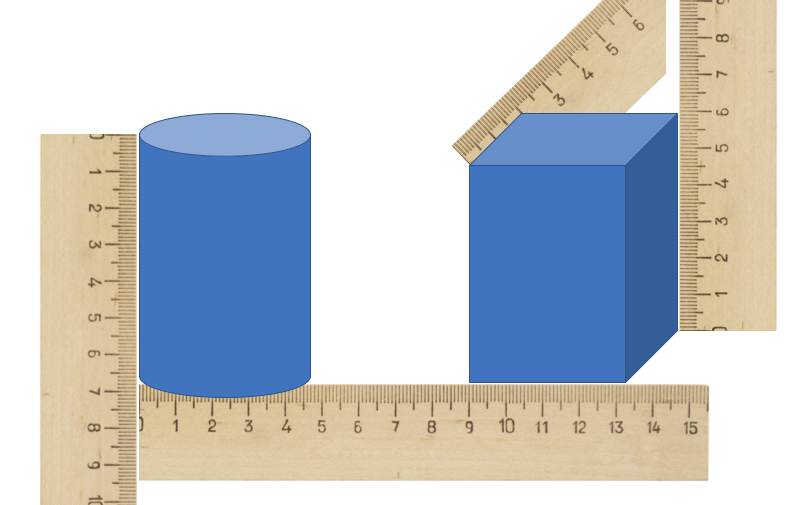
This decomposition is a powerful tool. It transforms a problem in three-dimensional space into a simpler one involving basic two-dimensional shapes. By understanding how a cylinder is constructed from its net, we can analyse its properties using familiar geometric rules.
The 'net' of a cylinder is composed of which combination of two-dimensional shapes?
The length of the rectangular part of a cylinder's net is determined by what property of its circular bases?
This method of breaking down complex objects into simpler components is a fundamental concept not just in geometry, but across all of science and engineering.