Deriving FEA Load Cases
Introduction to Structural Mechanics
Forces at Work
Every structure, from a towering skyscraper to a simple wooden chair, is in a constant battle with forces. Gravity pulls everything down, wind pushes from the side, and the weight of people and objects adds even more pressure. Structural mechanics is the science of understanding how these structures stand up to these forces without breaking.
To do this, we need to look inside the materials themselves. When you push, pull, or bend an object, a complex interplay of internal forces kicks into gear. The two most fundamental concepts for understanding this are stress and strain.
Stress and Strain
Imagine a rope in a game of tug-of-war. As both teams pull, the rope is under tension. Stress is the measure of that internal force spread out over the rope's cross-sectional area. It's a way to quantify how much force each bit of the material is handling.
In this formula, (sigma) is stress, is the force applied, and is the cross-sectional area over which the force is spread. A higher stress means the material is working harder.
Now, think about what's happening to the rope itself. As the teams pull, it stretches slightly. This deformation is called strain. Strain isn't about how much it stretched in total, but how much it stretched relative to its original length. It’s a measure of how much the material has deformed.
Here, (epsilon) is strain, is the change in length, and is the object's original length.
Stress is what's done to an object, while strain is how the object responds.
How Materials Behave
Different materials respond to stress in different ways. A rubber band and a steel rod will have very different strains when you apply the same stress. These responses are known as material properties.
One key property is elasticity. An elastic material is like a rubber band, it returns to its original shape after the force is removed. But if you pull too hard, you might stretch it permanently. This is called plastic deformation. The point where a material switches from elastic to plastic behavior is its yield point.
Engineers use stress-strain curves to understand a material's behavior. The steepness of the initial straight line tells us the material's stiffness—how much it resists deforming. A stiffer material, like steel, requires a lot of stress to create a little strain. The highest point on the curve represents the material's strength, or the maximum stress it can handle before it starts to fail.
Common Structural Elements
Engineers don't just choose the right materials; they also assemble them into specific shapes and configurations designed to handle forces in the most effective way. These are the basic building blocks of almost every structure you see.
Beam
noun
A structural element that primarily resists loads applied laterally to its axis.
Think of the shelves in a bookcase or the deck of a bridge. These are beams. Their main job is to resist bending. When you place a load on a beam, its top surface gets compressed and its bottom surface gets stretched, or put into tension.

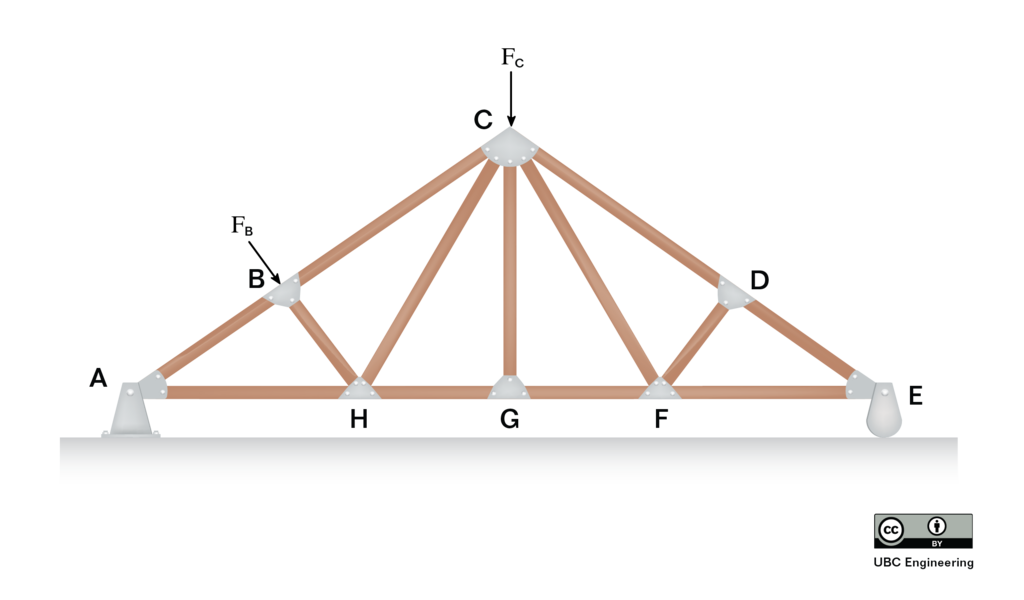
Another common element is the truss. Trusses are incredibly efficient because they use a simple, powerful shape: the triangle.
Truss
noun
A structure composed of members connected to form a rigid framework, typically in a series of triangles.
Unlike a square, which can be easily squashed into a diamond shape, a triangle is rigid. It can't be deformed without changing the length of one of its sides. By connecting many triangles, a truss distributes forces throughout its members. This allows it to span large distances using relatively little material, which is why you see trusses in bridges, roofs, and radio towers.
Finally, we have frames. A frame is composed of beams and columns that are rigidly connected. Think of the skeleton of a modern building.
Frame
noun
A rigid structural system that supports loads, typically made of connected beams and columns.
The key feature of a frame is that the connections, or joints, between the beams and columns are stiff. They resist rotation. This rigidity allows the frame to transfer bending forces from the horizontal beams to the vertical columns, making the entire structure very stable and capable of resisting lateral forces like wind or earthquakes.
Time to check your understanding of these core concepts.
What is the primary difference between stress and strain?
An engineer compares two materials. Material A has a very steep stress-strain curve but breaks at a lower stress level than Material B. Material B's curve is less steep but reaches a higher stress level before failing. Which statement is most accurate?
Understanding these elements—stress, strain, material properties, and basic components—is the first step in analyzing how any structure works. It's the foundation upon which all structural design is built.