Depthwise Separable Conv1D Explained
Introduction to 1D Convolutional Layers
Convolution in One Dimension
Many types of data come in sequences. Think of the words in a sentence, the price of a stock over time, or a DNA sequence. A 1D convolutional layer is a tool for finding patterns in this kind of sequential data. It works by looking at small segments of the sequence one at a time, rather than trying to process the whole thing at once.
This is different from how you might analyze a 2D image, where you'd look for patterns in a grid of pixels. For sequential data, the patterns exist along a single dimension: time, or position in the sequence.
How It Works
A 1D convolution slides a small window, called a filter or kernel, across the input sequence. This filter is essentially a pattern detector. It's a small array of numbers (weights) that the network learns. At each position, the layer calculates a dot product—multiplying the filter's values with the corresponding values in the input sequence segment and summing the results.
The result of this sliding operation is a new, shorter sequence called a feature map. Each number in the feature map represents how strongly the filter's pattern was detected at a particular point in the original sequence. A large positive value means a strong match, a value near zero means no match, and a large negative value can mean a strong match for the inverse pattern.
A single convolutional layer can use many different filters simultaneously. Each filter learns to detect a different pattern, so the layer can extract a rich set of features from the input data all at once.
Where We Use 1D Convolutions
Because they are so good at finding localized patterns in sequences, 1D convolutional layers are highly effective in several areas.
Time Series Analysis: They can identify patterns in financial data (like a sudden drop preceding a rise), sensor readings (like a specific vibration pattern indicating machine failure), or weather data.
Natural Language Processing (NLP): In text, they can detect n-grams, which are sequences of words or characters. For instance, a filter might learn to recognize patterns like "highly effective" or common word endings like "-ing," which are useful features for tasks like sentiment analysis or text classification.
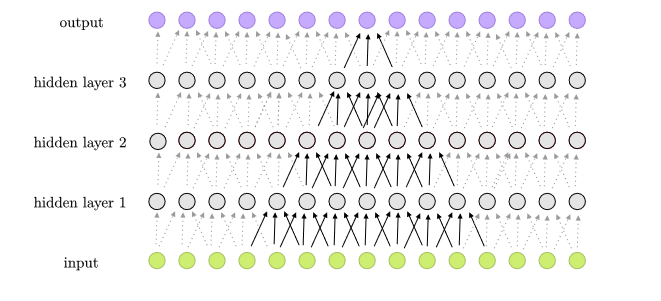
By stacking these layers, a network can learn hierarchical patterns. The first layer might find simple patterns like edges in a time series or common word pairs in text. Subsequent layers then combine these simple features to recognize more complex and abstract patterns, giving the model a deep understanding of the sequential data.
What is the primary type of data that a 1D convolutional layer is designed to process?
In a 1D convolution, the sliding window that detects patterns is known as a filter or a ____.