Deploying Machine Learning Models
Introduction to Model Deployment
From Lab to Real World
Imagine spending months designing and building a revolutionary car engine. It’s powerful, efficient, and a marvel of engineering. But until it's installed in a car and driven on the road, it’s just a blueprint, a collection of parts on a workshop floor. It has potential, but no real-world impact.
A machine learning model is like that engine. It might perform beautifully on your computer, correctly predicting outcomes from test data. But it doesn't create value until it’s taken out of that development environment—often a Jupyter notebook or a lab server—and put into a production system where it can make decisions on live data.
Deployment
noun
The process of integrating a machine learning model into an existing production environment, where it can take in input and return predictions for real-world use.
This process is called deployment. It’s the bridge between the experimental phase of data science and the operational phase where the model actually does its job. A fraud detection model isn't catching criminals until it's deployed and analyzing live transactions. A language translation app isn't helping travelers until its model is deployed and accessible on their phones.
A model in a notebook is a science experiment. A deployed model is a business solution.
The Deployment Lifecycle
Deployment isn't a one-time event where you just 'switch on' the model and walk away. It's a continuous cycle that ensures the model remains effective and reliable over time. Just like a car needs regular maintenance to keep running well, a model needs to be managed throughout its life.
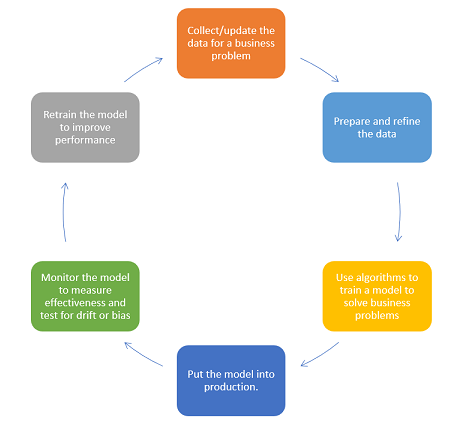
The journey starts with a business problem and the data needed to solve it. After the model is trained and validated, it's ready for deployment. This means packaging it up so it can run on a server and respond to requests.
Once live, the most critical phase begins: monitoring. We watch its performance closely. Is it making accurate predictions? Is it fast enough? Is the new data it's seeing different from the data it was trained on?
This monitoring often reveals that the model's performance is degrading. This is normal. The world changes, and the patterns the model learned may no longer be relevant. When this happens, it's time to go back to the beginning: collect new data, retrain the model, and deploy the new-and-improved version. This cycle ensures the application stays smart and effective.
Common Hurdles
The path from a working model to a deployed application is filled with potential challenges that are often more about engineering than data science.
| Challenge | Description |
|---|---|
| Integration | The model needs to fit into a complex ecosystem of existing software, databases, and user interfaces. Making it 'talk' to everything else can be tricky. |
| Scalability | A model that works for 10 users might crash when 10,000 users try to access it at once. The system must be able to handle a high volume of requests without slowing down. |
| Environment Mismatch | The model was built on a data scientist's laptop with specific software versions. The production server is a completely different environment. Getting it to run correctly requires careful management of dependencies. |
| Data Drift | The live data fed to the model in production starts to look different from the training data. This 'data drift' can cause the model's accuracy to plummet over time. |
Overcoming these hurdles requires a combination of skills from software engineering, DevOps, and data science. It highlights that building a great model is only half the battle; getting it into the hands of users is the other, equally important half.
What is the primary goal of deploying a machine learning model?
A company deployed a model to predict customer churn. After six months, its predictions are becoming less accurate. According to the typical deployment lifecycle, what is the most likely cause?
Now that you understand the basics of deployment, we'll move on to explore the specific strategies and architectures used to make it happen.